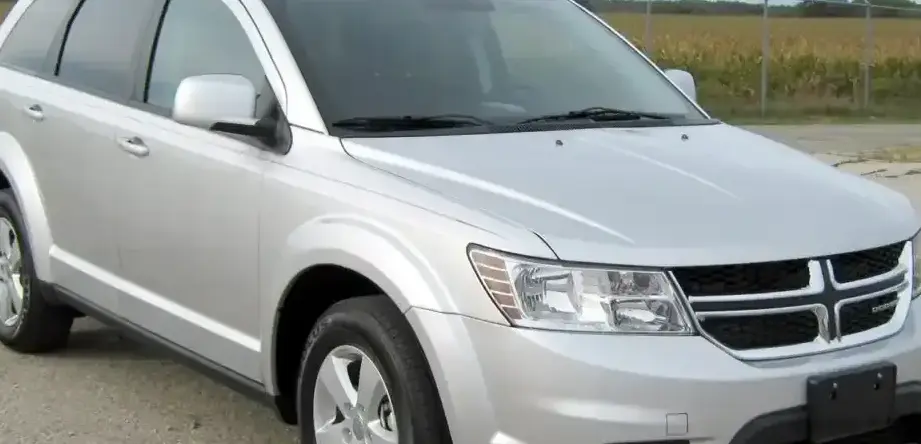
The Dodge Journey 2.7, produced from 2008 to 2010, represented Dodge’s entry into the mid-size crossover utility vehicle (CUV) segment. Positioned as a family-oriented vehicle offering optional third-row seating, the 2.7-liter variant served as the base engine option for the Journey during its initial production run. It was designed to appeal to buyers seeking a versatile and affordable vehicle with a focus on interior space and practicality. The Journey, built on a modified version of the Chrysler/Dodge Global Platform (often referred to as the JC49 platform), aimed to bridge the gap between smaller compact SUVs and larger, more expensive options.
Technical Specifications
| Brand | Dodge |
| Model | Journey |
| Generation | Journey |
| Type (Engine) | 2.7 (185 Hp) |
| Start of production | 2008 |
| End of production | 2010 |
| Powertrain Architecture | Internal Combustion engine |
| Body type | CUV |
| Seats | 5-7 |
| Doors | 5 |
| Fuel consumption (urban) | 15 l/100 km (15.7 US mpg, 18.8 UK mpg, 6.7 km/l) |
| Fuel consumption (extra urban) | 7.6 l/100 km (30.9 US mpg, 37.2 UK mpg, 13.2 km/l) |
| Fuel consumption (combined) | 10.3 l/100 km (22.8 US mpg, 27.4 UK mpg, 9.7 km/l) |
| Fuel Type | Petrol (Gasoline) |
| Acceleration 0 – 100 km/h | 10.8 sec |
| Acceleration 0 – 62 mph | 10.8 sec |
| Acceleration 0 – 60 mph | 10.3 sec |
| Maximum speed | 182 km/h (113.09 mph) |
| Emission standard | Euro 4 |
| Weight-to-power ratio | 9.8 kg/Hp, 102.5 Hp/tonne |
| Weight-to-torque ratio | 7.1 kg/Nm, 141.8 Nm/tonne |
| Power | 185 Hp @ 6400 rpm |
| Power per litre | 67.6 Hp/l |
| Torque | 256 Nm @ 4000 rpm (188.82 lb.-ft. @ 4000 rpm) |
| Engine layout | Front, Longitudinal |
| Engine Model/Code | EER |
| Engine displacement | 2736 cm3 (166.96 cu. in.) |
| Number of cylinders | 6 |
| Engine configuration | V-engine |
| Cylinder Bore | 86 mm (3.39 in.) |
| Piston Stroke | 78.5 mm (3.09 in.) |
| Compression ratio | 9.7:1 |
| Number of valves per cylinder | 4 |
| Fuel injection system | Multi-port manifold injection |
| Engine aspiration | Naturally aspirated engine |
| Engine oil capacity | 5.2 l (5.49 US qt | 4.58 UK qt) |
| Coolant | 9.3 l (9.83 US qt | 8.18 UK qt) |
| Kerb Weight | 1805 kg (3979.34 lbs.) |
| Max. weight | 2425 kg (5346.21 lbs.) |
| Max load | 620 kg (1366.87 lbs.) |
| Trunk (boot) space – minimum | 784 l (27.69 cu. ft.) |
| Fuel tank capacity | 77.6 l (20.5 US gal | 17.07 UK gal) |
| Length | 4888 mm (192.44 in.) |
| Width | 1878 mm (73.94 in.) |
| Height | 1691 mm (66.57 in.) |
| Wheelbase | 2890 mm (113.78 in.) |
| Front track | 1571 mm (61.85 in.) |
| Rear (Back) track | 1582 mm (62.28 in.) |
| Minimum turning circle | 11.9 m (39.04 ft.) |
| Drivetrain Architecture | The Internal combustion engine (ICE) drives the front wheels of the vehicle. |
| Drive wheel | Front wheel drive |
| Number of gears and type of gearbox | 4 gears, automatic transmission |
| Front suspension | Independent, type McPherson with coil spring and anti-roll bar |
| Rear suspension | Independent coil spring |
| Front brakes | Ventilated discs |
| Rear brakes | Drum |
| Assisting systems | ABS (Anti-lock braking system) |
| Steering type | Steering rack and pinion |
| Tires size | 225/65R16; 225/55R19 |
| Wheel rims size | 6.5J x 16; 7J x 19 |
Powertrain & Engine Architecture
The Dodge Journey 2.7 utilized the EER V6 engine, a 2.7-liter naturally aspirated powerplant. This engine, part of the Chrysler’s modular engine family, featured a 60-degree V-configuration and a cast iron block with aluminum cylinder heads. It employed a multi-port fuel injection (MPI) system, delivering fuel directly into the intake ports. The engine’s valvetrain consisted of two valves per cylinder (two intake, two exhaust) operated by a single overhead camshaft. The 4-speed automatic transmission, a Chrysler 41TE unit, was the sole transmission option paired with the 2.7-liter engine. This transmission was known for its smooth operation but lacked the efficiency of more modern transmissions with additional gears. The engine was longitudinally mounted, driving the front wheels.
Driving Characteristics
The 2.7-liter engine, producing 185 horsepower and 256 lb-ft of torque, provided adequate, but not exhilarating, performance for the Journey. Acceleration from 0-60 mph took around 10.3 seconds. The 4-speed automatic transmission, while smooth, resulted in noticeable gear hunting and a lack of responsiveness compared to the available manual transmission or the more powerful 3.5-liter V6 option. The gear ratios were optimized for fuel economy and cruising comfort rather than spirited driving. In real-world conditions, the 2.7-liter Journey felt most comfortable during highway driving, where the engine could maintain a steady speed without excessive strain. City driving and passing maneuvers required more planning and anticipation due to the engine’s limited power output.
Equipment & Trim Levels
The 2.7-liter Journey typically came standard with features such as air conditioning, power windows and locks, a basic audio system, and cloth upholstery. Higher trim levels, such as the SXT, added features like alloy wheels, upgraded audio systems, and optional third-row seating. Available options included a sunroof, leather upholstery, and a navigation system. The interior design was functional and family-friendly, with ample storage compartments and a relatively spacious cabin. The base trim focused on providing essential features at an affordable price point.
Chassis & Braking
The Dodge Journey featured an independent McPherson strut front suspension and an independent coil spring rear suspension. This setup provided a comfortable ride quality, although handling was not particularly sporty. The front brakes were ventilated discs, while the rear brakes were drum brakes. This configuration was typical for vehicles in this price range at the time. Anti-lock braking system (ABS) was standard. The Journey’s chassis was designed to prioritize ride comfort and interior space over sharp handling characteristics.
Market Reception & Comparison
Critics generally viewed the 2.7-liter Journey as a practical and affordable family vehicle, but noted its lack of performance compared to competitors and higher-trim Journey models. Fuel economy was considered average for its class, with combined ratings around 22.8 US mpg. The 3.5-liter V6 offered significantly more power and a more refined driving experience, but at a higher price point. The 2.7-liter version appealed to budget-conscious buyers who prioritized space and practicality over performance. Compared to other CUVs in its segment, such as the Honda CR-V and Toyota RAV4, the Journey offered more interior space but lacked the same level of refinement and fuel efficiency.
Legacy
The 2.7-liter EER V6 engine, while generally reliable, is known to be susceptible to oil consumption issues as it ages. Regular oil level checks and timely oil changes are crucial for maintaining its longevity. The 41TE automatic transmission is also known to be durable but may require servicing to address potential issues with the torque converter or valve body. Today, the 2.7-liter Journey can be found on the used car market at relatively affordable prices. It remains a viable option for buyers seeking a spacious and practical CUV, but potential buyers should be aware of the engine’s potential oil consumption issues and the transmission’s maintenance requirements.