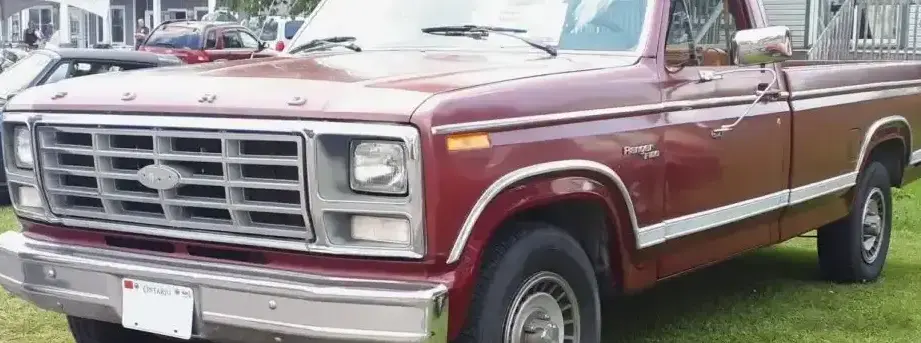
The Ford F-Series F-100 VII Regular Cab, equipped with the 3.8-liter V6 engine and automatic transmission, represented a key offering in Ford’s light-duty truck lineup during its 1982-1983 production run. This variant occupied a middle ground within the seventh generation of the F-Series (1980-1986), positioned as a more economical alternative to the larger V8 options while still providing adequate capability for typical light-duty tasks. It was part of a significant redesign for the F-Series, focusing on improved aerodynamics and interior comfort compared to previous generations. This generation saw the F-100 and F-150 models largely merge, with the F-150 becoming the more commonly marketed designation, though the F-100 nameplate persisted.
Technical Specifications
| Brand | Ford |
| Model | F-Series F-100/F-150 |
| Generation | F-Series F-100 VII Regular Cab |
| Type (Engine) | 3.8 V6 (110 Hp) Automatic |
| Start of production | 1982 |
| End of production | 1983 |
| Powertrain Architecture | Internal Combustion engine |
| Body type | Pick-up |
| Seats | 2-3 |
| Doors | 2 |
| Fuel Type | Petrol (Gasoline) |
| Power | 110 Hp |
| Power per litre | 28.9 Hp/l |
| Torque | 248 Nm / 182.92 lb.-ft. |
| Engine layout | Front, Longitudinal |
| Engine displacement | 3802 cm3 / 232.01 cu. in. |
| Number of cylinders | 6 |
| Engine configuration | V-engine |
| Fuel injection system | Carburettor |
| Engine aspiration | Naturally aspirated engine |
| Max. weight | 2132 kg / 4700.26 lbs. |
| Fuel tank capacity | 62-72 l / 16.38 – 19.02 US gal | 13.64 – 15.84 UK gal |
| Length | 4808-5291 mm / 189.29 – 208.31 in. |
| Width | 1372-1778 mm / 54.02 – 70 in. |
| Height | 1760-1765 mm / 69.29 – 69.49 in. |
| Wheelbase | 2967-3378 mm / 116.81 – 132.99 in. |
| Wading depth | 721-739 mm / 28.39 – 29.09 in. |
| Drivetrain Architecture | The Internal combustion engine (ICE) drives the rear wheels of the vehicle. |
| Drive wheel | Rear wheel drive |
| Number of gears and type of gearbox | automatic transmission SelectShift |
| Front suspension | Independent coil spring |
| Front brakes | Disc |
| Rear brakes | Drum |
| Power steering | Electric Steering |
| Tires size | 195/75 R15 |
| Wheel rims size | 5.5J x 15 |
Powertrain & Engine Architecture
The heart of this F-100 variant was the 3.8-liter (232 cubic inch) Ford V6 engine. While not a powerhouse, it was designed for fuel efficiency and reliability. This engine, often referred to as the 302-based V6, shared many components with Ford’s popular 302 cubic inch V8, making parts availability relatively good. The engine utilized a two-barrel carburetor for fuel delivery, a common setup for the era. The valvetrain employed a pushrod design with two valves per cylinder. The “SelectShift” automatic transmission was a three-speed unit, designed to provide smooth and reliable operation. It wasn’t known for particularly quick shifts, but it was durable and well-suited to the engine’s power characteristics. The engine was mounted longitudinally in the chassis, driving the rear wheels.
Driving Characteristics
The 110 horsepower and 183 lb-ft of torque produced by the 3.8L V6 and automatic transmission combination resulted in a driving experience focused on practicality rather than performance. Acceleration was modest, and passing maneuvers required planning. The automatic transmission’s gear ratios were optimized for fuel economy and towing capacity, rather than spirited driving. Compared to the available V8 engines, this variant felt significantly less powerful. However, the automatic transmission made it easier to drive in city traffic than the manual transmission options. The rear-wheel-drive configuration provided a traditional truck feel, with a focus on load-carrying capability. The suspension, while adequate, wasn’t designed for a particularly comfortable ride when the truck was unloaded.
Equipment & Trim Levels
The F-100 with the 3.8L V6 and automatic transmission typically came with a fairly basic level of equipment. Standard features included a vinyl bench seat, basic instrumentation (speedometer, fuel gauge, temperature gauge), and a simple AM radio. Options included upgraded interior trim, air conditioning, a more powerful radio, and various exterior enhancements. The trim level generally fell into the lower to mid-range of the F-100 offerings. It was aimed at buyers who needed a capable truck for everyday tasks but didn’t require the luxury features found in higher-end trims. The interior was functional and durable, designed to withstand the rigors of truck ownership.
Chassis & Braking
The F-100 VII utilized a body-on-frame construction, providing a robust and durable chassis. The front suspension consisted of independent coil springs, offering a reasonable level of ride comfort. The rear suspension employed leaf springs, which were well-suited for carrying heavy loads. Braking duties were handled by disc brakes in the front and drum brakes in the rear. Power steering was standard, making it easier to maneuver the truck, especially at low speeds. The tires were typically 195/75R15 size, providing a good balance of ride comfort and durability. The frame was designed to handle a significant amount of weight, making it suitable for towing and hauling.
Market Reception & Comparison
The 3.8L V6 automatic F-100 was generally viewed as a sensible and economical choice within the F-Series lineup. Critics acknowledged its fuel efficiency advantage over the V8 models, but also noted its lack of outright power. It was often compared to Chevrolet’s and Dodge’s equivalent light-duty trucks, with the Ford generally receiving positive marks for its build quality and reliability. Compared to the F-100s equipped with the 302 cubic inch V8, the 3.8L version offered lower purchase price and better fuel economy, but at the expense of performance. The 3.8L was a popular choice for those who primarily used their trucks for commuting and light-duty tasks.
Legacy
The 3.8L V6-powered F-100 has become a relatively affordable classic truck in the used car market. While not as sought-after as the V8 models, it offers a good entry point for those looking to own a vintage Ford truck. The powertrain is generally considered reliable, although age and maintenance history are crucial factors. Parts availability remains good, thanks to the engine’s shared components with the 302 V8. These trucks are often found in good condition, having been well-maintained by their original owners. They represent a simpler era of truck design, offering a unique driving experience that appeals to enthusiasts and collectors alike. The 3.8L V6, while not a performance icon, proved to be a durable and dependable engine, contributing to the F-Series’ long-standing reputation for reliability.