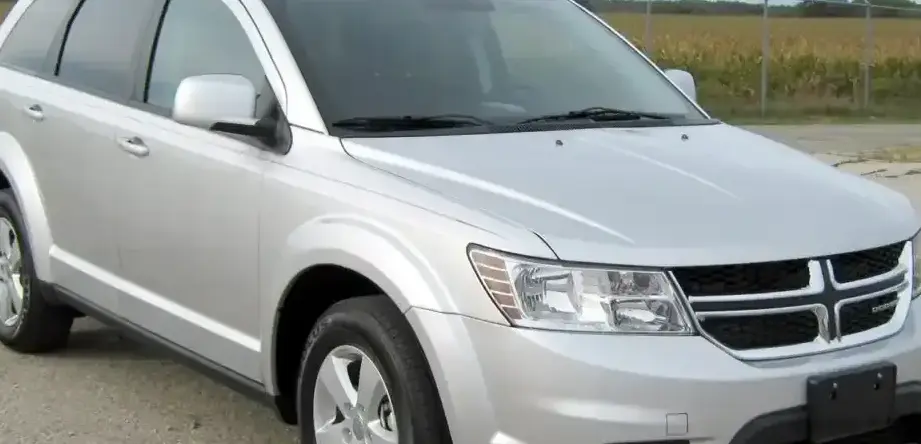
The Dodge Journey 3.5 V6 AWD Automatic 7-Seat, produced from 2009 to 2010, represented a significant offering in Dodge’s lineup as a mid-size crossover utility vehicle (CUV). Positioned as a family-oriented vehicle with three-row seating, it aimed to provide a blend of space, practicality, and available all-wheel drive capability. This particular variant, equipped with the 3.5-liter V6 engine and a six-speed automatic transmission, occupied the upper-mid range of the Journey model options, offering a step up in performance from the base 2.7-liter engine while remaining more accessible than potential future trim levels. It was primarily marketed towards North American families seeking a versatile vehicle for daily commuting, road trips, and light-duty hauling.
Technical Specifications
| Brand | Dodge |
| Model | Journey |
| Type | 3.5 V6 (235 Hp) AWD Automatic 7-Seat |
| Start of production | 2009 |
| End of production | 2010 |
| Powertrain Architecture | Internal Combustion engine |
| Body type | CUV |
| Seats | 7 |
| Doors | 5 |
| Fuel consumption (urban) | 15.7 l/100 km (15 US mpg, 18 UK mpg) |
| Fuel consumption (extra urban) | 10.2 l/100 km (23.1 US mpg, 27.7 UK mpg) |
| Fuel Type | Petrol (Gasoline) |
| Weight-to-power ratio | 8.1 kg/Hp |
| Weight-to-torque ratio | 6.1 kg/Nm |
| Power | 235 Hp @ 6400 rpm |
| Torque | 315 Nm @ 4000 rpm (232.33 lb.-ft. @ 4000 rpm) |
| Maximum engine speed | 6800 rpm |
| Engine layout | Front, Transverse |
| Engine displacement | 3518 cm3 (214.68 cu. in.) |
| Engine configuration | V-engine |
| Cylinder Bore | 96 mm (3.78 in.) |
| Piston Stroke | 81 mm (3.19 in.) |
| Compression ratio | 10:1 |
| Number of valves per cylinder | 4 |
| Fuel injection system | Multi-port manifold injection |
| Engine aspiration | Naturally aspirated |
| Engine oil capacity | 5.2 l (5.49 US qt | 4.58 UK qt) |
| Coolant capacity | 9.3 l (9.83 US qt | 8.18 UK qt) |
| Kerb Weight | 1910-1920 kg (4210.83 – 4232.88 lbs.) |
| Max. weight | 2540 kg (5599.74 lbs.) |
| Max load | 620-630 kg (1366.87 – 1388.91 lbs.) |
| Trunk (boot) space – minimum | 303 l (10.7 cu. ft.) |
| Trunk (boot) space – maximum | 1915 l (67.63 cu. ft.) |
| Fuel tank capacity | 80 l (21.13 US gal | 17.6 UK gal) |
| Permitted trailer load with brakes (12%) | 1600 kg (3527.4 lbs.) |
| Length | 4888 mm (192.44 in.) |
| Width | 1835 mm (72.24 in.) |
| Width including mirrors | 2127 mm (83.74 in.) |
| Height | 1765 mm (69.49 in.) |
| Wheelbase | 2890 mm (113.78 in.) |
| Front track | 1571 mm (61.85 in.) |
| Rear track | 1582 mm (62.28 in.) |
| Front overhang | 989 mm (38.94 in.) |
| Rear overhang | 1009 mm (39.72 in.) |
| Drag coefficient (Cd) | 0.37 |
| Minimum turning circle | 11.7 m (38.39 ft.) |
| Drivetrain | All wheel drive (4×4) |
| Number of gears | 6 |
| Gearbox type | Automatic transmission |
| Front suspension | Independent, McPherson with coil spring and anti-roll bar |
| Rear suspension | Independent multi-link with stabilizer |
| Front brakes | Ventilated discs, 302×28 mm |
| Rear brakes | Discs, 305×12 mm |
| Assisting systems | ABS (Anti-lock braking system) |
| Steering type | Steering rack and pinion |
| Tires size | 225/65 R17 |
| Wheel rims size | 6.5J x 17 |
INTRODUCTION
The Dodge Journey 3.5 V6 AWD, launched in 2009, was a key component of Dodge’s strategy to compete in the burgeoning mid-size CUV segment. Built on the JC49 platform (shared with the Mitsubishi Outlander), the Journey aimed to offer a more affordable and spacious alternative to some of its competitors. The 2009-2010 model years represented the initial phase of the Journey’s production run, establishing its core features and design. This 3.5L V6 AWD configuration was positioned as a strong all-around performer, balancing power with the added security of all-wheel drive, and offering seating for up to seven passengers. It was a direct response to the growing demand for family vehicles capable of handling diverse driving conditions.
Powertrain & Engine Architecture
At the heart of the Journey 3.5 V6 was the 3.5-liter EER V6 engine. This engine, part of the Chrysler’s EER (Enhanced Economical Ratio) family, featured a 60-degree V-angle and utilized a cast iron block with aluminum cylinder heads. The engine employed multi-port fuel injection and a single overhead camshaft (SOHC) valvetrain with two valves per cylinder. The engine produced 235 horsepower at 6400 rpm and 232 lb-ft of torque at 4000 rpm. The six-speed automatic transmission (62TE) was specifically chosen for its smooth shifting and ability to handle the engine’s output. This transmission featured a torque converter lock-up clutch to improve fuel efficiency at highway speeds. The all-wheel-drive system was an on-demand system, primarily driving the front wheels but automatically engaging the rear wheels when wheel slip was detected.
Driving Characteristics
The Journey 3.5 V6 AWD offered a noticeable step up in performance compared to the base 2.7-liter four-cylinder engine. Acceleration was brisk, allowing for confident merging and passing maneuvers. The six-speed automatic transmission provided reasonably quick and smooth shifts, although it wasn’t as sporty or responsive as some dual-clutch transmissions found in competing vehicles. The all-wheel-drive system provided enhanced traction in inclement weather, making it a capable vehicle for regions experiencing snow or rain. However, the added weight of the AWD system and the V6 engine did impact fuel economy. The suspension was tuned for comfort, providing a relatively smooth ride, but it wasn’t particularly engaging for spirited driving. The steering felt somewhat vague, lacking the precision found in some European-market CUVs.
Equipment & Trim Levels
The Journey 3.5 V6 AWD typically came standard with features such as air conditioning, power windows and locks, a CD player with auxiliary input, and keyless entry. Higher trim levels added features like leather upholstery, heated front seats, a sunroof, and a premium sound system. The interior design was functional and family-friendly, with durable materials and ample storage space. The third-row seats were relatively cramped, best suited for children or shorter adults. Optional extras included a rear-seat entertainment system, navigation system, and upgraded alloy wheels.
Chassis & Braking
The Journey’s chassis featured an independent McPherson strut front suspension and an independent multi-link rear suspension. This setup provided a comfortable ride, but wasn’t designed for aggressive handling. The front brakes were ventilated discs measuring 302x28mm, while the rear brakes were solid discs measuring 305x12mm. Anti-lock brakes (ABS) were standard. The steering system utilized a rack-and-pinion setup with hydraulic power assist. The standard tire size was 225/65R17, mounted on 6.5J x 17 inch alloy wheels.
Market Reception & Comparison
The Dodge Journey 3.5 V6 AWD was generally well-received by critics as a practical and spacious family vehicle. However, some reviewers noted its somewhat uninspired driving dynamics and average fuel economy. Compared to the base 2.7-liter model, the 3.5 V6 offered a significant performance boost, but at the cost of increased fuel consumption. Against competitors like the Honda Pilot, Toyota Highlander, and Ford Explorer, the Journey offered a more affordable price point but lacked the refinement and driving experience of those vehicles. Its fuel economy was generally lower than many of its competitors.
Legacy
The Dodge Journey continued in production for many years with various updates and revisions. The 3.5-liter V6 powertrain, while not known for exceptional reliability, proved to be reasonably durable with proper maintenance. Common issues included occasional problems with the transmission and the all-wheel-drive system. Today, used examples of the 2009-2010 Journey 3.5 V6 AWD are relatively affordable and can represent a good value for families seeking a spacious and capable vehicle. However, potential buyers should be aware of the potential for maintenance issues and carefully inspect the vehicle before purchase.