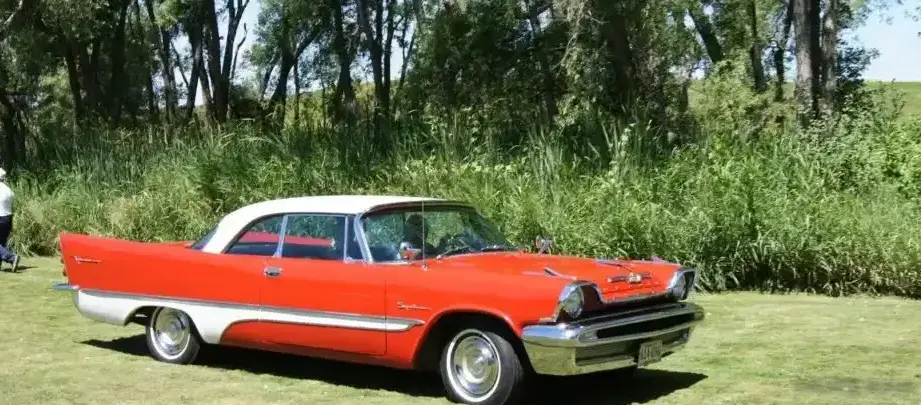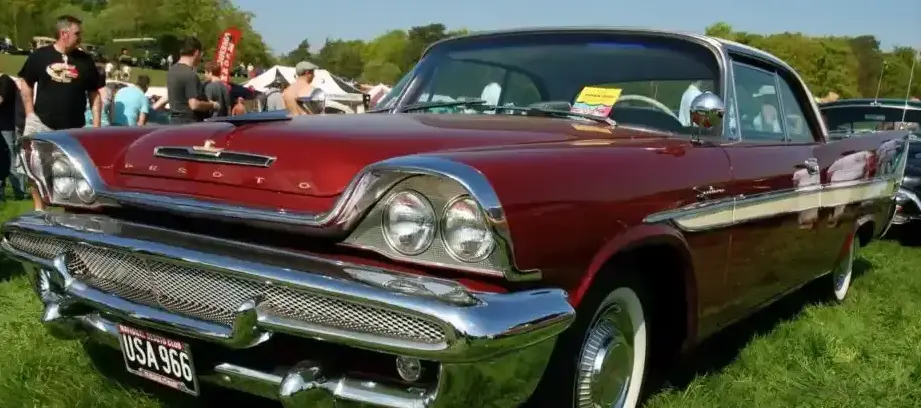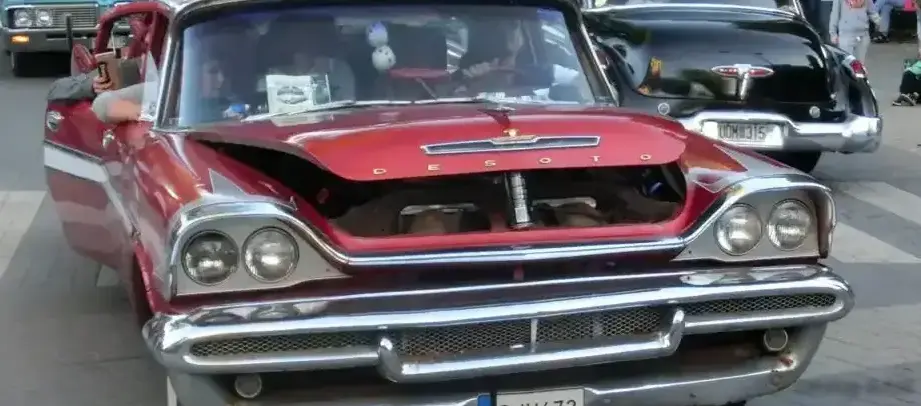
The DeSoto Firesweep I 4-Door Sedan, specifically the facelifted 1958 model year equipped with the 5.7-liter V8 engine producing 280 horsepower, represents a pivotal, though ultimately short-lived, moment in the American automotive landscape. Produced from 1957 to 1958, the Firesweep was positioned as DeSoto’s full-size offering, slotting above the DeSoto Diplomat and aimed at buyers seeking a blend of style, performance, and relative luxury. The 1958 facelift brought significant cosmetic changes, including revised grille work and tailfin styling, in an attempt to bolster sales against increasingly competitive rivals. This particular configuration, with the larger V8, was intended to appeal to drivers wanting a more spirited driving experience than the base engine options provided.
Technical Specifications
| Brand | DeSoto |
| Model | Firesweep |
| Generation | Firesweep I 4-Door Sedan (facelift 1958) |
| Type (Engine) | 5.7 V8 (280 Hp) |
| Start of production | 1957 |
| End of production | 1958 |
| Powertrain Architecture | Internal Combustion engine |
| Body type | Sedan |
| Seats | 6 |
| Doors | 4 |
| Fuel Type | Petrol (Gasoline) |
| Weight-to-power ratio | 6.3 kg/Hp, 159.1 Hp/tonne |
| Weight-to-torque ratio | 3.4 kg/Nm, 292.6 Nm/tonne |
| Power | 280 Hp @ 4600 rpm |
| Power per litre | 48.8 Hp/l |
| Torque | 515 Nm @ 2400 rpm, 379.84 lb.-ft. @ 2400 rpm |
| Engine displacement | 5735 cm3, 349.97 cu. in. |
| Number of cylinders | 8 |
| Engine configuration | V-engine |
| Cylinder Bore | 103.12 mm, 4.06 in. |
| Piston Stroke | 85.85 mm, 3.38 in. |
| Compression ratio | 10:1 |
| Number of valves per cylinder | 2 |
| Fuel injection system | Carburettor |
| Engine aspiration | Naturally aspirated engine |
| Valvetrain | OHV |
| Engine oil capacity | 3.8 l, 4.02 US qt | 3.34 UK qt |
| Coolant | 16.1 l, 17.01 US qt | 14.17 UK qt |
| Kerb Weight | 1760 kg, 3880.14 lbs |
| Fuel tank capacity | 76 l, 20.08 US gal | 16.72 UK gal |
| Length | 5499 mm, 216.5 in |
| Width | 1989 mm, 78.31 in |
| Height | 1443 mm, 56.81 in |
| Wheelbase | 3099 mm, 122.01 in |
| Front track | 1547 mm, 60.91 in |
| Rear (Back) track | 1516 mm, 59.69 in |
| Front overhang | 940 mm, 37.01 in |
| Rear overhang | 1461 mm, 57.52 in |
| Ride height (ground clearance) | 142 mm, 5.59 in |
| Minimum turning circle (turning diameter) | 14.2 m, 46.59 ft |
| Approach angle | 16.5° |
| Departure angle | 11.4° |
| Ramp-over (brakeover) angle | 10.5° |
| Drivetrain Architecture | The Internal combustion engine (ICE) drives the rear wheels of the vehicle. |
| Drive wheel | Rear wheel drive |
| Number of gears and type of gearbox | 3 gears, manual transmission |
| Front suspension | Independent coil spring |
| Rear suspension | Leaf spring |
| Front brakes | Drum, 279 mm |
| Rear brakes | Drum, 279 mm |
| Steering type | Worm-reduction unit |
Powertrain & Engine Architecture
The heart of the 1958 Firesweep was the DeSoto 5.7-liter (349.97 cubic inch) V8 engine. This engine, designated within the Chrysler corporation as the “Hemi” despite not featuring a true hemispherical combustion chamber, was a robust and relatively modern design for its time. It utilized a cast iron block and aluminum cylinder heads. The engine employed a single Carter carburetor, feeding a 10:1 compression ratio. The overhead valve (OHV) configuration, with two valves per cylinder, was typical for American V8s of the era. The 280 horsepower output was achieved at 4600 rpm, while peak torque of 515 Nm (379.84 lb-ft) arrived at a relatively low 2400 rpm, promising strong low-end and mid-range acceleration. The standard transmission for this engine was a three-speed manual, though a TorqueFlite automatic transmission was also available, and quite popular with buyers.
Driving Characteristics
The 1958 Firesweep with the 5.7L V8 and manual transmission offered a noticeably more engaging driving experience than the base engine options. While not a sports car by any means, the 280 horsepower provided ample power for comfortable highway cruising and brisk acceleration. The three-speed manual gearbox, while not particularly sophisticated, allowed the driver to effectively utilize the engine’s torque curve. Compared to the automatic transmission, the manual offered a more direct connection to the engine and improved fuel economy, though at the cost of convenience. The leaf spring rear suspension, common on American cars of this period, provided a comfortable ride but could exhibit some axle hop under hard acceleration or on uneven surfaces.
Equipment & Trim Levels
The Firesweep, even in its base form, was reasonably well-equipped for the late 1950s. Standard features included full wheel covers, a two-tone paint scheme, and a spacious interior upholstered in cloth and vinyl. The 1958 facelift brought a more luxurious interior with improved trim materials and revised dashboard styling. Optional extras included power steering, power brakes, a radio, and air conditioning. The Firesweep was available in a variety of body styles, including a 2-door coupe, a 4-door sedan (as described here), and a station wagon.
Chassis & Braking
The Firesweep rode on a traditional body-on-frame chassis. The front suspension utilized independent coil springs, providing a more comfortable ride than the solid axle setups found on some competitors. The rear suspension employed leaf springs, a cost-effective and durable design. Braking was accomplished via drum brakes on all four wheels, measuring 279mm in diameter. While adequate for the time, the drum brakes lacked the stopping power and fade resistance of disc brakes, which were still relatively uncommon on American cars in the late 1950s. Steering was handled by a worm-reduction unit, which provided relatively heavy but precise steering feel.
Market Reception & Comparison
The 1958 DeSoto Firesweep faced stiff competition from established rivals like Chevrolet, Ford, and Plymouth. Critics generally praised the Firesweep’s styling and comfortable ride, but some noted its relatively high price compared to its competitors. The 5.7L V8 engine was well-regarded for its performance and smoothness. However, the Firesweep’s sales were hampered by a combination of factors, including a recession and increasing competition. Compared to the base engine Firesweep models, the 280 hp version commanded a premium, attracting buyers who prioritized performance. The automatic transmission option was popular, sacrificing some performance for ease of use.
Legacy
The DeSoto Firesweep, and the DeSoto brand as a whole, was discontinued after the 1961 model year. The 1958 Firesweep, while not a commercial success, remains a desirable classic car among collectors. The 5.7L V8 engine, while not as legendary as some other Chrysler engines of the era, was a durable and reliable powerplant. Today, well-maintained examples of the 1958 Firesweep are relatively rare and command a premium in the used car market. The Firesweep represents a fleeting moment of optimism and extravagance in American automotive history, a symbol of the tailfin era and the promise of the open road.