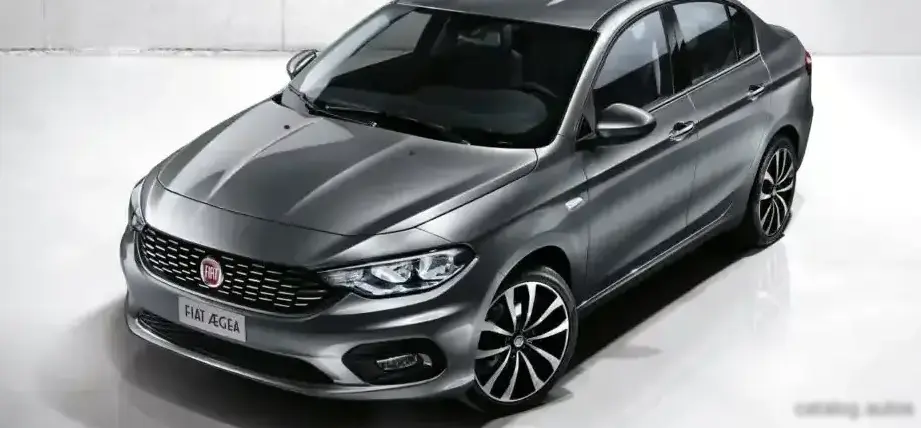
The Fiat Egea Hatchback (Project 357) 1.6 E-Torq with the 110 horsepower engine and automatic transmission was a key offering in Fiat’s European C-segment lineup from 2016 to 2019. Positioned as a comfortable and practical option, it aimed to provide a balance between affordability and convenience for buyers seeking a family-friendly hatchback. This variant represented a significant portion of Egea Hatchback sales, particularly among customers prioritizing ease of driving over outright performance. The Egea, designed as a replacement for the Bravo, was intended to be a globally relevant vehicle, with production occurring in Turkey for European markets and Brazil for South American markets.
Technical Specifications
| Brand | Fiat |
| Model | Egea |
| Generation | Egea Hatchback (357) |
| Type (Engine) | 1.6 E-Torq (110 Hp) Automatic |
| Start of production | 2016 |
| End of production | 2019 |
| Powertrain Architecture | Internal Combustion engine |
| Body type | Hatchback |
| Seats | 5 |
| Doors | 5 |
| Fuel consumption (urban) | 9.2 l/100 km (25.6 US mpg) |
| Fuel consumption (extra urban) | 4.6 l/100 km (51.1 US mpg) |
| Fuel consumption (combined) | 6.3 l/100 km (37.3 US mpg) |
| CO2 emissions | 147 g/km |
| Fuel Type | Petrol (Gasoline) |
| Acceleration 0 – 100 km/h | 11.5 sec |
| Acceleration 0 – 62 mph | 11.5 sec |
| Acceleration 0 – 60 mph | 10.9 sec |
| Maximum speed | 192 km/h (119.3 mph) |
| Emission standard | Euro 6 |
| Weight-to-power ratio | 11.8 kg/Hp |
| Weight-to-torque ratio | 8.6 kg/Nm |
| Power | 110 Hp @ 5500 rpm |
| Torque | 152 Nm @ 4500 rpm (112.11 lb.-ft. @ 4500 rpm) |
| Engine layout | Front, Transverse |
| Engine Model/Code | 55268036 |
| Engine displacement | 1598 cm3 (97.52 cu. in.) |
| Number of cylinders | 4 |
| Engine configuration | Inline |
| Cylinder Bore | 77 mm (3.03 in.) |
| Piston Stroke | 85.8 mm (3.38 in.) |
| Compression ratio | 11.1:1 |
| Number of valves per cylinder | 4 |
| Fuel injection system | Multi-port manifold injection |
| Engine aspiration | Naturally aspirated engine |
| Valvetrain | SOHC |
| Engine oil capacity | 4.7 l (4.97 US qt | 4.14 UK qt) |
| Coolant capacity | 5.4 l (5.71 US qt | 4.75 UK qt) |
| Kerb Weight | 1300 kg (2866.01 lbs.) |
| Trunk (boot) space – minimum | 440 l (15.54 cu. ft.) |
| Fuel tank capacity | 50 l (13.21 US gal | 11 UK gal) |
| Max. roof load | 55 kg (121.25 lbs.) |
| Length | 4368 mm (171.97 in.) |
| Width | 1792 mm (70.55 in.) |
| Width including mirrors | 2002 mm (78.82 in.) |
| Height | 1495 mm (58.86 in.) |
| Wheelbase | 2638 mm (103.86 in.) |
| Front track | 1542 mm (60.71 in.) |
| Rear track | 1543 mm (60.75 in.) |
| Front overhang | 893 mm (35.16 in.) |
| Rear overhang | 837 mm (32.95 in.) |
| Minimum turning circle | 10.9 m (35.76 ft.) |
| Drivetrain Architecture | Front wheel drive |
| Number of gears | 6 |
| Gearbox type | Automatic transmission |
| Front suspension | Independent type McPherson |
| Rear suspension | Torsion |
| Front brakes | Disc, 284×22 mm |
| Rear brakes | Disc, 251×10 mm |
| Assisting systems | ABS (Anti-lock braking system) |
| Steering type | Steering rack and pinion |
| Power steering | Electric Steering |
| Tires size | 195/55 R15; 205/55 R16; 225/45 R17 |
| Wheel rims size | 6J x 15; 6.5J x 16; 7J x 17 |
INTRODUCTION
The Fiat Egea Hatchback 1.6 E-Torq Automatic, launched in 2016, was a crucial model for Fiat as it sought to regain market share in the competitive European compact hatchback segment. Built on the 357 project platform, the Egea aimed to offer a more spacious and refined alternative to rivals like the Volkswagen Golf and Ford Focus. The 1.6 E-Torq engine, paired with a six-speed automatic transmission, was positioned as the entry-level automatic option, appealing to buyers who valued comfort and convenience over sporty performance. It served as a stepping stone to the more powerful 1.4 T-Jet and diesel variants within the Egea range.
Powertrain & Engine Architecture
The heart of this Egea variant is the 1.6-liter E-Torq inline-four cylinder engine, designated with engine code 55268036. This engine is a naturally aspirated unit featuring a single overhead camshaft (SOHC) valvetrain and four valves per cylinder. Fuel delivery is managed by a multi-point fuel injection system. The engine produces 110 horsepower at 5500 rpm and 152 Nm (112 lb-ft) of torque at 4500 rpm. The six-speed automatic transmission is a conventional torque converter type, prioritizing smooth shifts and ease of use over rapid gear changes. While not a dual-clutch transmission, it was a significant upgrade from older Fiat automatic offerings. The engine’s design emphasizes durability and relatively low maintenance costs, typical of Fiat’s approach to engine development.
Driving Characteristics
The 1.6 E-Torq Automatic Egea delivers a comfortable, if not particularly exhilarating, driving experience. Acceleration from 0-100 km/h (0-62 mph) takes approximately 11.5 seconds, making it slower than the manual transmission or higher-powered versions. The automatic transmission is tuned for fuel efficiency and smooth operation, resulting in somewhat leisurely gear changes. The gear ratios are optimized for everyday driving, providing adequate power for merging onto highways and navigating city streets. Compared to the manual version, the automatic sacrifices some responsiveness, but gains in ease of use, especially in congested traffic. The engine feels strained when pushed hard, and the transmission can sometimes hunt for the right gear on inclines.
Equipment & Trim Levels
The 1.6 E-Torq Automatic trim typically included standard features such as air conditioning, power windows, central locking, and a basic audio system with USB connectivity. Safety equipment included ABS brakes, electronic stability control, and airbags. Higher trim levels, available as options, added features like alloy wheels, a touchscreen infotainment system, rear parking sensors, and cruise control. Interior upholstery was typically cloth, with a functional and durable design. The dashboard layout was straightforward and user-friendly, prioritizing practicality over aesthetic flair.
Chassis & Braking
The Egea Hatchback utilizes a McPherson strut independent suspension setup at the front and a torsion beam suspension at the rear. This configuration provides a good balance between ride comfort and handling. The front brakes are ventilated discs, while the rear brakes are solid discs. The steering is electrically assisted, offering light and precise control. The suspension is tuned for comfort, absorbing bumps and imperfections in the road surface effectively. Stabilizer bars are fitted to both the front and rear axles to reduce body roll during cornering.
Market Reception & Comparison
The Fiat Egea 1.6 E-Torq Automatic received mixed reviews from automotive critics. While praised for its spacious interior, comfortable ride, and competitive pricing, it was often criticized for its lackluster performance and somewhat dated automatic transmission. Compared to the 1.4 T-Jet turbo engine, the 1.6 E-Torq offered significantly less power and responsiveness. The diesel variants provided better fuel economy but came with a higher purchase price. However, the 1.6 E-Torq Automatic appealed to buyers who prioritized affordability and ease of driving, making it a popular choice for families and commuters.
Legacy
The Fiat Egea 1.6 E-Torq Automatic has proven to be a relatively reliable powertrain in the used car market. The 1.6 E-Torq engine is known for its durability and relatively low maintenance costs. The automatic transmission, while not the most sophisticated, has also demonstrated reasonable reliability. Common issues reported by owners include occasional sensor failures and minor electrical glitches. Overall, the Egea 1.6 E-Torq Automatic represents a practical and affordable option for buyers seeking a comfortable and reliable compact hatchback.