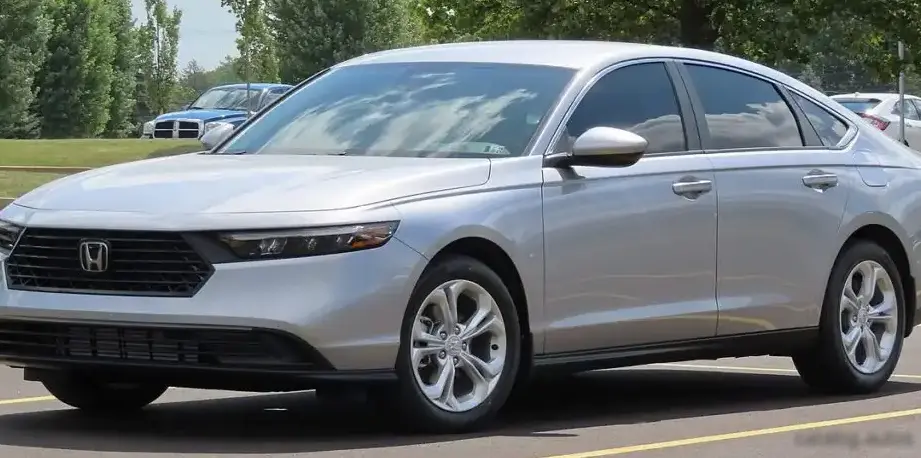
The Honda Accord IX 2.4, produced from 2012 to 2015, represented the ninth generation of Honda’s popular mid-size sedan. This variant, equipped with a 2.4-liter inline-four engine producing 188 horsepower and a Continuously Variable Transmission (CVT), occupied a significant position in the Accord lineup, offering a balance between performance and fuel efficiency. It was positioned as a step up from the base 2.0-liter models, appealing to buyers seeking more power without the higher price tag of the V6 options. The Accord IX, built on the FA9 platform, aimed to deliver improved refinement, technology, and driving dynamics compared to its predecessor.
Technical Specifications
| Brand | Honda |
| Model | Accord |
| Generation | Accord IX |
| Type (Engine) | 2.4 (188 Hp) CVT |
| Start of production | 2012 |
| End of production | 2015 |
| Powertrain Architecture | Internal Combustion engine |
| Body type | Sedan |
| Seats | 5 |
| Doors | 4 |
| Fuel consumption (urban) | 8.7 l/100 km (27 US mpg) |
| Fuel consumption (extra urban) | 6.5 l/100 km (36.2 US mpg) |
| Fuel consumption (combined) | 7.8 l/100 km (30.2 US mpg) |
| Fuel Type | Petrol (Gasoline) |
| Weight-to-power ratio | 8 kg/Hp |
| Weight-to-torque ratio | 6.2 kg/Nm |
| Power | 188 Hp @ 6400 rpm |
| Power per litre | 79.8 Hp/l |
| Torque | 245 Nm @ 3900 rpm (180.7 lb.-ft. @ 3900 rpm) |
| Maximum engine speed | 6800 rpm |
| Engine layout | Front, Transverse |
| Engine Model/Code | K24W |
| Engine displacement | 2356 cm3 (143.77 cu. in.) |
| Number of cylinders | 4 |
| Engine configuration | Inline |
| Cylinder Bore | 87 mm (3.43 in.) |
| Piston Stroke | 99.1 mm (3.9 in.) |
| Compression ratio | 11.1:1 |
| Number of valves per cylinder | 4 |
| Fuel injection system | Direct injection |
| Engine aspiration | Naturally aspirated engine |
| Valvetrain | DOHC, i-VTEC |
| Engine oil capacity | 4.2 l (4.44 US qt | 3.7 UK qt) |
| Coolant | 6.3 l (6.66 US qt | 5.54 UK qt) |
| Kerb Weight | 1513 kg (3335.59 lbs.) |
| Trunk (boot) space – minimum | 447 l (15.79 cu. ft.) |
| Fuel tank capacity | 65 l (17.17 US gal | 14.3 UK gal) |
| Length | 4862 mm (191.42 in.) |
| Width | 1849 mm (72.8 in.) |
| Height | 1466 mm (57.72 in.) |
| Wheelbase | 2776 mm (109.29 in.) |
| Front track | 1585 mm (62.4 in.) |
| Rear (Back) track | 1582 mm (62.28 in.) |
| Drag coefficient (Cd) | 0.30 |
| Minimum turning circle (turning diameter) | 11.6 m (38.06 ft.) |
| Drivetrain Architecture | The Internal combustion engine (ICE) drives the front wheels of the vehicle. |
| Drive wheel | Front wheel drive |
| Number of gears and type of gearbox | automatic transmission CVT |
| Front suspension | Independent type McPherson |
| Rear suspension | Independent multi-link suspension |
| Front brakes | Ventilated discs |
| Rear brakes | Disc |
| Assisting systems | ABS (Anti-lock braking system) |
| Steering type | Steering rack and pinion |
| Power steering | Electric Steering |
| Tires size | 215/55 R17 94V |
| Wheel rims size | 7.5J x 17 ET55 |
Powertrain & Engine Architecture
The heart of the Accord IX 2.4 was the K24W engine, a 2.4-liter inline-four cylinder powerplant. This engine utilized Honda’s i-VTEC (Variable Valve Timing and Lift Electronic Control) technology, allowing for optimized valve timing for both low-end torque and high-end horsepower. Direct fuel injection further enhanced efficiency and performance. The K24W produced 188 hp at 6400 rpm and 245 Nm (180.7 lb-ft) of torque at 3900 rpm. Paired with this engine was a Continuously Variable Transmission (CVT). Unlike traditional automatic transmissions with fixed gear ratios, the CVT offered a virtually infinite number of ratios, optimizing engine speed for efficiency or power as needed. This CVT was designed to mimic the feel of traditional gear changes, addressing a common complaint about earlier CVT implementations.
Driving Characteristics
The 2.4-liter engine and CVT combination in the Accord IX delivered a smooth and refined driving experience. While not as overtly sporty as the V6 models, the 2.4 provided adequate acceleration for everyday driving situations. The CVT, while efficient, sometimes felt less responsive than a traditional automatic, particularly during quick acceleration maneuvers. The CVT’s programming prioritized fuel economy, resulting in a slightly more relaxed power delivery. Compared to the manual transmission options, the CVT offered greater convenience, especially in urban traffic, but sacrificed some driver engagement. The Accord’s suspension, featuring independent McPherson struts in the front and a multi-link setup in the rear, provided a comfortable ride without sacrificing handling.
Equipment & Trim Levels
The Accord IX 2.4 CVT was typically offered in several trim levels, including LX, EX, and EX-L. The base LX trim included standard features such as air conditioning, power windows and locks, a rearview camera, and a basic audio system. The EX trim added features like alloy wheels, a sunroof, and an upgraded audio system with more speakers. The top-of-the-line EX-L trim included leather upholstery, heated front seats, and a navigation system. Optional extras included features like a premium audio system, and advanced safety technologies.
Chassis & Braking
The Accord IX featured a front-wheel-drive layout. The front suspension utilized independent McPherson struts, while the rear employed an independent multi-link suspension. This setup provided a good balance between ride comfort and handling. Braking duties were handled by ventilated discs in the front and solid discs in the rear. Anti-lock Braking System (ABS) was standard. The Accord’s chassis was designed to provide a stable and predictable driving experience, with a focus on minimizing body roll during cornering.
Market Reception & Comparison
The Honda Accord IX 2.4 CVT was generally well-received by automotive critics. It was praised for its fuel efficiency, comfortable ride, and spacious interior. However, some reviewers noted that the CVT could feel somewhat sluggish during aggressive acceleration. Compared to the V6 Accord, the 2.4 offered a more affordable entry point with acceptable performance for most drivers. Against competitors like the Toyota Camry and Nissan Altima, the Accord IX 2.4 CVT held its own, offering a compelling combination of features, reliability, and value. Fuel economy figures consistently placed it among the leaders in its class.
Legacy
The K24W engine, in general, has proven to be a reliable and durable powerplant. The CVT, while initially met with some skepticism, has also demonstrated reasonable long-term reliability when properly maintained. In the used car market, the Accord IX 2.4 CVT remains a popular choice due to its reputation for dependability and affordability. Regular maintenance, including timely CVT fluid changes, is crucial for ensuring the longevity of this powertrain. The Accord IX generation, and specifically the 2.4 CVT variant, solidified Honda’s position as a leader in the mid-size sedan segment, offering a well-rounded package that appealed to a broad range of buyers.