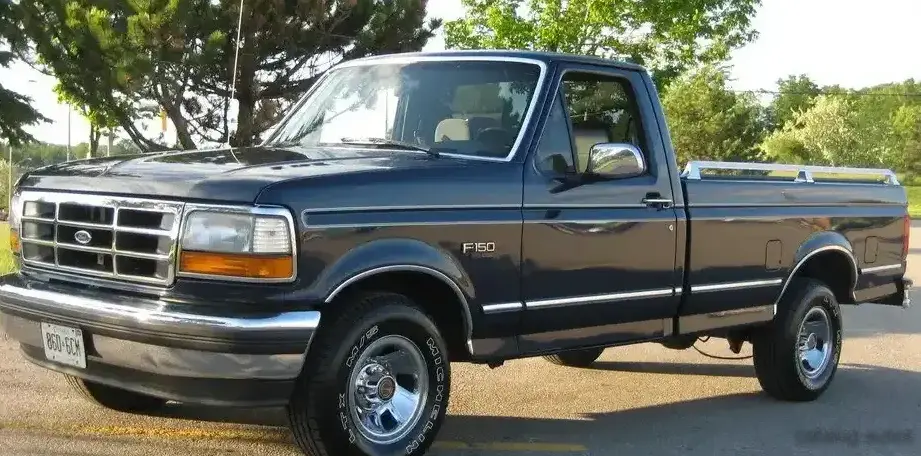
The Ford F-Series F-150 IX Regular Cab, equipped with the 4.9-liter inline-six engine producing 150 horsepower and a four-wheel-drive system, was a mainstay of the American pickup truck market from 1994 to 1997. This configuration represented a work-oriented, value-focused option within the ninth generation (F-Series IX) of Ford’s immensely popular F-Series line. Positioned as an entry-level 4×4 offering, it catered to buyers prioritizing capability and durability over outright performance or luxury. It was built on the same platform as the F-100, with the F-150 designation signifying a higher Gross Vehicle Weight Rating (GVWR) and increased payload capacity.
Technical Specifications
| Brand | Ford |
| Model | F-Series F-150 |
| Generation | F-Series F-150 IX Regular Cab |
| Type (Engine) | 4.9 (150 Hp) 4×4 |
| Start of production | 1994 |
| End of production | 1997 |
| Powertrain Architecture | Internal Combustion engine |
| Body type | Pick-up |
| Seats | 3 |
| Doors | 2 |
| Fuel Type | Petrol (Gasoline) |
| Power | 150 Hp |
| Power per litre | 30.6 Hp/l |
| Torque | 353 Nm / 260.36 lb.-ft. |
| Engine layout | Front, Longitudinal |
| Engine displacement | 4900 cm3 / 299.02 cu. in. |
| Number of cylinders | 6 |
| Engine configuration | Inline |
| Cylinder Bore | 101.6 mm / 4 in. |
| Piston Stroke | 101 mm / 3.98 in. |
| Number of valves per cylinder | 2 |
| Fuel injection system | Multi-port manifold injection |
| Engine aspiration | Naturally aspirated engine |
| Engine oil capacity | 4.7 l / 4.97 US qt | 4.14 UK qt |
| Coolant | 12 l / 12.68 US qt | 10.56 UK qt |
| Max. weight | 2835 kg / 6250.11 lbs. |
| Fuel tank capacity | 69-141 l / 18.23 – 37.25 US gal | 15.18 – 31.02 UK gal |
| Length | 5006-5418 mm / 197.09 – 213.31 in. |
| Width | 2007 mm / 79.02 in. |
| Height | 1872 mm / 73.7 in. |
| Wheelbase | 2972-3378 mm / 117.01 – 132.99 in. |
| Wading depth | 851 mm / 33.5 in. |
| Drivetrain Architecture | The Internal combustion engine (ICE) drives the rear wheels permanently, and the front wheels are driven through an electrically or mechanically operated clutch if necessary. |
| Drive wheel | All wheel drive (4×4) |
| Number of gears and type of gearbox | 5 gears, manual transmission |
| Front suspension | Independent coil spring |
| Rear suspension | Leaf spring |
| Front brakes | Disc |
| Rear brakes | Drum |
| Power steering | Electric Steering |
| Tires size | 235/75 R15 |
| Wheel rims size | 15 |
Powertrain & Engine Architecture
The heart of this F-150 variant was the 4.9-liter (299 cubic inch) inline-six engine, often referred to as the “300 six” due to its earlier 4.9-liter predecessor. This engine, designated internally as the 4.9L Windsor, was a long-stroke design known for its robust construction and ample low-end torque. It featured a cast-iron block and cylinder head, a relatively simple overhead valve (OHV) valvetrain with two valves per cylinder, and a multi-port fuel injection system. The fuel injection system, while not as sophisticated as later sequential systems, provided a significant improvement over carbureted engines in terms of fuel efficiency and emissions. The engine’s durability was legendary, and it was often favored for its ability to withstand heavy use and minimal maintenance. The 150 horsepower output was achieved at 4,200 rpm, while peak torque of 260 lb-ft arrived at a low 2,800 rpm. This configuration was paired with a standard five-speed manual transmission, optimized for work applications. The 4×4 system employed a transfer case allowing the driver to switch between two-wheel drive and four-wheel drive modes, with a low-range gear for enhanced off-road capability.
Driving Characteristics
The 4.9-liter engine and five-speed manual transmission combination in the F-150 IX delivered a utilitarian driving experience. Acceleration was modest, with 0-60 mph times estimated around 11-12 seconds. However, the engine’s strong low-end torque made it well-suited for hauling and towing. The gear ratios in the five-speed manual were spaced to maximize pulling power, rather than prioritize quick acceleration. Compared to the optional 5.0-liter V8, the 4.9-liter offered less horsepower but a broader, more usable torque curve. The V8 provided quicker acceleration and a more refined driving experience, but at the cost of fuel economy. Compared to later fuel-injected versions of the 300 six, this earlier iteration felt a bit rougher around the edges, with more noticeable engine noise and vibration. The 4×4 system provided confident traction in slippery conditions, but the truck’s relatively high center of gravity and leaf spring rear suspension resulted in a somewhat bouncy ride, especially when unloaded.
Equipment & Trim Levels
The F-150 IX Regular Cab 4.9 4×4 was typically offered in a base trim level, focusing on functionality rather than luxury. Standard equipment included a basic vinyl bench seat, a simple dashboard with analog gauges, and manual windows and locks. An AM/FM radio was standard, with an optional cassette player available. Air conditioning, power windows and locks, and upgraded interior trim were available as options. The exterior featured black plastic bumpers and side moldings, and steel wheels were standard. The Regular Cab configuration offered a single row of seating, maximizing cargo space in the bed. The interior was designed for durability and ease of cleaning, with hard-wearing materials used throughout.
Chassis & Braking
The F-150 IX chassis featured a body-on-frame construction, providing a robust and durable platform. The front suspension utilized independent coil springs, offering a reasonable level of ride comfort. The rear suspension employed leaf springs, which were well-suited for carrying heavy loads but could result in a harsher ride when unloaded. Braking duties were handled by disc brakes at the front and drum brakes at the rear. Power steering was standard, making the truck easier to maneuver at low speeds. The 235/75R15 tires provided adequate grip for both on-road and off-road driving. The frame itself was heavily reinforced to withstand the stresses of hauling and towing.
Market Reception & Comparison
The F-150 IX Regular Cab 4.9 4×4 was well-received by buyers seeking a capable and affordable work truck. Critics praised its durability, reliability, and strong low-end torque. However, its modest horsepower and basic interior were points of criticism. Compared to the V8-powered F-150 models, the 4.9-liter version offered better fuel economy, achieving around 14-16 mpg in city driving and 17-19 mpg on the highway. The 4.9-liter engine also required less frequent maintenance than the V8, making it a cost-effective choice for budget-conscious buyers. It was a popular choice among farmers, ranchers, and construction workers who needed a reliable truck for demanding tasks.
Legacy
The 4.9-liter inline-six engine continued to be a popular choice in Ford trucks well into the 1990s. Its reputation for durability and reliability has made it a favorite among enthusiasts and mechanics. Today, well-maintained examples of the F-150 IX Regular Cab 4.9 4×4 are sought after by collectors and those looking for a classic American work truck. The engine’s simplicity makes it relatively easy to repair and maintain, and parts are still readily available. While not a high-performance machine, the 4.9-liter F-150 represents a bygone era of rugged, dependable trucks built to last. Its enduring appeal lies in its ability to get the job done without fuss, and its status as a symbol of American work ethic.