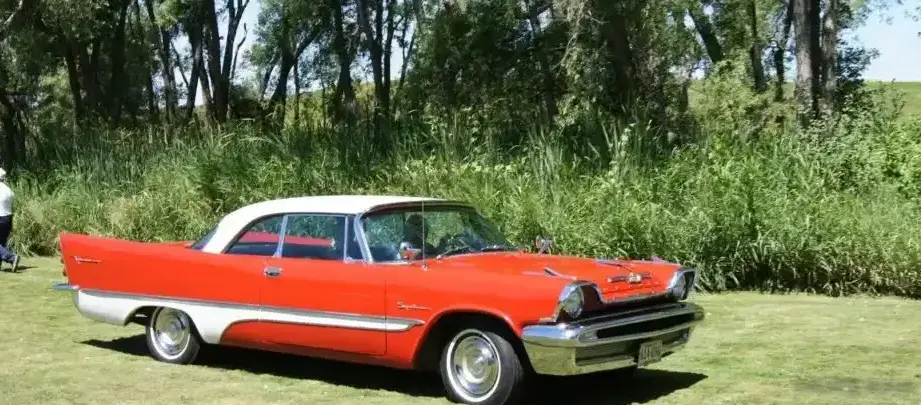
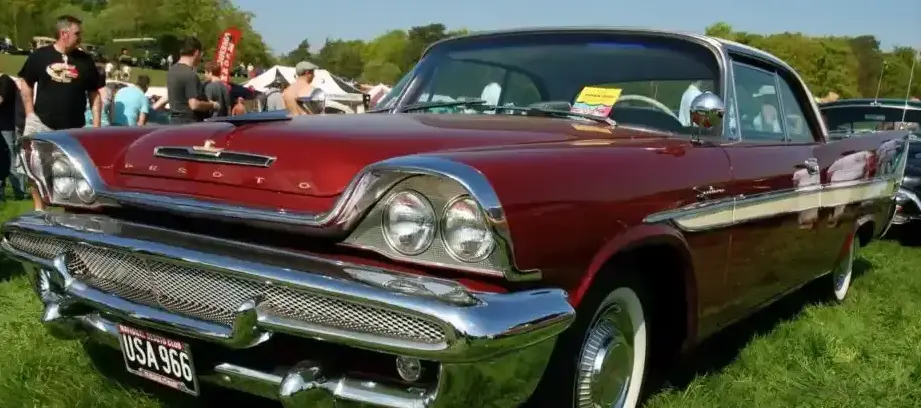
The DeSoto Firesweep, particularly the 4-Door Sedan facelifted for 1959, represented a significant, though ultimately short-lived, attempt by the DeSoto division of Chrysler Corporation to compete in the mid-range American automotive market. Produced from 1958 to 1959, the Firesweep was positioned as a more affordable alternative to Chrysler’s higher-end models, offering a blend of style and performance. The 1959 facelift brought revised styling, including a more prominent grille and altered tailfin design, aiming to attract buyers in a fiercely competitive segment. This specific configuration, featuring a 5.9-liter V8 engine paired with a TorqueFlite automatic transmission, was a mainstay of the Firesweep lineup, offering a balance between power and ease of driving.
Technical Specifications
| Brand | DeSoto |
| Model | Firesweep |
| Generation | Firesweep I 4-Door Sedan (facelift 1959) |
| Type (Engine) | 5.9 V8 (295 Hp) TorqueFlite |
| Start of production | 1958 |
| End of production | 1959 |
| Powertrain Architecture | Internal Combustion engine |
| Body type | Sedan |
| Seats | 6 |
| Doors | 4 |
| Fuel Type | Petrol (Gasoline) |
| Power | 295 Hp @ 4600 rpm |
| Power per litre | 49.9 Hp/l |
| Torque | 529 Nm @ 2400 rpm / 390.17 lb.-ft. @ 2400 rpm |
| Engine displacement | 5916 cm3 / 361.02 cu. in. |
| Number of cylinders | 8 |
| Engine configuration | V-engine |
| Cylinder Bore | 104.65 mm / 4.12 in. |
| Piston Stroke | 85.85 mm / 3.38 in. |
| Compression ratio | 10:1 |
| Number of valves per cylinder | 2 |
| Fuel injection system | Carburettor |
| Engine aspiration | Naturally aspirated engine |
| Valvetrain | OHV |
| Engine oil capacity | 4.7 l / 4.97 US qt | 4.14 UK qt |
| Coolant | 16.1 l / 17.01 US qt | 14.17 UK qt |
| Fuel tank capacity | 76 l / 20.08 US gal | 16.72 UK gal |
| Length | 5514 mm / 217.09 in. |
| Width | 1999 mm / 78.7 in. |
| Height | 1443 mm / 56.81 in. |
| Wheelbase | 3099 mm / 122.01 in. |
| Front track | 1547 mm / 60.91 in. |
| Rear (Back) track | 1516 mm / 59.69 in. |
| Ride height (ground clearance) | 140 mm / 5.51 in. |
| Minimum turning circle (turning diameter) | 14.2 m / 46.59 ft. |
| Approach angle | 15° |
| Departure angle | 10° |
| Ramp-over (brakeover) angle | 10.4° |
| Drivetrain Architecture | The Internal combustion engine (ICE) drives the rear wheels of the vehicle. |
| Drive wheel | Rear wheel drive |
| Number of gears and type of gearbox | 3 gears, automatic transmission TorqueFlite |
| Front suspension | Independent torsion bar, double wishbone |
| Rear suspension | Leaf spring |
| Front brakes | Drum, 279 mm |
| Rear brakes | Drum, 279 mm |
| Steering type | Worm-reduction unit |
Powertrain & Engine Architecture
The heart of the 1959 Firesweep was the Chrysler-built 5.9-liter (361 cubic inch) V8 engine. This engine, designated within Chrysler as part of the “B” engine family, featured a cast iron block and cylinder heads, with a two-barrel carburetor managing fuel delivery. The overhead valve (OHV) configuration utilized a conventional pushrod valvetrain. The 10:1 compression ratio contributed to the engine’s respectable 295 horsepower output at 4,600 rpm and 390 lb-ft of torque at 2,400 rpm. The TorqueFlite automatic transmission, a three-speed unit, was standard equipment. This transmission was known for its smoothness and durability, though it lacked the efficiency of more modern automatics. The TorqueFlite’s gear ratios were optimized for cruising, prioritizing comfortable highway driving over rapid acceleration.
Driving Characteristics
The combination of the 5.9-liter V8 and the TorqueFlite automatic provided a comfortable and capable driving experience. While not a performance-oriented machine, the Firesweep offered ample power for merging onto highways and passing slower traffic. The automatic transmission, while smooth, did result in some power loss compared to the available manual transmission options in other DeSoto models. Acceleration was adequate, but the car’s substantial weight (approximately 3,700 lbs) limited its overall responsiveness. The suspension, featuring independent torsion bars at the front and leaf springs in the rear, provided a reasonably comfortable ride, though it wasn’t particularly sporty. Steering was accomplished via a worm-reduction unit, which offered substantial assist but lacked the precision of more modern steering systems.
Equipment & Trim Levels
The 1959 Firesweep 4-Door Sedan, with the 5.9L V8 and TorqueFlite, occupied a mid-range position within the Firesweep lineup. Standard features included a spacious interior with seating for six passengers, a full-width bench seat, and a basic instrument panel. Interior upholstery was typically cloth and vinyl, with color options varying depending on the exterior paint choice. Optional extras included power steering, power brakes, a radio, and whitewall tires. Air conditioning was also available, though it was a relatively expensive option. The dashboard featured a straightforward layout with minimal ornamentation, reflecting the Firesweep’s positioning as a value-oriented vehicle.
Chassis & Braking
The Firesweep rode on a traditional body-on-frame chassis. The front suspension utilized independent torsion bars and a double wishbone setup, while the rear suspension employed leaf springs. This configuration provided a comfortable ride but wasn’t particularly sophisticated. Braking was accomplished via drum brakes on all four wheels, measuring 279mm in diameter. While adequate for the time, the drum brakes lacked the stopping power and fade resistance of disc brakes. Steering was handled by a worm-reduction unit, providing ample assist but lacking the precision of more modern systems.
Market Reception & Comparison
The 1959 Firesweep faced stiff competition from other mid-size American cars, including models from Ford, Chevrolet, and Plymouth. Critics generally praised the Firesweep’s styling and comfortable ride, but some noted its lack of performance compared to some of its rivals. The 5.9-liter V8 and TorqueFlite combination was considered a good balance of power and convenience, but it wasn’t the most fuel-efficient option. Compared to the smaller-displacement engines offered in other Firesweep models, the 5.9L provided significantly more power, but at the cost of increased fuel consumption. Compared to the higher-end Chrysler models, the Firesweep offered a more affordable entry point into the Chrysler family of vehicles.
Legacy
The DeSoto Firesweep, and the DeSoto brand as a whole, was discontinued after the 1961 model year. The 1959 Firesweep, while not a long-lived model, remains a popular choice among classic car enthusiasts. The 5.9-liter V8 engine, while not known for exceptional reliability, is generally considered durable and relatively easy to maintain. Parts availability can be a challenge, but many components are interchangeable with other Chrysler “B” engine family members. Today, well-maintained 1959 Firesweep Sedans are sought after for their classic styling and represent a unique piece of American automotive history. The TorqueFlite transmission, if properly maintained, continues to provide reliable service in surviving examples.