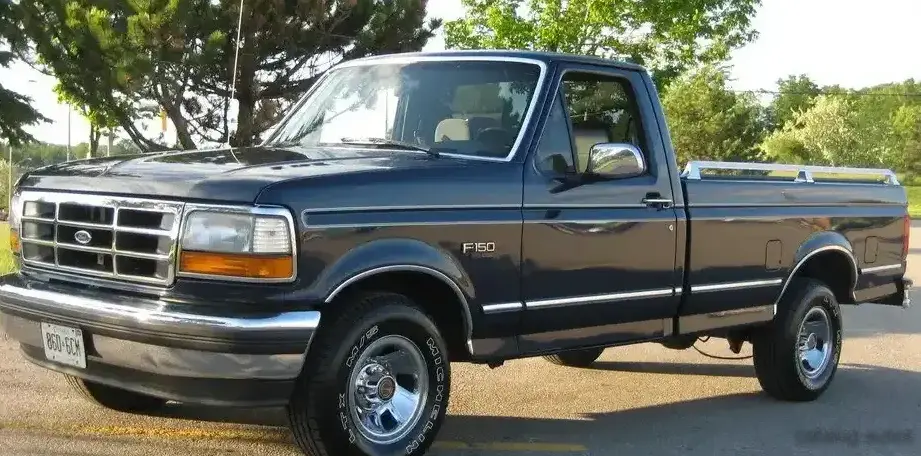
The Ford F-Series F-150 IX Regular Cab, equipped with the 5.0-liter V8 engine producing 185 horsepower and paired with an automatic transmission, was a mainstay of Ford’s truck lineup from 1991 to 1993. This configuration represented a middle-ground offering within the ninth generation of the F-Series (1987-1991, with minor updates extending into 1993), positioned between the base inline-six cylinder engines and the more powerful 5.8-liter V8. It catered to buyers needing a capable work truck without the expense of the top-tier performance options. The “IX” designation denoted a specific trim level, typically indicating a step up in features from the base models.
Technical Specifications
| Brand | Ford |
| Model | F-Series F-100/F-150 |
| Generation | F-Series F-150 IX Regular Cab |
| Type (Engine) | 5.0 V8 (185 Hp) Automatic |
| Start of production | August, 1991 |
| End of production | 1993 |
| Powertrain Architecture | Internal Combustion engine |
| Body type | Pick-up |
| Seats | 3 |
| Doors | 2 |
| Fuel Type | Petrol (Gasoline) |
| Power | 185 Hp |
| Power per litre | 37.4 Hp/l |
| Torque | 366 Nm / 269.95 lb.-ft. |
| Engine layout | Front, Longitudinal |
| Engine displacement | 4942 cm3 / 301.58 cu. in. |
| Number of cylinders | 8 |
| Engine configuration | V-engine |
| Number of valves per cylinder | 2 |
| Fuel injection system | Multi-port manifold injection |
| Engine aspiration | Naturally aspirated engine |
| Engine oil capacity | 4.7 l / 4.97 US qt | 4.14 UK qt |
| Max. weight | 2835 kg / 6250.11 lbs. |
| Fuel tank capacity | 131-141 l / 34.61 – 37.25 US gal | 28.82 – 31.02 UK gal |
| Length | 5006-5418 mm / 197.09 – 213.31 in. |
| Width | 2007 mm / 79.02 in. |
| Height | 1798 mm / 70.79 in. |
| Wheelbase | 2972-3378 mm / 117.01 – 132.99 in. |
| Wading depth | 767 mm / 30.2 in. |
| Drivetrain Architecture | The Internal combustion engine (ICE) drives the rear wheels of the vehicle. |
| Drive wheel | Rear wheel drive |
| Number of gears and type of gearbox | 4 gears, automatic transmission |
| Front suspension | Independent coil spring |
| Rear suspension | Leaf spring |
| Front brakes | Disc |
| Rear brakes | Drum |
| Power steering | Electric Steering |
| Tires size | 215/75 R15; 235/75 R15 |
| Wheel rims size | 15 |
Powertrain & Engine Architecture
The heart of this F-150 IX was the Ford 302 cubic inch (4.9 liter) small-block V8, specifically the Windsor engine family. This engine, internally designated with various codes depending on specific calibration, produced 185 horsepower and 366 Nm (269.95 lb-ft) of torque. The engine utilized a cast iron block and cylinder heads, with a two-barrel carburetor feeding the multi-port fuel injection system. This setup was a departure from earlier carbureted Ford V8s, offering improved fuel efficiency and drivability. The engine featured a hydraulic lifter camshaft, simplifying maintenance. The automatic transmission was a Ford AOD (Automatic Overdrive) four-speed unit. The AOD provided both automatic shifting and an overdrive gear for improved highway fuel economy, a significant feature for a full-size pickup truck.
Driving Characteristics
The 185 hp V8 and AOD automatic transmission combination delivered adequate, but not exhilarating, performance. Acceleration was reasonable for everyday driving and light hauling, but it lacked the punch of the larger 5.8-liter V8. The AOD transmission, while offering overdrive, wasn’t known for particularly crisp shifts. The gear ratios were optimized for towing and hauling, resulting in a lower first gear for getting heavier loads moving, but this also meant slower acceleration from a standstill. Compared to the five-speed manual transmission available on other F-150 trims, the automatic felt less responsive and resulted in slightly lower fuel economy. However, the automatic provided a more comfortable and convenient driving experience, particularly in stop-and-go traffic.
Equipment & Trim Levels
The F-150 IX Regular Cab with the 5.0L V8 and automatic transmission typically included features such as a basic AM/FM radio, cloth upholstery, and a tilt steering wheel. Power steering was standard. Air conditioning and a sliding rear window were common options. The “IX” trim level generally offered a step up in interior appointments compared to the base models, with slightly nicer fabrics and trim pieces. However, it still remained a fairly utilitarian interior focused on durability and functionality rather than luxury. Optional extras included upgraded sound systems, cruise control, and various towing packages.
Chassis & Braking
The F-150 IX utilized a body-on-frame construction, typical of trucks of this era. The front suspension consisted of independent coil springs, providing a relatively comfortable ride. The rear suspension employed leaf springs, designed to handle heavier loads. Braking duties were handled by disc brakes in the front and drum brakes in the rear. Power-assisted steering was standard. The rear axle ratios varied depending on the intended use of the truck, with lower ratios (numerically higher) for heavier towing and hauling, and higher ratios for improved fuel economy. Stabilizer bars were not typically standard on this trim level, contributing to a slightly more pronounced body roll in corners.
Market Reception & Comparison
The F-150 IX with the 5.0L V8 and automatic transmission was generally well-received as a practical and reliable work truck. Critics noted its adequate power and comfortable ride, but also pointed out its lack of outright performance compared to the larger engine options. Fuel economy was considered average for a full-size pickup truck of the time. Compared to the inline-six cylinder models, the V8 offered a significant increase in power and towing capacity. Compared to the 5.8-liter V8, it provided a more affordable entry point with slightly better fuel economy, albeit at the expense of performance. Reliability was generally good, with the 5.0L Windsor engine being known for its durability.
Legacy
The Ford F-150 IX with the 5.0L V8 and automatic transmission remains a relatively common sight in the used car market today. The 5.0L Windsor engine is known for its longevity and relatively simple maintenance requirements. Parts availability is generally good, making it a relatively affordable truck to keep running. While not a collector’s item, these trucks are appreciated by those seeking a dependable and capable work truck. The AOD transmission, however, can be a potential weak point, and may require rebuilding or replacement over time. Overall, this configuration represents a solid and dependable option within the ninth generation of the Ford F-Series, offering a balance of power, affordability, and practicality.