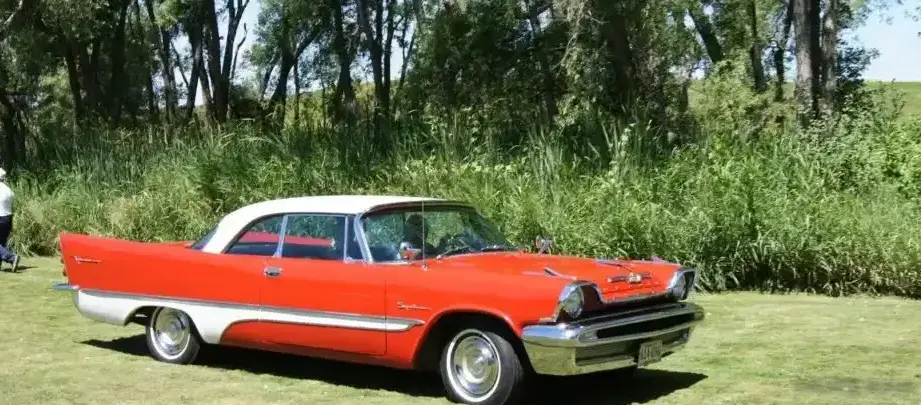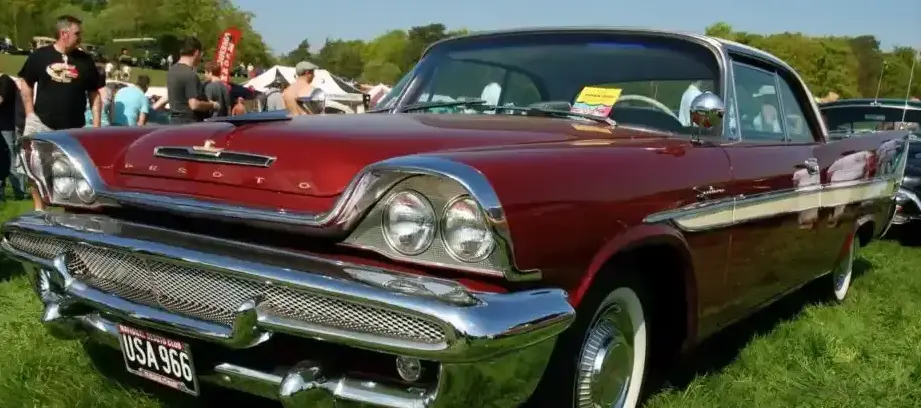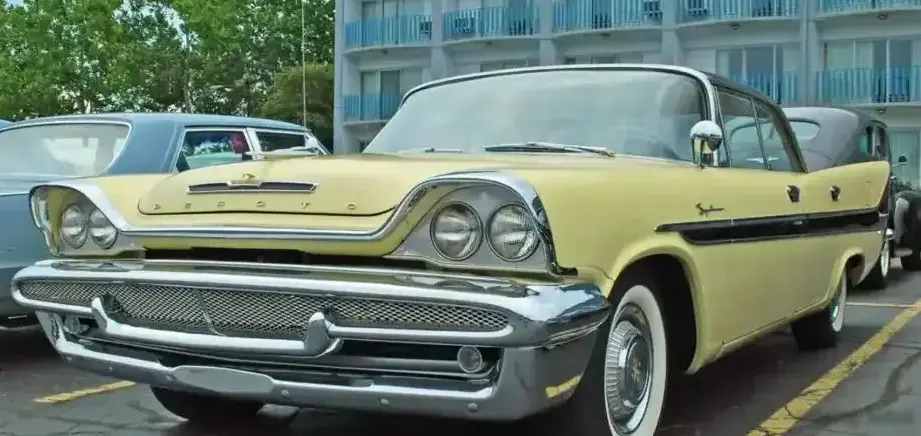
The DeSoto Firesweep I 4-Door Sportsman, specifically the 1958 facelifted model equipped with the 5.7-liter V8 engine and PowerFlite automatic transmission, represents a pivotal moment in the final years of the DeSoto marque. Produced from 1957 to 1958, this variant occupied a middle-ground position within the Firesweep lineup, offering a balance between performance and comfort for American families. It was part of the first generation of the Firesweep, a full-size car intended to modernize the DeSoto image and compete with offerings from Buick and Oldsmobile. The 1958 model year saw significant styling revisions, including a more prominent grille and revised tailfins, reflecting the burgeoning tailfin craze of the late 1950s.
Technical Specifications
| Brand | DeSoto |
| Model | Firesweep |
| Generation | Firesweep I 4-Door Sportsman (facelift 1958) |
| Type (Engine) | 5.7 V8 (280 Hp) PowerFlite |
| Start of production | 1957 |
| End of production | 1958 |
| Powertrain Architecture | Internal Combustion engine |
| Body type | Sedan |
| Seats | 6 |
| Doors | 4 |
| Fuel Type | Petrol (Gasoline) |
| Power | 280 Hp @ 4600 rpm |
| Power per litre | 48.8 Hp/l |
| Torque | 515 Nm @ 2400 rpm / 379.84 lb.-ft. @ 2400 rpm |
| Engine displacement | 5735 cm3 / 349.97 cu. in. |
| Number of cylinders | 8 |
| Engine configuration | V-engine |
| Cylinder Bore | 103.12 mm / 4.06 in. |
| Piston Stroke | 85.85 mm / 3.38 in. |
| Compression ratio | 10:1 |
| Number of valves per cylinder | 2 |
| Fuel injection system | Carburettor |
| Engine aspiration | Naturally aspirated engine |
| Valvetrain | OHV |
| Engine oil capacity | 3.8 l / 4.02 US qt | 3.34 UK qt |
| Coolant | 16.1 l / 17.01 US qt | 14.17 UK qt |
| Fuel tank capacity | 76 l / 20.08 US gal | 16.72 UK gal |
| Length | 5499 mm / 216.5 in. |
| Width | 1989 mm / 78.31 in. |
| Height | 1443 mm / 56.81 in. |
| Wheelbase | 3099 mm / 122.01 in. |
| Front track | 1547 mm / 60.91 in. |
| Rear track | 1516 mm / 59.69 in. |
| Front overhang | 940 mm / 37.01 in. |
| Rear overhang | 1461 mm / 57.52 in. |
| Ride height (ground clearance) | 142 mm / 5.59 in. |
| Minimum turning circle | 14.2 m / 46.59 ft. |
| Approach angle | 16.5° |
| Departure angle | 11.4° |
| Ramp-over angle | 10.5° |
| Drivetrain Architecture | Rear wheel drive, Internal Combustion engine (ICE) |
| Drive wheel | Rear wheel drive |
| Number of gears and type of gearbox | 2 gears, automatic transmission PowerFlite |
| Front suspension | Independent coil spring |
| Rear suspension | Leaf spring |
| Front brakes | Drum, 279 mm |
| Rear brakes | Drum, 279 mm |
| Steering type | Worm-reduction unit |
Powertrain & Engine Architecture
The heart of the 1958 Firesweep Sportsman was the DeSoto 5.7-liter (349.97 cubic inch) V8 engine. This engine, designated within Chrysler as the “B” engine family, featured a cast iron block and aluminum cylinder heads. It produced 280 horsepower at 4600 rpm and 515 Nm (379.84 lb-ft) of torque at 2400 rpm. The engine utilized a single Carter carburetor and an overhead valve (OHV) valvetrain with two valves per cylinder. The 10:1 compression ratio contributed to the engine’s respectable power output for the era. The PowerFlite automatic transmission, a two-speed unit, was the standard transmission offering for this variant. It was a torque converter automatic, providing smooth, albeit not particularly quick, shifts. The PowerFlite was known for its durability but lacked the sophistication of some contemporary automatic transmissions.
Driving Characteristics
The combination of the 280 hp V8 and the two-speed PowerFlite transmission resulted in a driving experience geared towards comfortable cruising rather than outright performance. Acceleration was adequate for the time, but the limited number of gears in the PowerFlite meant that the engine often operated at higher RPMs during highway driving. Compared to the manual transmission options available on other Firesweep models, the automatic version felt less responsive. However, it provided a more relaxed driving experience, particularly in city traffic. The rear-wheel-drive layout and relatively soft suspension settings contributed to a comfortable ride, typical of American cars of the late 1950s.
Equipment & Trim Levels
The Firesweep I 4-Door Sportsman with the 5.7 V8 and PowerFlite transmission was positioned as a mid-range offering within the Firesweep lineup. Standard features included a spacious interior with seating for six passengers, a full-width bench seat, and a generously sized trunk. Interior upholstery typically consisted of cloth and vinyl, with options for upgraded materials. The dashboard featured a straightforward layout with basic instrumentation, including a speedometer, fuel gauge, and temperature gauge. Optional extras included power steering, power brakes, a radio, and whitewall tires. The 1958 facelift brought revised interior trim options and a more modern dashboard design.
Chassis & Braking
The Firesweep I rode on a traditional body-on-frame chassis. The front suspension utilized independent coil springs, while the rear suspension employed leaf springs. This setup provided a comfortable ride but wasn’t particularly sporty. Braking duties were handled by drum brakes on all four wheels, measuring 279 mm in diameter. While adequate for the time, the drum brakes lacked the stopping power of disc brakes, which were becoming increasingly common on European cars. Steering was accomplished via a worm-reduction unit, which provided relatively heavy but precise steering feel.
Market Reception & Comparison
The 1958 DeSoto Firesweep received mixed reviews from automotive critics. While the styling was generally praised, the performance of the 5.7 V8 with the PowerFlite transmission was considered adequate but not exceptional. Critics noted that the two-speed automatic transmission limited the engine’s potential. Compared to other DeSoto models, such as the Adventurer, the Firesweep offered a more affordable and practical option. In terms of fuel economy, the Firesweep was typical for a full-size American car of the era, achieving around 15-18 miles per gallon. Reliability was generally good, although the carburetor could require occasional adjustments.
Legacy
The DeSoto Firesweep I 4-Door Sportsman, particularly the 1958 model, represents a significant piece of American automotive history. While DeSoto ceased production in 1961, the Firesweep remains a popular choice among classic car enthusiasts. The 5.7 V8 engine, while not the most powerful engine of its time, is known for its durability and relative simplicity. Today, well-maintained examples of the 1958 Firesweep Sportsman are sought after by collectors and are often seen at classic car shows. The PowerFlite transmission, while not a performance powerhouse, is generally reliable and relatively easy to maintain. The car’s enduring appeal lies in its distinctive styling, comfortable ride, and nostalgic charm.