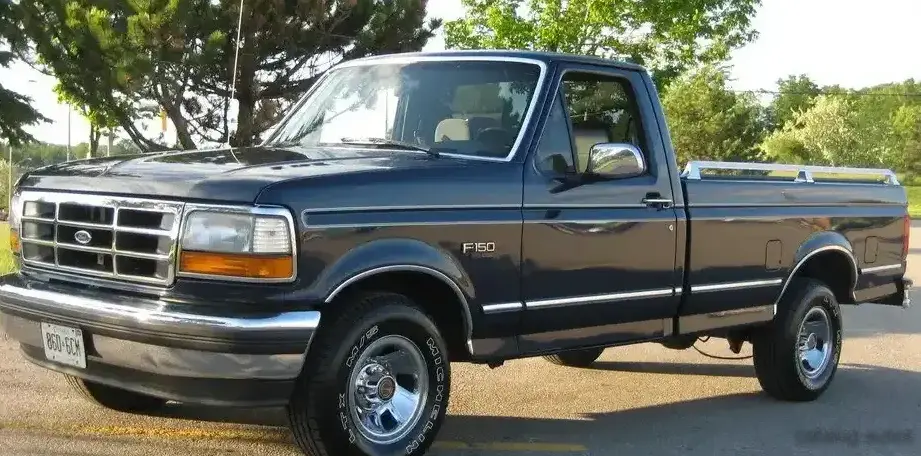
The Ford F-Series F-150 IX Regular Cab, equipped with the 5.8-liter V8 engine producing 210 horsepower, represents a significant iteration of Ford’s long-running and immensely popular pickup truck line. Produced from 1991 through 1997, this variant occupied a middle ground within the ninth generation (F-Series IX) of the F-150, offering a balance between capability and affordability. It served as a workhorse for a broad range of buyers, from farmers and ranchers to contractors and everyday users needing a robust vehicle for hauling and towing. This configuration, while not the top-performing trim, provided a dependable and relatively accessible entry point into the world of full-size Ford pickups.
Technical Specifications
| Brand | Ford |
| Model | F-Series F-100/F-150 |
| Generation | F-Series F-150 IX Regular Cab |
| Type (Engine) | 5.8 V8 (210 Hp) |
| Start of production | August, 1991 |
| End of production | 1997 |
| Powertrain Architecture | Internal Combustion engine |
| Body type | Pick-up |
| Seats | 3 |
| Doors | 2 |
| Fuel Type | Petrol (Gasoline) |
| Power | 210 Hp |
| Power per litre | 36.2 Hp/l |
| Torque | 427 Nm / 314.94 lb.-ft. |
| Engine layout | Front, Longitudinal |
| Engine displacement | 5800 cm3 / 353.94 cu. in. |
| Number of cylinders | 8 |
| Engine configuration | V-engine |
| Number of valves per cylinder | 2 |
| Fuel injection system | Multi-port manifold injection |
| Engine aspiration | Naturally aspirated engine |
| Engine oil capacity | 4.7 l / 4.97 US qt | 4.14 UK qt |
| Coolant | 14.9 l / 15.74 US qt | 13.11 UK qt |
| Max. weight | 2835 kg / 6250.11 lbs. |
| Fuel tank capacity | 131-141 l / 34.61 – 37.25 US gal | 28.82 – 31.02 UK gal |
| Length | 5006-5418 mm / 197.09 – 213.31 in. |
| Width | 2007 mm / 79.02 in. |
| Height | 1798 mm / 70.79 in. |
| Wheelbase | 2972-3378 mm / 117.01 – 132.99 in. |
| Wading depth | 767 mm / 30.2 in. |
| Drivetrain Architecture | The Internal combustion engine (ICE) drives the rear wheels of the vehicle. |
| Drive wheel | Rear wheel drive |
| Number of gears and type of gearbox | 5 gears, manual transmission |
| Front suspension | Independent coil spring |
| Rear suspension | Leaf spring |
| Front brakes | Disc |
| Rear brakes | Drum |
| Power steering | Electric Steering |
| Tires size | 215/75 R15; 235/75 R15 |
| Wheel rims size | 15 |
Powertrain & Engine Architecture
The heart of this F-150 variant is the 5.8-liter (351 cubic inch) Windsor V8 engine. This engine, a staple of Ford trucks for decades, is a pushrod design featuring a cast iron block and cast iron cylinder heads. The 210 horsepower output was achieved through a multi-port fuel injection system, a significant upgrade from the carbureted engines of earlier F-Series models. The engine’s two valves per cylinder and relatively conservative compression ratio prioritized durability and low-end torque over outright horsepower. The 5.8L V8 was known for its robust construction and ability to withstand considerable abuse. The standard transmission for this model year was a 5-speed manual transmission, providing direct control over the engine’s power. While an automatic transmission was available, the manual was favored by those prioritizing fuel economy and a more connected driving experience.
Driving Characteristics
The 1991-1997 F-150 with the 5.8L V8 and 5-speed manual offered a distinctly truck-like driving experience. Acceleration was adequate, but not particularly brisk, with 0-60 mph times estimated around 9-10 seconds. The engine’s strength lay in its mid-range torque, making it well-suited for hauling loads and navigating challenging terrain. The manual transmission allowed drivers to keep the engine in its optimal power band, providing good control when towing or climbing hills. Compared to the smaller 4.9L inline-six engine, the 5.8L offered significantly more power and capability. However, it lacked the refinement and higher output of the optional 5.0L V8. The leaf spring rear suspension provided a firm ride, especially when unladen, but contributed to the truck’s impressive load-carrying capacity.
Equipment & Trim Levels
The F-150 IX Regular Cab with the 5.8L V8 typically came with a fairly basic level of equipment. Standard features included a vinyl bench seat, AM/FM radio, and manual windows and locks. Air conditioning and a more comfortable cloth bench seat were common options. Higher trim levels, such as the XL and XLT, added features like power windows and locks, upgraded interior trim, and chrome exterior accents. The Regular Cab configuration offered a simple, no-frills interior focused on functionality and durability. The dashboard layout was straightforward, with clearly labeled controls and a large instrument cluster.
Chassis & Braking
The F-150 IX utilized a body-on-frame construction, providing a solid and durable platform. The front suspension featured independent coil springs, while the rear suspension employed leaf springs. This setup prioritized load-carrying capacity and durability over ride comfort. Braking duties were handled by disc brakes in the front and drum brakes in the rear. Power steering was standard, making the truck relatively easy to maneuver despite its size. Tire sizes typically ranged from 215/75R15 to 235/75R15, providing a good balance between on-road comfort and off-road traction.
Market Reception & Comparison
The 1991-1997 F-150 with the 5.8L V8 was generally well-received by buyers seeking a capable and affordable full-size pickup. Critics praised its durability and strong torque output, but noted its relatively modest horsepower and somewhat rough ride. Compared to the smaller 4.9L inline-six, the 5.8L offered a significant performance upgrade, but at the cost of slightly lower fuel economy. The 5.0L V8 offered a compromise between the two, providing more power than the 5.8L while maintaining reasonable fuel efficiency. The 5.8L V8 was often chosen by those who prioritized towing capacity and long-term reliability over outright speed.
Legacy
The 5.8L Windsor V8-powered F-150 has proven to be a remarkably durable and long-lasting vehicle. Many examples are still on the road today, a testament to the engine’s robust construction and Ford’s reputation for building tough trucks. While fuel economy is not a strong point, the 5.8L V8 is relatively easy to maintain and repair, making it a popular choice among enthusiasts and those seeking a dependable work truck. In the used car market, these F-150s are often valued for their simplicity, affordability, and classic American truck aesthetic. They represent a bygone era of full-size pickups, characterized by ruggedness, durability, and a focus on practical functionality.