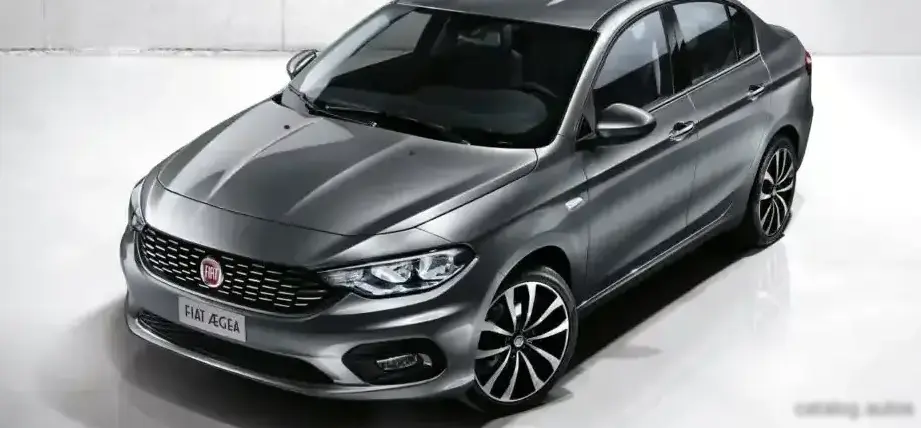
The Fiat Egea Station Wagon, specifically the 1.3 Multijet II variant producing 95 horsepower, represents an entry-level offering within the Egea (also known as the Tipo in some markets) lineup following its facelift in 2020. Introduced as a practical and fuel-efficient option, this model aimed to provide a balance between affordability, space, and reasonable performance for families and individuals seeking a versatile vehicle. The Egea, positioned as a mainstream compact, was designed to compete with established rivals like the Volkswagen Golf, Ford Focus, and Peugeot 308, though often at a more competitive price point. This particular station wagon body style, the ‘Egea Station Wagon’ (project code 358), was primarily targeted at the European market, where demand for practical estate cars remained strong.
Technical Specifications
| Brand | Fiat |
| Model | Egea |
| Generation | Egea Station Wagon (358, facelift 2020) |
| Type (Engine) | 1.3 Multijet II (95 Hp) |
| Start of production | 2020 |
| Powertrain Architecture | Internal Combustion engine |
| Body type | Station wagon (estate) |
| Seats | 5 |
| Doors | 5 |
| Combined fuel consumption (WLTP) | 4.3-4.5 l/100 km (54.7 – 52.3 US mpg, 65.7 – 62.8 UK mpg, 23.3 – 22.2 km/l) |
| CO2 emissions (WLTP) | 114-119 g/km |
| Fuel Type | Diesel |
| Acceleration 0 – 100 km/h | 13.5 sec |
| Acceleration 0 – 62 mph | 13.5 sec |
| Acceleration 0 – 60 mph | 12.8 sec |
| Maximum speed | 180 km/h (111.85 mph) |
| Emission standard | Euro 6d-FINAL |
| Weight-to-power ratio | 13.8 kg/Hp, 72.5 Hp/tonne |
| Weight-to-torque ratio | 6.6 kg/Nm, 152.7 Nm/tonne |
| Power | 95 Hp @ 3750 rpm |
| Power per litre | 76.1 Hp/l |
| Torque | 200 Nm @ 1500 rpm (147.51 lb.-ft. @ 1500 rpm) |
| Engine layout | Front, Transverse |
| Engine Model/Code | 46345266 |
| Engine displacement | 1248 cm3 (76.16 cu. in.) |
| Number of cylinders | 4 |
| Engine configuration | Inline |
| Cylinder Bore | 69.6 mm (2.74 in.) |
| Piston Stroke | 82 mm (3.23 in.) |
| Compression ratio | 16.8:1 |
| Number of valves per cylinder | 4 |
| Fuel injection system | Diesel Commonrail |
| Engine aspiration | Turbocharger, Intercooler |
| Valvetrain | DOHC |
| Engine oil capacity | 3.9 l (4.12 US qt | 3.43 UK qt) |
| Coolant | 6.1 l (6.45 US qt | 5.37 UK qt) |
| Kerb Weight | 1310 kg (2888.06 lbs.) |
| Max. weight | 1860 kg (4100.6 lbs.) |
| Max load | 550 kg (1212.54 lbs.) |
| Trunk (boot) space – minimum | 550 l (19.42 cu. ft.) |
| Fuel tank capacity | 50 l (13.21 US gal | 11 UK gal) |
| Max. roof load | 75 kg (165.35 lbs.) |
| Permitted trailer load with brakes (12%) | 1500 kg (3306.93 lbs.) |
| Permitted trailer load without brakes | 500 kg (1102.31 lbs.) |
| Permitted towbar download | 60 kg (132.28 lbs.) |
| Length | 4571 mm (179.96 in.) |
| Width | 1792 mm (70.55 in.) |
| Width including mirrors | 2002 mm (78.82 in.) |
| Height | 1514 mm (59.61 in.) |
| Wheelbase | 2638 mm (103.86 in.) |
| Front track | 1542 mm (60.71 in.) |
| Rear (Back) track | 1543 mm (60.75 in.) |
| Front overhang | 893 mm (35.16 in.) |
| Rear overhang | 1040 mm (40.94 in.) |
| Minimum turning circle (turning diameter) | 10.9 m (35.76 ft.) |
| Drivetrain Architecture | The Internal combustion engine (ICE) drives the front wheels of the vehicle. |
| Drive wheel | Front wheel drive |
| Number of gears and type of gearbox | 5 gears, manual transmission |
| Front suspension | Independent type McPherson |
| Rear suspension | Torsion |
| Front brakes | Disc |
| Rear brakes | Disc |
| Assisting systems | ABS (Anti-lock braking system) |
| Steering type | Steering rack and pinion |
| Power steering | Electric Steering |
| Tires size | 205/55 R16; 225/45 R17; 225/40 R18 |
| Wheel rims size | 6.5J x 16; 7J x 17; 7.5J x 18 |
Powertrain & Engine Architecture
The heart of this Egea Station Wagon is the 1.3 Multijet II diesel engine, a member of Fiat’s widely-used family of small-displacement diesel engines. This engine, identified by code 46345266, is a four-cylinder, inline configuration, boasting a displacement of 1248cc. It features a turbocharger with an intercooler to enhance power output and efficiency. The engine utilizes a common rail direct injection system, delivering fuel directly into the combustion chamber at extremely high pressure for optimized combustion. The DOHC (Double Overhead Camshaft) valvetrain, with four valves per cylinder, further contributes to the engine’s breathing efficiency. A key feature of the Multijet II technology is its ability to perform multiple fuel injections per combustion cycle, improving refinement and reducing noise. This variant was typically paired with a 5-speed manual transmission, sending power to the front wheels.
Driving Characteristics
The 95 horsepower and 200 Nm (147.51 lb-ft) of torque produced by the 1.3 Multijet II engine in the Egea Station Wagon translate to adequate, but not exhilarating, performance. Acceleration from 0-100 km/h (0-62 mph) takes around 13.5 seconds, and top speed is limited to 180 km/h (111.85 mph). The engine’s torque peak at 1500 rpm provides reasonable pulling power for everyday driving and carrying loads, but it can feel strained when fully loaded or tackling steep inclines. Compared to higher-output versions of the Egea, such as those with the 1.6-liter petrol engine, this diesel variant prioritizes fuel economy over outright speed. The 5-speed manual transmission offers a fairly conventional gear ratio spread, geared towards maximizing fuel efficiency rather than sporty driving.
Equipment & Trim Levels
The 1.3 Multijet II 95 hp variant of the Egea Station Wagon typically occupied the entry-level or mid-range position within the lineup. Standard equipment generally included air conditioning, power steering, electric front windows, a basic audio system with USB connectivity, and ABS brakes. Safety features like ESP (Electronic Stability Program) were also commonly included. Higher trim levels offered upgrades such as alloy wheels, a touchscreen infotainment system with navigation, rear parking sensors, cruise control, and automatic climate control. Interior upholstery was typically cloth, with options for upgraded materials on higher trims.
Chassis & Braking
The Egea Station Wagon utilizes a McPherson strut independent suspension setup at the front, providing a comfortable ride quality. The rear suspension employs a torsion beam setup, which is a cost-effective solution for compact cars. Braking duties are handled by disc brakes on all four wheels, providing adequate stopping power for the vehicle’s weight. ABS (Anti-lock Braking System) is standard, enhancing safety during emergency braking situations. The steering system is a rack and pinion type with electric power assistance, offering a light and easy steering feel.
Market Reception & Comparison
The Fiat Egea Station Wagon 1.3 Multijet II was generally well-received for its practicality, fuel efficiency, and competitive pricing. Critics praised its spacious interior and large cargo area, making it a suitable choice for families. However, some reviewers noted that the engine could feel underpowered, particularly when fully loaded. Compared to other diesel-powered station wagons in its class, the Egea offered a compelling value proposition, often undercutting rivals in terms of price. Fuel economy was a strong point, with combined consumption figures ranging from 4.3 to 4.5 l/100 km (54.7 – 52.3 US mpg).
Legacy
The 1.3 Multijet II engine has proven to be a relatively reliable powertrain, although, like all diesel engines, it requires regular maintenance, including oil changes and filter replacements. The Egea Station Wagon, in general, has established a reputation as a dependable and affordable vehicle in the used car market. While not known for its performance, this variant remains a popular choice for buyers seeking a practical and economical estate car. Common issues reported with this engine include potential problems with the diesel particulate filter (DPF) if the vehicle is primarily used for short journeys, and occasional issues with the turbocharger. However, with proper maintenance, these engines can provide many years of reliable service.