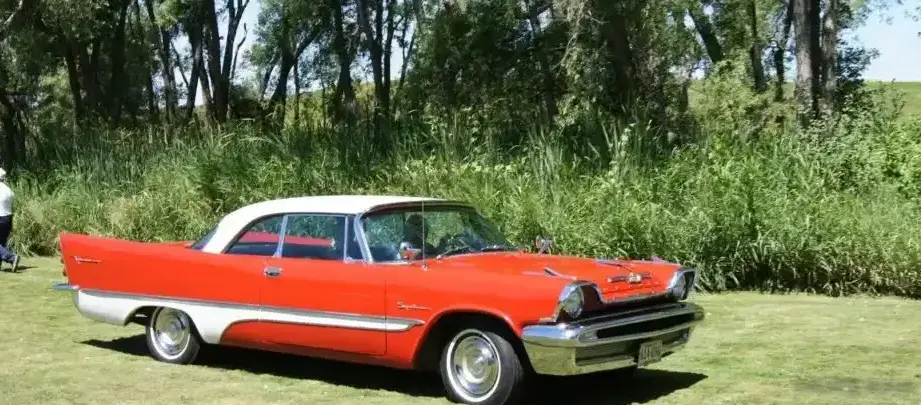
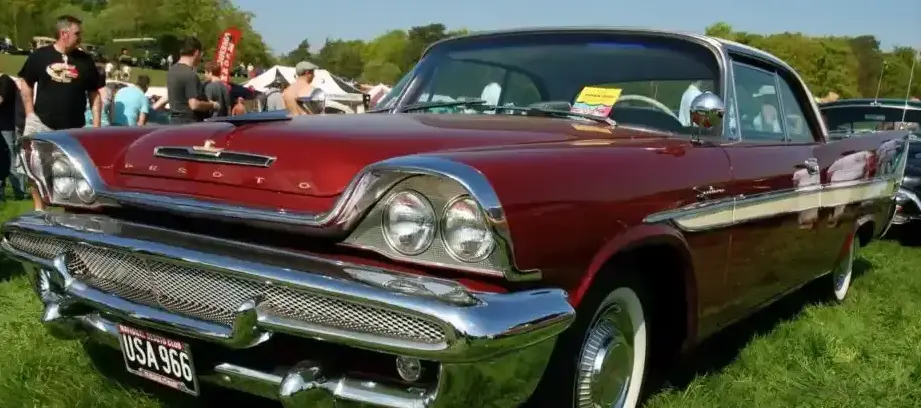
The DeSoto Firesweep I 4-Door Sportsman, as presented in its 1959 facelift, represented a significant offering from the Chrysler Corporation’s mid-range brand. Produced for the 1958 and 1959 model years, the Firesweep occupied a space between the entry-level DeSoto Diplomat and the more luxurious DeSoto Adventurer. This particular variant, equipped with the 5.9-liter (361 cubic inch) V8 engine producing 295 horsepower and paired with the PowerFlite two-speed automatic transmission, was positioned as a comfortable and capable family sedan, offering a blend of performance and convenience. The Firesweep aimed to appeal to buyers seeking a stylish and well-equipped vehicle without the higher price tag of the premium DeSoto models.
Technical Specifications
| Brand | DeSoto |
| Model | Firesweep |
| Generation | Firesweep I 4-Door Sportsman (facelift 1959) |
| Type (Engine) | 5.9 V8 (295 Hp) PowerFlite |
| Start of production | 1958 |
| End of production | 1959 |
| Powertrain Architecture | Internal Combustion engine |
| Body type | Sedan |
| Seats | 6 |
| Doors | 4 |
| Fuel Type | Petrol (Gasoline) |
| Power | 295 Hp @ 4600 rpm |
| Power per litre | 49.9 Hp/l |
| Torque | 529 Nm @ 2400 rpm / 390.17 lb.-ft. @ 2400 rpm |
| Engine displacement | 5916 cm3 / 361.02 cu. in. |
| Number of cylinders | 8 |
| Engine configuration | V-engine |
| Cylinder Bore | 104.65 mm / 4.12 in. |
| Piston Stroke | 85.85 mm / 3.38 in. |
| Compression ratio | 10:1 |
| Number of valves per cylinder | 2 |
| Fuel injection system | Carburettor |
| Engine aspiration | Naturally aspirated engine |
| Valvetrain | OHV |
| Engine oil capacity | 4.7 l / 4.97 US qt | 4.14 UK qt |
| Coolant | 16.1 l / 17.01 US qt | 14.17 UK qt |
| Fuel tank capacity | 76 l / 20.08 US gal | 16.72 UK gal |
| Length | 5514 mm / 217.09 in. |
| Width | 1999 mm / 78.7 in. |
| Height | 1394 mm / 54.88 in. |
| Wheelbase | 3099 mm / 122.01 in. |
| Front track | 1547 mm / 60.91 in. |
| Rear track | 1516 mm / 59.69 in. |
| Ride height (ground clearance) | 140 mm / 5.51 in. |
| Minimum turning circle | 14.2 m / 46.59 ft. |
| Approach angle | 15° |
| Departure angle | 10° |
| Ramp-over angle | 10.4° |
| Drivetrain Architecture | Rear wheel drive. Internal Combustion engine (ICE) |
| Drive wheel | Rear wheel drive |
| Number of gears and type of gearbox | 2 gears, automatic transmission PowerFlite |
| Front suspension | Independent torsion bar, double wishbone |
| Rear suspension | Leaf spring |
| Front brakes | Drum, 279 mm |
| Rear brakes | Drum, 279 mm |
| Steering type | Worm-reduction unit |
Powertrain & Engine Architecture
The heart of the 1959 Firesweep Sportsman was the DeSoto 361 cubic inch (5.9-liter) V8 engine. This engine, part of Chrysler’s “A” engine family, featured a cast iron block and cylinder heads, with a 10:1 compression ratio. It utilized a single Carter carburetor for fuel delivery and employed an overhead valve (OHV) valvetrain. The engine’s design prioritized low-end torque, making it well-suited for the typical driving conditions of the late 1950s. The PowerFlite automatic transmission was a two-speed unit, known for its smoothness but lacking the efficiency and versatility of more modern automatics. It was a typical transmission for the era, prioritizing comfort over performance. The PowerFlite’s relatively simple design contributed to its reliability, but it did limit the engine’s potential for acceleration and highway cruising.
Driving Characteristics
The combination of the 295 horsepower V8 and the PowerFlite automatic transmission resulted in a driving experience focused on comfortable cruising rather than outright performance. Acceleration was adequate for the time, but the two-speed transmission meant that the engine often operated at higher RPMs during highway driving. The Firesweep wasn’t designed to be a sporty car; instead, it offered a smooth and relaxed ride, thanks to its torsion bar front suspension and leaf spring rear suspension. Compared to the more powerful DeSoto Adventurer, the Firesweep felt less responsive, but it provided a more economical and practical option for families.
Equipment & Trim Levels
The Firesweep I 4-Door Sportsman came standard with a respectable array of features for 1959. Interior appointments included cloth and vinyl upholstery, a full-width bench seat, and a basic instrument panel. Power steering and power brakes were often included, enhancing the driving experience. Optional extras included air conditioning, a radio, and whitewall tires. The exterior styling featured generous chrome trim, a prominent grille, and distinctive tailfins, characteristic of the era’s automotive design trends. The Sportsman trim level generally offered a slightly more upscale interior compared to the base Firesweep models.
Chassis & Braking
The Firesweep’s chassis featured an independent torsion bar suspension in the front, providing a relatively comfortable ride. The rear suspension utilized leaf springs, a common design for American cars of the period. Braking was accomplished via drum brakes on all four wheels. While adequate for the time, the drum brakes lacked the stopping power and fade resistance of disc brakes. The steering system employed a worm-reduction unit, which provided a relatively indirect steering feel.
Market Reception & Comparison
The 1959 DeSoto Firesweep received mixed reviews from automotive critics. While praised for its styling and comfortable ride, it was often criticized for its lack of performance compared to competitors like the Ford Fairlane and Chevrolet Impala. The PowerFlite transmission was also a point of contention, with some reviewers noting its limited gear range. Fuel economy was typical for a large American car of the era, and reliability was generally considered good. Compared to other DeSoto models, the Firesweep offered a more affordable entry point into the brand, appealing to buyers who prioritized value and practicality.
Legacy
The DeSoto Firesweep, and the DeSoto brand as a whole, had a relatively short lifespan. Production ceased in 1961 due to declining sales and internal competition within the Chrysler Corporation. Today, the 1959 Firesweep is a sought-after classic car, particularly among enthusiasts of 1950s American automobiles. The 361 cubic inch V8 engine is known for its durability and relative simplicity, making it a relatively easy engine to maintain and rebuild. While not a high-performance machine by modern standards, the Firesweep represents a significant piece of automotive history, embodying the style and optimism of the late 1950s. Finding well-preserved examples can be challenging, but the Firesweep remains a charming and collectible piece of Americana.