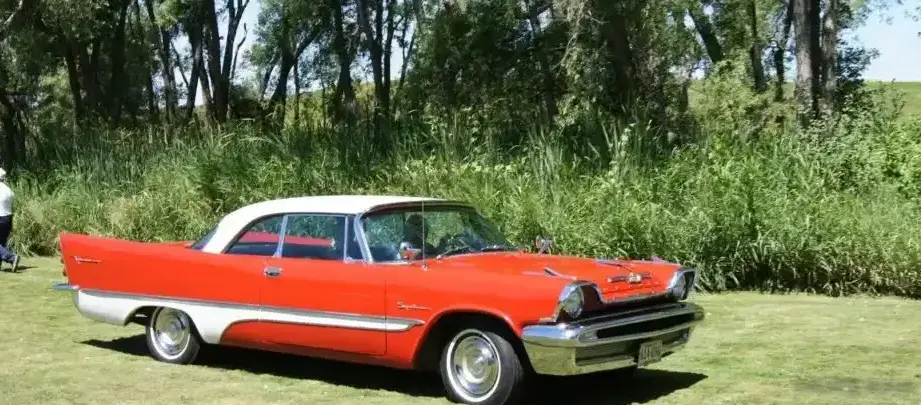
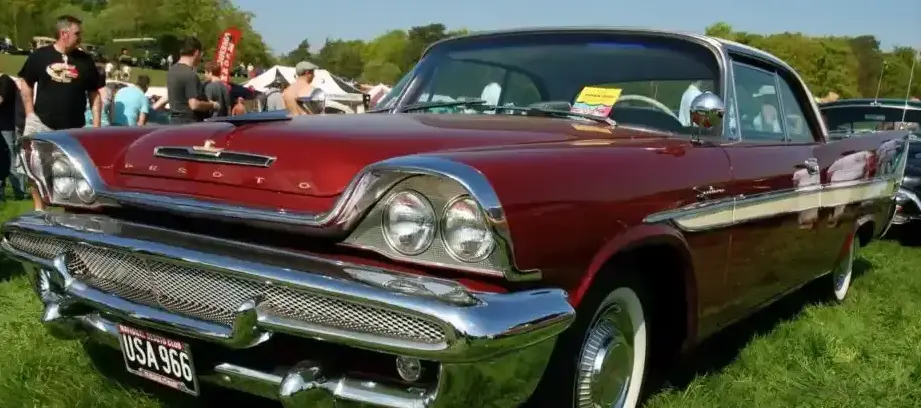
The DeSoto Firesweep I 4-Door Sportsman, as presented in its 1959 facelift, represented a significant offering from the Chrysler Corporation’s mid-range brand. Produced for the 1958 and 1959 model years, the Firesweep occupied a space between the more affordable Dodge and the luxury-oriented Chrysler models. This particular variant, equipped with the 5.9-liter (361 cubic inch) V8 engine producing 295 horsepower and paired with a TorqueFlite automatic transmission, was positioned as a comfortable and powerful family sedan, aimed at buyers seeking a blend of style, performance, and convenience. The Firesweep nameplate itself was new for 1958, replacing the DeSoto Fireflite, and was intended to evoke a sense of modern design and spirited driving.
Technical Specifications
| Brand | DeSoto |
| Model | Firesweep |
| Generation | Firesweep I 4-Door Sportsman (facelift 1959) |
| Type (Engine) | 5.9 V8 (295 Hp) TorqueFlite |
| Start of production | 1958 |
| End of production | 1959 |
| Powertrain Architecture | Internal Combustion engine |
| Body type | Sedan |
| Seats | 6 |
| Doors | 4 |
| Fuel Type | Petrol (Gasoline) |
| Power | 295 Hp @ 4600 rpm |
| Power per litre | 49.9 Hp/l |
| Torque | 529 Nm @ 2400 rpm / 390.17 lb.-ft. @ 2400 rpm |
| Engine displacement | 5916 cm3 / 361.02 cu. in. |
| Number of cylinders | 8 |
| Engine configuration | V-engine |
| Cylinder Bore | 104.65 mm / 4.12 in. |
| Piston Stroke | 85.85 mm / 3.38 in. |
| Compression ratio | 10:1 |
| Number of valves per cylinder | 2 |
| Fuel injection system | Carburettor |
| Engine aspiration | Naturally aspirated engine |
| Valvetrain | OHV |
| Engine oil capacity | 4.7 l / 4.97 US qt | 4.14 UK qt |
| Coolant | 16.1 l / 17.01 US qt | 14.17 UK qt |
| Fuel tank capacity | 76 l / 20.08 US gal | 16.72 UK gal |
| Length | 5514 mm / 217.09 in. |
| Width | 1999 mm / 78.7 in. |
| Height | 1394 mm / 54.88 in. |
| Wheelbase | 3099 mm / 122.01 in. |
| Front track | 1547 mm / 60.91 in. |
| Rear (Back) track | 1516 mm / 59.69 in. |
| Ride height (ground clearance) | 140 mm / 5.51 in. |
| Minimum turning circle (turning diameter) | 14.2 m / 46.59 ft. |
| Approach angle | 15° |
| Departure angle | 10° |
| Ramp-over (brakeover) angle | 10.4° |
| Drivetrain Architecture | The Internal combustion engine (ICE) drives the rear wheels of the vehicle. |
| Drive wheel | Rear wheel drive |
| Number of gears and type of gearbox | 3 gears, automatic transmission TorqueFlite |
| Front suspension | Independent torsion bar, double wishbone |
| Rear suspension | Leaf spring |
| Front brakes | Drum, 279 mm |
| Rear brakes | Drum, 279 mm |
| Steering type | Worm-reduction unit |
Powertrain & Engine Architecture
The heart of this Firesweep variant was the DeSoto 361 cubic inch (5.9-liter) V8 engine. This engine, part of Chrysler’s “A” engine family, featured a cast iron block and cylinder heads, with a 10:1 compression ratio. It utilized a single Carter carburetor for fuel delivery and employed an overhead valve (OHV) valvetrain. The 295 horsepower output was respectable for the late 1950s, providing ample power for highway cruising and passing maneuvers. The TorqueFlite automatic transmission, a three-speed unit, was a key component of the car’s appeal, offering smooth and effortless shifting. This transmission was known for its durability and relative simplicity, making it a reliable partner for the V8 engine.
Driving Characteristics
The 1959 Firesweep with the 361 V8 and TorqueFlite transmission delivered a driving experience focused on comfort and relaxed power. While not a performance-oriented machine, the engine provided sufficient torque to accelerate briskly, especially considering the car’s substantial weight. The TorqueFlite transmission’s gear ratios were optimized for cruising, providing smooth transitions between speeds. Compared to the more powerful Chrysler models, or even a manual transmission equipped DeSoto, this variant felt less eager to rev, but offered a more forgiving and user-friendly driving experience. The rear-wheel drive configuration and leaf spring rear suspension contributed to a somewhat traditional ride quality, typical of American cars of the era.
Equipment & Trim Levels
The Firesweep 4-Door Sportsman was well-equipped for its time, offering a comfortable and stylish interior. Standard features typically included a spacious bench seat upholstered in durable cloth or vinyl, a full-width dashboard with a prominent instrument cluster, and ample chrome trim both inside and out. Power steering and power brakes were often included, enhancing the driving experience. Optional extras could include air conditioning, a radio, whitewall tires, and upgraded interior trim packages. The 1959 facelift brought revised styling cues, including a more prominent grille and redesigned taillights, adding to the car’s visual appeal.
Chassis & Braking
The Firesweep rode on a sturdy chassis featuring independent torsion bar suspension in the front and a leaf spring setup in the rear. This combination provided a reasonable balance between ride comfort and handling. Braking duties were handled by drum brakes on all four wheels, which were adequate for the car’s weight and performance capabilities, though they lacked the stopping power of more modern braking systems. The steering system utilized a worm-reduction unit, providing a relatively direct steering feel, though it required some effort at low speeds.
Market Reception & Comparison
The 1959 DeSoto Firesweep faced stiff competition from other mid-range American cars, including models from Ford, Chevrolet, and Plymouth. Critics generally praised the Firesweep’s styling and comfortable ride, but some noted that its performance was not as exhilarating as some of its rivals. The 361 V8 and TorqueFlite combination offered a good balance of power and convenience, but it wasn’t the most fuel-efficient option available. Compared to other DeSoto trims, such as those equipped with larger displacement engines, this variant represented a more affordable and practical choice for families.
Legacy
The DeSoto Firesweep, and the DeSoto brand as a whole, had a relatively short lifespan. Production ceased in 1961 due to declining sales and internal restructuring within Chrysler Corporation. However, the Firesweep remains a popular choice among classic car enthusiasts, particularly those seeking a stylish and well-maintained example of 1950s American automotive design. The 361 V8 engine and TorqueFlite transmission are known for their durability and relative ease of maintenance, making these cars relatively reliable for their age. Today, well-preserved Firesweeps command a respectable price in the used car market, appealing to collectors and those seeking a nostalgic driving experience.