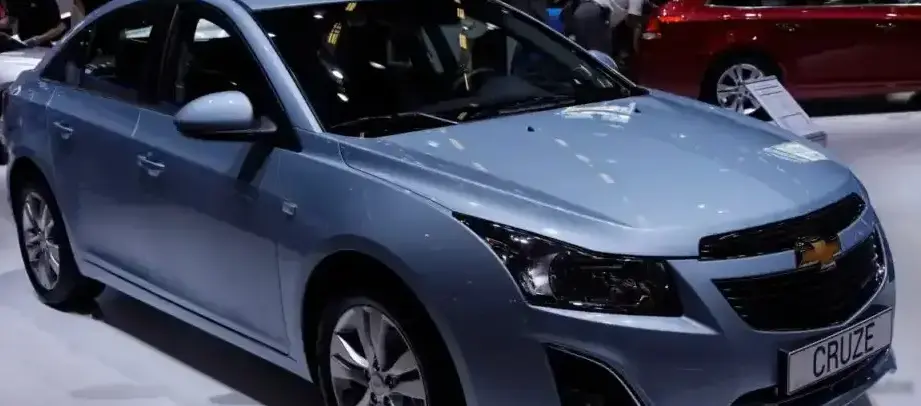
The Chevrolet Cruze Sedan (facelift, 2013) equipped with the 1.4-liter turbocharged engine producing 140 horsepower was a key variant in Chevrolet’s compact car lineup in North America. Introduced as part of a mid-cycle refresh for the first-generation Cruze, this model year represented a significant effort by Chevrolet to compete in a crowded segment dominated by the Honda Civic and Toyota Corolla. Production of this specific configuration ran from 2013 to 2016, aiming to provide a balance of fuel efficiency and acceptable performance for the average commuter. It occupied a mid-range position within the Cruze lineup, slotting between the base 1.8-liter naturally aspirated engine and the more powerful diesel options available in some markets.
Technical Specifications
| Brand | Chevrolet |
| Model | Cruze |
| Generation | Cruze Sedan (facelift 2013) |
| Type (Engine) | 1.4 Turbo (140 Hp) |
| Start of production | 2013 |
| End of production | 2016 |
| Powertrain Architecture | Internal Combustion engine |
| Body type | Sedan |
| Seats | 5 |
| Doors | 4 |
| Fuel consumption (urban) | 7.5 l/100 km (31.4 US mpg) |
| Fuel consumption (extra urban) | 4.7 l/100 km (50 US mpg) |
| Fuel consumption (combined) | 5.7 l/100 km (41.3 US mpg) |
| CO2 emissions | 132 g/km |
| Fuel Type | Petrol (Gasoline) |
| Acceleration 0 – 100 km/h | 9.3 sec |
| Acceleration 0 – 62 mph | 9.3 sec |
| Acceleration 0 – 60 mph | 8.8 sec |
| Maximum speed | 200 km/h (124.27 mph) |
| Emission standard | Euro 5 |
| Weight-to-power ratio | 9.5 kg/Hp |
| Weight-to-torque ratio | 6.7 kg/Nm |
| Power | 140 Hp @ 4900 rpm |
| Torque | 200 Nm @ 1850 rpm (147.51 lb.-ft. @ 1850 rpm) |
| Engine layout | Front, Transverse |
| Engine Model/Code | LUJ |
| Engine displacement | 1362 cm3 (83.11 cu. in.) |
| Number of cylinders | 4 |
| Engine configuration | Inline |
| Cylinder Bore | 72.5 mm (2.85 in.) |
| Piston Stroke | 82.6 mm (3.25 in.) |
| Compression ratio | 9.5:1 |
| Fuel injection system | Multi-port manifold injection |
| Engine aspiration | Turbocharger, Intercooler |
| Engine oil capacity | 4 l (4.23 US qt | 3.52 UK qt) |
| Coolant capacity | 6.2 l (6.55 US qt | 5.46 UK qt) |
| Kerb Weight | 1335 kg (2943.17 lbs.) |
| Max. weight | 1873 kg (4129.26 lbs.) |
| Max load | 538 kg (1186.09 lbs.) |
| Trunk (boot) space – minimum | 469 l (16.56 cu. ft.) |
| Fuel tank capacity | 60 l (15.85 US gal | 13.2 UK gal) |
| Length | 4603 mm (181.22 in.) |
| Width | 1797 mm (70.75 in.) |
| Height | 1477 mm (58.15 in.) |
| Wheelbase | 2685 mm (105.71 in.) |
| Front track | 1544 mm (60.79 in.) |
| Rear track | 1558 mm (61.34 in.) |
| Drivetrain Architecture | Front wheel drive |
| Number of gears | 6 gears, manual transmission |
| Front suspension | Independent, type McPherson with coil spring and anti-roll bar |
| Rear suspension | Torsion |
| Front brakes | Ventilated discs |
| Rear brakes | Disc |
| Assisting systems | ABS (Anti-lock braking system) |
| Steering type | Steering rack and pinion |
| Power steering | Electric Steering |
Powertrain & Engine Architecture
The heart of this Cruze variant is the LUJ engine, a 1.4-liter inline-four cylinder gasoline engine. This engine utilizes a single-scroll turbocharger with an intercooler to boost power and efficiency. The engine employs multi-port fuel injection and a timing chain for durability. The 9.5:1 compression ratio strikes a balance between performance and fuel economy. The engine’s output of 140 horsepower at 4900 rpm and 200 Nm (147.51 lb-ft) of torque at 1850 rpm was considered adequate for daily driving. The engine is transversely mounted, driving the front wheels. The six-speed manual transmission was the standard offering, providing drivers with direct control over gear selection. While an automatic transmission was available, it was often criticized for its sluggish shifts and impact on fuel economy.
Driving Characteristics
The 1.4-liter turbo engine in the Cruze offered a noticeable improvement in responsiveness compared to the base 1.8-liter engine. While not a performance car, the turbocharger provided a useful boost of power for merging onto highways and overtaking slower traffic. The 0-60 mph time of around 8.8 seconds was respectable for its class. The manual transmission allowed for a more engaging driving experience, but the relatively long throws and somewhat vague shift feel weren’t universally praised. The suspension was tuned for comfort, resulting in a relatively soft ride, but this came at the expense of sharp handling. Compared to the diesel variants, the 1.4T offered quicker acceleration but lacked the diesel’s superior fuel economy and low-end torque.
Equipment & Trim Levels
The 1.4 Turbo trim typically included standard features such as air conditioning, power windows and locks, a basic audio system with USB connectivity, and steel wheels with wheel covers. Higher trim levels, such as the 2LT, added features like alloy wheels, a more advanced infotainment system with a touchscreen display, a sunroof, and upgraded interior materials. Interior upholstery was typically cloth, with optional leather available on higher trims. Safety features included standard ABS, stability control, and a suite of airbags.
Chassis & Braking
The Cruze utilized a McPherson strut front suspension and a torsion beam rear suspension. This setup was a cost-effective solution that provided a reasonable level of ride comfort. The front brakes were ventilated discs, while the rear brakes were solid discs. ABS was standard, providing enhanced braking performance in emergency situations. The steering was electrically assisted, offering light and easy steering feel. The relatively lightweight construction of the Cruze helped to offset the modest power output of the 1.4-liter engine.
Market Reception & Comparison
The 2013-2016 Chevrolet Cruze 1.4 Turbo received mixed reviews. Critics generally praised its fuel economy and comfortable ride, but many found the engine to be somewhat underpowered and the handling less engaging than competitors like the Mazda3 and Ford Focus. The manual transmission was preferred by enthusiasts, while the automatic transmission was often criticized for its slow response and tendency to hunt for gears. Compared to the base 1.8-liter Cruze, the 1.4 Turbo offered a significant performance upgrade, but at a slightly higher price point. The diesel variants offered even better fuel economy but came with a higher initial cost and potential maintenance concerns.
Legacy
The Chevrolet Cruze, despite being discontinued in North America in 2019, remains a relatively common sight on used car lots. The 1.4-liter turbocharged engine, while not without its quirks, has proven to be reasonably reliable with proper maintenance. Common issues include oil consumption and potential turbocharger failures, but these are not widespread. The Cruze’s affordability and fuel efficiency continue to make it an attractive option for budget-conscious buyers. However, potential buyers should be aware of the potential for these issues and factor them into their purchasing decision. The Cruze’s impact lies in its attempt to offer a competitive and fuel-efficient compact car to the American market, paving the way for future Chevrolet models.