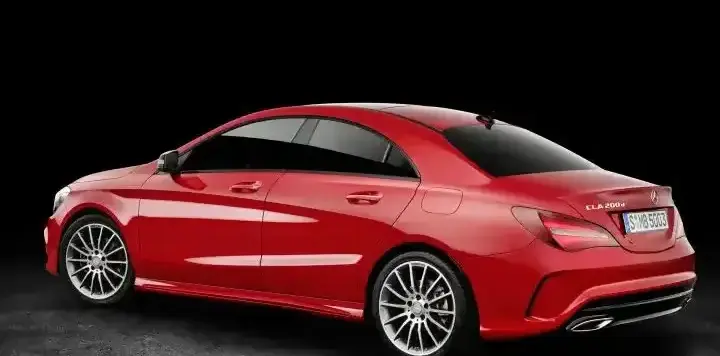
Technical Specifications
| Brand | Mercedes-Benz |
| Model | CLA |
| Generation | CLA Coupe (C117, facelift 2016) |
| Type (Engine) | CLA 180 (122 Hp) DCT |
| Start of production | April, 2016 |
| End of production | May, 2018 |
| Powertrain Architecture | Internal Combustion engine |
| Body type | Coupe |
| Seats | 5 |
| Doors | 4 |
| Fuel consumption (urban) | 7.2-6.9 l/100 km (32.7 – 34.1 US mpg) |
| Fuel consumption (extra urban) | 4.7-4.3 l/100 km (50 – 54.7 US mpg) |
| Fuel consumption (combined) | 5.6-5.2 l/100 km (42 – 45.2 US mpg) |
| CO2 emissions | 128-121 g/km |
| Fuel Type | Petrol (Gasoline) |
| Acceleration 0 – 100 km/h | 8.7 sec |
| Acceleration 0 – 62 mph | 8.7 sec |
| Acceleration 0 – 60 mph | 8.3 sec |
| Maximum speed | 210 km/h (130.49 mph) |
| Emission standard | Euro 6 |
| Weight-to-power ratio | 10.8 kg/Hp |
| Weight-to-torque ratio | 5.1 kg/Nm |
| Power | 122 Hp @ 5000 rpm |
| Torque | 260 Nm @ 1750-2500 rpm (191.77 lb.-ft.) |
| Engine layout | Front, Transverse |
| Engine Model/Code | M 270.910 |
| Engine displacement | 1595 cm3 (97.33 cu. in.) |
| Number of cylinders | 4 |
| Engine configuration | Inline |
| Compression ratio | 10.3:1 |
| Number of valves per cylinder | 4 |
| Fuel injection system | Direct injection |
| Engine aspiration | Turbocharger, Intercooler |
| Engine oil capacity | 5.8 l (6.13 US qt | 5.1 UK qt) |
| Coolant capacity | 7 l (7.4 US qt | 6.16 UK qt) |
| Kerb Weight | 1320 kg (2910.1 lbs.) |
| Max. weight | 1920 kg (4232.88 lbs.) |
| Max load | 600 kg (1322.77 lbs.) |
| Trunk (boot) space – minimum | 470 l (16.6 cu. ft.) |
| Fuel tank capacity | 50 l (13.21 US gal | 11 UK gal) |
| Max. roof load | 100 kg (220.46 lbs.) |
| Permitted trailer load with brakes (12%) | 1200 kg (2645.55 lbs.) |
| Permitted trailer load without brakes | 715 kg (1576.31 lbs.) |
| Length | 4640 mm (182.68 in.) |
| Width | 1777 mm (69.96 in.) |
| Width including mirrors | 2032 mm (80 in.) |
| Height | 1432 mm (56.38 in.) |
| Wheelbase | 2699 mm (106.26 in.) |
| Front track | 1549 mm (60.98 in.) |
| Rear track | 1547 mm (60.91 in.) |
| Drag coefficient (Cd) | 0.24 |
| Minimum turning circle | 11.00 m (36.09 ft.) |
| Drivetrain Architecture | Front wheel drive |
| Number of gears and type of gearbox | 7 gears, automatic transmission G-DCT |
| Front suspension | Double wishbone |
| Rear suspension | Trailing arm |
| Front brakes | Ventilated discs |
| Rear brakes | Disc |
| Assisting systems | ABS (Anti-lock braking system) |
| Steering type | Steering rack and pinion |
| Power steering | Electric Steering |
| Tires size | 205/55 R16 |
| Wheel rims size | 16 |
The Mercedes-Benz CLA 180, specifically the facelifted version produced from April 2016 to May 2018 (designated as the C117), served as the entry point into the CLA Coupe range. Designed to attract a younger demographic and those new to the Mercedes-Benz brand, it offered a stylish and relatively affordable option within the compact executive segment. This variant featured a 1.6-liter turbocharged four-cylinder engine coupled with a 7-speed dual-clutch transmission (DCT), striking a balance between fuel efficiency and acceptable performance. The CLA 180 played a significant role in expanding the appeal of the CLA, a novel body style for Mercedes-Benz – a four-door coupe – and broadened its reach in the competitive market.
Powertrain & Engine Architecture
The CLA 180 was powered by the M 270.910 engine, a 1.6-liter inline-four cylinder gasoline engine. This engine was part of Mercedes-Benz’s modular engine family, celebrated for its compact design and efficiency. It incorporated direct fuel injection and a single turbocharger with an intercooler, resulting in a favorable combination of power and fuel economy. The engine generated 122 horsepower at 5000 rpm and 260 Nm (191.77 lb-ft) of torque between 1750 and 2500 rpm. The 7G-DCT (7-speed dual-clutch transmission) was a crucial component, providing rapid and seamless gear changes. This transmission offered both fully automatic operation and manual gear selection through steering wheel-mounted paddles. The DCT contributed to the car’s relatively quick acceleration and enhanced fuel efficiency compared to a conventional automatic transmission.
Driving Characteristics
The CLA 180 Automatic delivered a comfortable and refined driving experience, prioritizing ease of use over outright performance. Acceleration from 0-60 mph took around 8.3 seconds, with a top speed limited to 130.49 mph. While not particularly sporty, the engine provided sufficient power for typical driving scenarios. The DCT transmission ensured responsive shifts, although it could occasionally exhibit slight hesitation at lower speeds. Compared to the more potent CLA 250 or AMG models, the 180 felt noticeably less energetic. However, it offered a more relaxed and fuel-efficient driving experience, making it well-suited for urban commuting and extended highway trips. The gear ratios were optimized for efficiency, with taller gearing in higher gears to minimize engine speed and fuel consumption.
Equipment & Trim Levels
The CLA 180 generally came standard with features such as air conditioning, a multi-function steering wheel, a basic infotainment system featuring a central display screen, and cloth upholstery. Safety features included ABS, ESP (Electronic Stability Program), and multiple airbags. Optional extras encompassed leather upholstery, a panoramic sunroof, upgraded infotainment systems with navigation, and various driver assistance systems like lane keeping assist and blind spot monitoring. The interior design was modern and stylish, aligning with the overall aesthetic of the CLA. Trim levels varied depending on the market, but typically offered packages that bundled together popular options.
Chassis & Braking
The CLA 180 employed a front-wheel-drive layout with a double wishbone front suspension and a trailing arm rear suspension. This suspension configuration provided a good compromise between comfort and handling. The braking system consisted of ventilated discs at the front and solid discs at the rear. ABS (Anti-lock Braking System) was standard equipment. The chassis was tuned for comfort, prioritizing ride quality over sharp handling characteristics. Stabilizer bars were fitted to both the front and rear axles to minimize body roll during cornering maneuvers.
Market Reception & Comparison
The CLA 180 was generally well-received as an accessible and stylish entry point into the Mercedes-Benz lineup. Critics lauded its fuel efficiency and comfortable ride, although some noted its relative lack of performance compared to higher-powered variants. When compared to competitors like the Audi A3 and BMW 1 Series, the CLA 180 offered a more distinctive and coupe-like design. Fuel economy was a significant strength, with combined figures ranging from 42 to 45.2 US mpg. Reliability was generally good, although some owners reported minor issues with the infotainment system. The CLA 180 presented a compelling value proposition for buyers seeking a premium compact car with a stylish design and a comfortable driving experience.
Legacy
The CLA 180 (C117) equipped with the 1.6-liter turbocharged engine and 7G-DCT transmission has demonstrated relatively good reliability in the used car market. While consistent maintenance is crucial, major mechanical failures are uncommon. The engine is known for its durability, and the DCT transmission, despite its complexity, has generally proven robust over time. Today, these vehicles offer an affordable way to experience the Mercedes-Benz brand, providing a blend of style, comfort, and fuel efficiency. However, prospective buyers should be mindful of potential wear and tear on components such as the turbocharger and the DCT’s mechatronic unit, and ensure a thorough inspection before making a purchase.