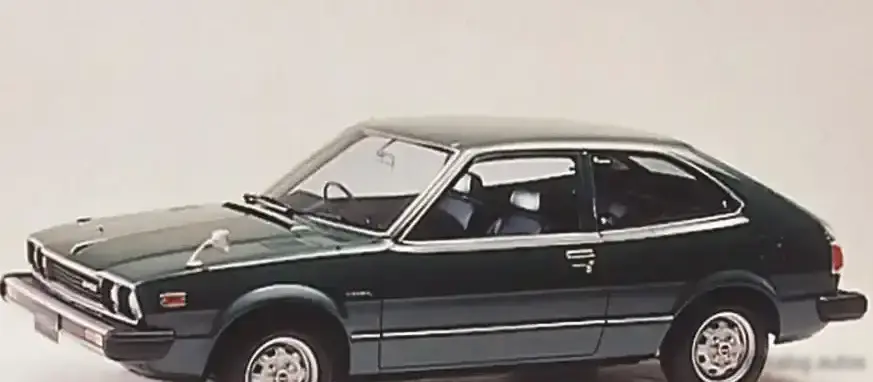
The Honda Accord V (CC7), specifically the facelifted version produced from 1996 to 1998, represented a significant evolution of Honda’s popular mid-size sedan. While the Accord was largely known for its gasoline engines, the 2.0 TDi variant, powered by a turbocharged diesel engine, was primarily aimed at the European market where diesel fuel was more prevalent and economically advantageous. This model sought to offer a blend of fuel efficiency and reasonable performance, appealing to drivers seeking lower running costs without sacrificing the Accord’s reputation for reliability. The CC7 facelift brought subtle styling updates and refinements to the already well-regarded fourth-generation Accord.
Technical Specifications
| Brand | Honda |
| Model | Accord |
| Generation | Accord V (CC7, facelift 1996) |
| Type (Engine) | 2.0 TDi (105 Hp) |
| Start of production | 1996 |
| End of production | 1998 |
| Powertrain Architecture | Internal Combustion engine |
| Body type | Sedan |
| Seats | 5 |
| Doors | 4 |
| Fuel consumption (urban) | 8.5 l/100 km (27.7 US mpg) |
| Fuel consumption (extra urban) | 4.5 l/100 km (52.3 US mpg) |
| Fuel consumption (combined) | 5.1 l/100 km (46.1 US mpg) |
| Fuel Type | Diesel |
| Acceleration 0 – 100 km/h | 11.6 sec |
| Acceleration 0 – 62 mph | 11.6 sec |
| Acceleration 0 – 60 mph | 11 sec |
| Maximum speed | 185 km/h (114.95 mph) |
| Weight-to-power ratio | 13.4 kg/Hp |
| Weight-to-torque ratio | 6.7 kg/Nm |
| Power | 105 Hp @ 4200 rpm |
| Torque | 210 Nm @ 2000 rpm (154.89 lb.-ft. @ 2000 rpm) |
| Engine layout | Front, Transverse |
| Engine Model/Code | L / 20T2N |
| Engine displacement | 1994 cm3 (121.68 cu. in.) |
| Number of cylinders | 4 |
| Engine configuration | Inline |
| Cylinder Bore | 84.5 mm (3.33 in.) |
| Piston Stroke | 88.9 mm (3.5 in.) |
| Compression ratio | 19.5:1 |
| Number of valves per cylinder | 2 |
| Fuel injection system | Precombustion chamber injection |
| Engine aspiration | Turbocharger, Intercooler |
| Valvetrain | OHC |
| Engine oil capacity | 5 l (5.28 US qt | 4.4 UK qt) |
| Coolant capacity | 9 l (9.51 US qt | 7.92 UK qt) |
| Kerb Weight | 1405 kg (3097.49 lbs.) |
| Max. weight | 1880 kg (4144.69 lbs.) |
| Max load | 475 kg (1047.2 lbs.) |
| Trunk (boot) space – minimum | 405 l (14.3 cu. ft.) |
| Fuel tank capacity | 65 l (17.17 US gal | 14.3 UK gal) |
| Length | 4685 mm (184.45 in.) |
| Width | 1720 mm (67.72 in.) |
| Height | 1380 mm (54.33 in.) |
| Wheelbase | 2720 mm (107.09 in.) |
| Front track | 1475 mm (58.07 in.) |
| Rear (Back) track | 1480 mm (58.27 in.) |
| Drivetrain Architecture | Front wheel drive |
| Number of gears and type of gearbox | 5 gears, manual transmission |
| Front suspension | Double wishbone |
| Rear suspension | Transverse stabilizer |
| Front brakes | Ventilated discs |
| Rear brakes | Disc |
| Assisting systems | ABS (Anti-lock braking system) |
| Steering type | Steering rack and pinion |
| Power steering | Hydraulic Steering |
| Tires size | 185/65 R15 |
| Wheel rims size | 15 |
Powertrain & Engine Architecture
The heart of the 1996-1998 Honda Accord 2.0 TDi was the L / 20T2N engine, a 1.994-liter inline-four cylinder diesel. This engine utilized a precombustion chamber injection system, a common technology for diesel engines of the era, designed to improve combustion efficiency and reduce noise. A turbocharger with an intercooler was employed to boost power output to 105 horsepower at 4200 rpm and 210 Nm (155 lb-ft) of torque at 2000 rpm. The engine featured a relatively high compression ratio of 19.5:1, typical for diesel engines. The single overhead camshaft (OHC) valvetrain operated two valves per cylinder. The engine was transversely mounted in the front of the vehicle, driving the front wheels. The 5-speed manual transmission was the only gearbox option available with this engine.
Driving Characteristics
The 2.0 TDi Accord offered a distinctly different driving experience compared to its gasoline-powered counterparts. While not a performance-oriented variant, the turbo-diesel engine provided adequate power for everyday driving. Acceleration to 60 mph took around 11 seconds, and the top speed was approximately 115 mph. The torque delivery was relatively flat, making it suitable for relaxed cruising and overtaking. The manual transmission allowed for driver control, but the gear ratios were optimized for fuel economy rather than outright acceleration. Compared to the more powerful 2.2L gasoline engine available in some markets, the 2.0 TDi felt noticeably slower, but it compensated with significantly better fuel economy.
Equipment & Trim Levels
The 2.0 TDi Accord typically came with a moderate level of equipment. Standard features generally included power steering, central locking, electric windows, and an AM/FM radio. Interior upholstery was typically cloth, and the dashboard featured a functional, if somewhat understated, design. Optional extras could include air conditioning, alloy wheels, and a sunroof. The trim level was generally positioned as a mid-range offering, bridging the gap between the base models and the more luxurious trims available with gasoline engines. The focus was on providing a practical and well-equipped vehicle at a competitive price point.
Chassis & Braking
The Accord V utilized a double wishbone suspension setup at the front and a transverse stabilizer at the rear, providing a comfortable and controlled ride. The front brakes were ventilated discs, offering good stopping power, while the rear brakes were solid discs. ABS (Anti-lock Braking System) was standard, enhancing safety. The chassis was designed to balance ride comfort with handling stability. The curb weight of 1405 kg (3097 lbs) was relatively moderate for a vehicle of its size, contributing to its manageable handling characteristics.
Market Reception & Comparison
The 2.0 TDi Accord was well-received in European markets where diesel engines were popular. Critics praised its fuel efficiency and reliability, but some noted its relatively modest performance compared to gasoline-powered rivals. Fuel economy figures of around 46 mpg (combined) were a major selling point. Compared to other diesel Accords, the 2.0 TDi offered a good balance between power and economy. It was often seen as a more sensible and practical choice than the higher-performance gasoline models, appealing to drivers who prioritized fuel costs and long-term reliability.
Legacy
The Honda Accord V 2.0 TDi, while not as widely recognized as its gasoline counterparts, has proven to be a durable and reliable vehicle. The 20T2N engine, when properly maintained, is known for its longevity. In the used car market, these Accords are often sought after by buyers looking for a fuel-efficient and dependable sedan. Parts availability is generally good, and the relatively simple mechanical design makes them relatively easy to maintain. The 2.0 TDi variant represents a unique chapter in the Accord’s history, demonstrating Honda’s willingness to adapt to different market demands and offer a diesel option to European customers.