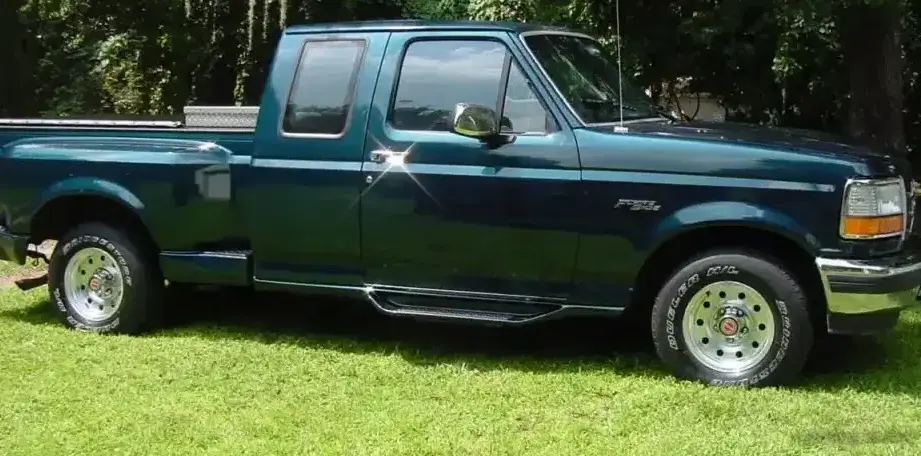
The Ford F-Series F-150 IX SuperCab, equipped with the 4.9-liter inline-six engine producing 150 horsepower, was a mainstay of the American pickup truck market from 1994 to 1997. This variant occupied a crucial position in the F-Series lineup, serving as the entry-level engine option for buyers prioritizing affordability and durability over outright performance. It represented a continuation of the long-running 4.9L engine, a workhorse known for its reliability, and was offered within the broader context of the ninth-generation F-Series (1992-1997), which introduced significant styling and comfort upgrades compared to previous generations. The SuperCab configuration offered extended passenger space, making it a popular choice for families and crews.
Technical Specifications
| Brand | Ford |
| Model | F-Series F-100/F-150 |
| Generation | F-Series F-150 IX SuperCab |
| Type (Engine) | 4.9 (150 Hp) |
| Start of production | 1994 |
| End of production | 1997 |
| Powertrain Architecture | Internal Combustion engine |
| Body type | Pick-up |
| Seats | 5-6 |
| Doors | 2 |
| Fuel Type | Petrol (Gasoline) |
| Power | 150 Hp |
| Power per litre | 30.6 Hp/l |
| Torque | 353 Nm / 260.36 lb.-ft. |
| Engine layout | Front, Longitudinal |
| Engine displacement | 4900 cm3 / 299.02 cu. in. |
| Number of cylinders | 6 |
| Engine configuration | Inline |
| Cylinder Bore | 101.6 mm / 4 in. |
| Piston Stroke | 101 mm / 3.98 in. |
| Number of valves per cylinder | 2 |
| Fuel injection system | Multi-port manifold injection |
| Engine aspiration | Naturally aspirated engine |
| Engine oil capacity | 4.7 l / 4.97 US qt | 4.14 UK qt |
| Coolant | 12 l / 12.68 US qt | 10.56 UK qt |
| Max. weight | 2835 kg / 6250.11 lbs. |
| Fuel tank capacity | 131-141 l / 34.61 – 37.25 US gal | 28.82 – 31.02 UK gal |
| Length | 5565-5977 mm / 219.09 – 235.31 in. |
| Width | 2007 mm / 79.02 in. |
| Height | 1821 mm / 71.69 in. |
| Wheelbase | 3531-3937 mm / 139.02 – 155 in. |
| Wading depth | 780 mm / 30.71 in. |
| Drivetrain Architecture | The Internal combustion engine (ICE) drives the rear wheels of the vehicle. |
| Drive wheel | Rear wheel drive |
| Number of gears and type of gearbox | 5 gears, manual transmission |
| Front suspension | Independent coil spring |
| Rear suspension | Leaf spring |
| Front brakes | Disc |
| Rear brakes | Drum |
| Power steering | Electric Steering |
| Tires size | 235/75 R15 |
| Wheel rims size | 15 |
Powertrain & Engine Architecture
The heart of this F-150 variant was the 4.9-liter (299 cubic inch) inline-six engine, often referred to as the “300 six” due to its earlier 4.9-liter predecessor. This engine, designated internally as the 4.9L Windsor, was a long-stroke design known for its robust bottom end and ample low-end torque. It featured a cast iron block and cylinder head, contributing to its durability. Fuel delivery was managed by a multi-port fuel injection system, a significant upgrade from the carburetor systems used in earlier iterations of the engine. The engine utilized a two-valve per cylinder configuration and a relatively simple valvetrain, prioritizing reliability over high-revving performance. The 150 horsepower output was achieved through a combination of modest compression ratio and carefully tuned fuel injection mapping. The standard transmission was a 5-speed manual, although a 4-speed automatic transmission was also available as an option. The automatic, while offering convenience, did slightly diminish the engine’s already modest acceleration.
Driving Characteristics
The 4.9L/manual transmission combination in the F-150 IX SuperCab delivered a utilitarian driving experience. Acceleration was adequate for everyday tasks, but it wasn’t designed for rapid speeds. The engine’s strength lay in its low-end torque, making it capable of hauling moderate loads and navigating rough terrain. The 5-speed manual transmission allowed drivers to keep the engine in its optimal power band, but the gear ratios were spaced to prioritize fuel economy and durability rather than sporty performance. Compared to the optional 5.0L V8 or the later 5.8L V8, the 4.9L felt significantly less powerful, especially when fully loaded. However, the V8s came at a price premium and often sacrificed fuel efficiency. The automatic transmission further reduced the perceived performance, resulting in slower acceleration and a less engaging driving experience.
Equipment & Trim Levels
The 4.9L-equipped F-150 SuperCab typically represented the base trim level. Standard features included a basic interior with vinyl upholstery, a simple dashboard layout, and manual windows and locks. Air conditioning was often an optional extra, as was an upgraded sound system. The SuperCab configuration added extended rear seating, providing more passenger space than the standard cab models. Options like power windows, power locks, and a tilt steering wheel were available, but they were typically bundled into higher trim packages. The exterior styling was relatively basic, with minimal chrome trim and standard steel wheels. Buyers could opt for features like a sliding rear window and a bedliner to enhance the truck’s functionality.
Chassis & Braking
The F-150 IX SuperCab utilized a body-on-frame construction, typical of pickup trucks of the era. The front suspension consisted of independent coil springs, providing a reasonably comfortable ride. The rear suspension employed leaf springs, which were well-suited for carrying heavy loads. Braking duties were handled by disc brakes at the front and drum brakes at the rear. Power steering was standard, making the truck easier to maneuver. The tires were typically 235/75R15 size, providing a good balance of on-road comfort and off-road capability. The chassis was designed to prioritize durability and load-carrying capacity over sporty handling.
Market Reception & Comparison
The 4.9L F-150 SuperCab was well-received by buyers who prioritized affordability and reliability. Critics acknowledged the engine’s durability and low-end torque, but often noted its lack of outright power compared to the V8 options. Fuel economy was considered reasonable for a full-size pickup truck. In terms of reliability, the 4.9L engine had a strong reputation, and maintenance costs were generally lower than those associated with the V8 engines. Compared to the 5.0L V8, the 4.9L offered a lower purchase price and better fuel economy, but at the expense of performance. Compared to the later 5.8L V8, the difference in power and towing capacity was even more significant.
Legacy
The 4.9L inline-six engine has achieved a legendary status among Ford truck enthusiasts. Its simplicity, durability, and readily available parts have made it a popular choice for restoration projects and engine swaps. While no longer in production, many 4.9L-powered F-150s remain on the road today, a testament to the engine’s longevity. In the used car market, these trucks are often sought after by buyers looking for a reliable and affordable work truck. The 4.9L/manual transmission combination is particularly valued by those who appreciate a simple and robust powertrain. The F-150 IX SuperCab 4.9L represents a significant chapter in the history of the Ford F-Series, embodying the values of practicality, durability, and affordability that have made it America’s best-selling pickup truck for decades.