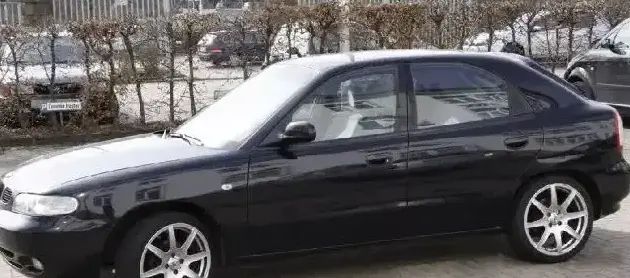
The Daewoo Nubira Hatchback, specifically the KLAJ generation produced between 2000 and 2001, represented Daewoo’s attempt to establish a foothold in the competitive compact car segment. This particular variant, powered by a 1.6-liter inline-four engine producing 110 horsepower and paired with a four-speed automatic transmission, was positioned as a practical and affordable option for buyers prioritizing ease of use over outright performance. The Nubira, in general, aimed to offer a compelling package of space, features, and value, particularly in European and emerging markets. It was a key model for Daewoo before the brand was absorbed by General Motors.
Technical Specifications
| Brand | Daewoo |
| Model | Nubira |
| Generation | Nubira Hatchback (KLAJ) |
| Type (Engine) | 1.6 i 16V (110 Hp) Automatic |
| Start of production | 2000 year |
| End of production | 2001 year |
| Powertrain Architecture | Internal Combustion engine |
| Body type | Hatchback |
| Seats | 5 |
| Doors | 4 |
| Fuel consumption (urban) | 9.1 l/100 km (25.8 US mpg, 31 UK mpg, 11 km/l) |
| Fuel consumption (extra urban) | 6 l/100 km (39.2 US mpg, 47.1 UK mpg, 16.7 km/l) |
| Fuel consumption (combined) | 8.1 l/100 km (29 US mpg, 34.9 UK mpg, 12.3 km/l) |
| Fuel Type | Petrol (Gasoline) |
| Acceleration 0 – 100 km/h | 14.3 sec |
| Acceleration 0 – 62 mph | 14.3 sec |
| Acceleration 0 – 60 mph | 13.6 sec |
| Maximum speed | 176 km/h (109.36 mph) |
| Weight-to-power ratio | 10.7 kg/Hp, 93.2 Hp/tonne |
| Weight-to-torque ratio | 7.9 kg/Nm, 127.1 Nm/tonne |
| Power | 110 Hp @ 5800 rpm |
| Power per litre | 68.8 Hp/l |
| Torque | 150 Nm @ 4000 rpm (110.63 lb.-ft. @ 4000 rpm) |
| Engine layout | Front, Transverse |
| Engine displacement | 1598 cm3 (97.52 cu. in.) |
| Number of cylinders | 4 |
| Engine configuration | Inline |
| Cylinder Bore | 79 mm (3.11 in.) |
| Piston Stroke | 81.5 mm (3.21 in.) |
| Compression ratio | 9.5:1 |
| Number of valves per cylinder | 4 |
| Fuel injection system | Multi-port manifold injection |
| Engine aspiration | Naturally aspirated engine |
| Valvetrain | DOHC |
| Kerb Weight | 1180 kg (2601.45 lbs.) |
| Max. weight | 1660 kg (3659.67 lbs.) |
| Max load | 480 kg (1058.22 lbs.) |
| Trunk (boot) space – minimum | 404 l (14.27 cu. ft.) |
| Fuel tank capacity | 60 l (15.85 US gal | 13.2 UK gal) |
| Length | 4500 mm (177.17 in.) |
| Width | 1725 mm (67.91 in.) |
| Height | 1445 mm (56.89 in.) |
| Wheelbase | 2600 mm (102.36 in.) |
| Front track | 1480 mm (58.27 in.) |
| Rear (Back) track | 1480 mm (58.27 in.) |
| Drivetrain Architecture | The Internal combustion engine (ICE) drives the front wheels of the vehicle. |
| Drive wheel | Front wheel drive |
| Number of gears and type of gearbox | 4 gears, automatic transmission |
| Front suspension | Spring Strut |
| Rear suspension | Double wishbone |
| Front brakes | Ventilated discs |
| Rear brakes | Disc |
| Assisting systems | ABS (Anti-lock braking system) |
| Steering type | Steering rack and pinion |
| Tires size | 195/55 R14 |
| Wheel rims size | 6Jx14 |
Powertrain & Engine Architecture
The heart of this Nubira variant is the Daewoo-developed 1.6-liter (1598cc) inline-four cylinder engine. This engine, often referred to by its internal code, typically falls under the A16DMS designation. It features a double overhead camshaft (DOHC) valvetrain with four valves per cylinder, contributing to improved breathing and efficiency. Fuel delivery is managed by a multi-point fuel injection system, a common setup for engines of this era. The engine produces 110 horsepower at 5800 rpm and 150 Nm (110.63 lb-ft) of torque at 4000 rpm. The four-speed automatic transmission, while providing convenience, was a relatively basic unit compared to more modern automatics. It prioritized smooth shifts over aggressive performance.
Driving Characteristics
The 1.6L automatic Nubira offered a comfortable, if not particularly exciting, driving experience. Acceleration from 0-60 mph took around 13.6 seconds, and top speed was approximately 109 mph. The automatic transmission’s gear ratios were tuned for fuel economy and smooth cruising rather than spirited acceleration. Compared to the manual transmission versions of the Nubira, or those equipped with the larger 1.8-liter engine, this variant felt noticeably slower. However, the automatic transmission made it a more accessible option for drivers who preferred the convenience of not having to shift gears, especially in urban environments. The power delivery was linear, but the engine lacked the punch of higher-output alternatives.
Equipment & Trim Levels
The 1.6L automatic Nubira typically came with a reasonable level of standard equipment. This generally included power steering, central locking, electric front windows, and an AM/FM radio. Air conditioning was often an optional extra, as were features like alloy wheels and a more advanced audio system. Interior upholstery was typically cloth, with a relatively simple dashboard layout. The trim level often dictated the quality of the cloth and the availability of additional features. This trim was generally considered the entry-level or mid-range option within the Nubira lineup.
Chassis & Braking
The Nubira Hatchback utilized a front-wheel-drive layout with a MacPherson strut suspension in the front and a double wishbone suspension in the rear. The front brakes were ventilated discs, providing adequate stopping power, while the rear brakes were solid discs. ABS (Anti-lock Braking System) was often included as standard equipment, enhancing safety. The suspension setup was tuned for comfort, providing a relatively smooth ride over uneven surfaces. Stabilizer bars were present, but were relatively modest in size, reflecting the car’s focus on practicality rather than sporty handling.
Market Reception & Comparison
The Daewoo Nubira, including the 1.6L automatic variant, received mixed reviews. Critics generally praised its spacious interior, competitive price, and decent level of equipment. However, the engine was often criticized for being underpowered, particularly when paired with the automatic transmission. Fuel economy was considered average for its class. Compared to rivals like the Honda Civic, Toyota Corolla, and Ford Focus, the Nubira offered a more affordable alternative, but lacked the brand recognition and refinement of those established players. The automatic transmission, while convenient, was often seen as detracting from the car’s overall performance.
Legacy
The Daewoo Nubira, and specifically this 1.6L automatic version, has become a relatively affordable and accessible used car. While not known for exceptional reliability, the engine and transmission are generally durable if properly maintained. Common issues include oil leaks and wear on suspension components. Parts availability can be a challenge, as Daewoo no longer exists as an independent brand, but many components are shared with other General Motors vehicles. Today, the Nubira represents a snapshot of a bygone era of automotive design and engineering, offering a simple and practical transportation solution for budget-conscious buyers.