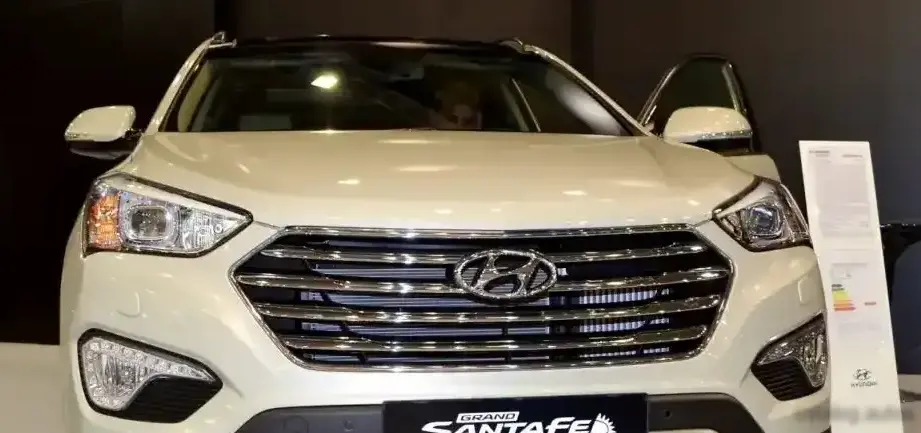
The Hyundai Grand Santa Fe (NC), produced from 2014 to 2016, represented a significant expansion of Hyundai’s SUV lineup. Positioned as a larger, three-row variant of the popular Santa Fe, the Grand Santa Fe aimed to cater to families requiring more space and seating capacity. This particular variant, the 2.2 CRDi with 200 horsepower, coupled with a four-wheel-drive system and a six-speed automatic transmission, was a key offering in many markets, particularly where diesel engines were favored for their fuel efficiency and torque. It occupied a mid-to-upper trim level within the Grand Santa Fe range, offering a balance of performance, features, and practicality.
Technical Specifications
| Brand | Hyundai |
| Model | Santa Fe |
| Generation | Grand Santa Fe (NC) |
| Type | 2.2 CRDi (200 Hp) 4WD Automatic 7 Seat |
| Start of production | 2014 |
| End of production | 2016 |
| Powertrain Architecture | Internal Combustion engine |
| Body type | SUV |
| Seats | 7 |
| Doors | 5 |
| Fuel consumption (urban) | 9.6 l/100 km (24.5 US mpg) |
| Fuel consumption (extra urban) | 6.5 l/100 km (36.2 US mpg) |
| Fuel consumption (combined) | 7.6 l/100 km (30.9 US mpg) |
| CO2 emissions | 199 g/km |
| Fuel Type | Diesel |
| Acceleration 0 – 100 km/h | 10.3 sec |
| Acceleration 0 – 62 mph | 10.3 sec |
| Acceleration 0 – 60 mph | 9.8 sec |
| Maximum speed | 200 km/h (124.27 mph) |
| Emission standard | Euro 6 |
| Weight-to-power ratio | 9.6 kg/Hp |
| Weight-to-torque ratio | 4.4 kg/Nm |
| Power | 200 Hp @ 3800 rpm |
| Torque | 440 Nm @ 1750-2750 rpm (324.53 lb.-ft.) |
| Engine layout | Front, Transverse |
| Engine Model/Code | R II / D4HB |
| Engine displacement | 2199 cm3 (134.19 cu. in.) |
| Number of cylinders | 4 |
| Engine configuration | Inline |
| Cylinder Bore | 85.4 mm (3.36 in.) |
| Piston Stroke | 96 mm (3.78 in.) |
| Number of valves per cylinder | 4 |
| Fuel injection system | Diesel Commonrail |
| Engine aspiration | Turbocharger, Intercooler |
| Engine oil capacity | 6.3 l (6.66 US qt | 5.54 UK qt) |
| Coolant capacity | 9.1 l (9.62 US qt | 8.01 UK qt) |
| Kerb Weight | 1916-2056 kg (4224.06 – 4532.7 lbs.) |
| Max. weight | 2630 kg (5798.16 lbs.) |
| Max load | 574-714 kg (1265.45 – 1574.1 lbs.) |
| Trunk (boot) space – minimum | 634 l (22.39 cu. ft.) |
| Trunk (boot) space – maximum | 1842 l (65.05 cu. ft.) |
| Fuel tank capacity | 71 l (18.76 US gal | 15.62 UK gal) |
| Max. roof load | 100 kg (220.46 lbs.) |
| Permitted trailer load with brakes (12%) | 2000 kg (4409.25 lbs.) |
| Permitted trailer load without brakes | 750 kg (1653.47 lbs.) |
| Permitted towbar download | 100 kg (220.46 lbs.) |
| Length | 4915 mm (193.5 in.) |
| Width | 1885 mm (74.21 in.) |
| Height | 1695 mm (66.73 in.) |
| Wheelbase | 2800 mm (110.24 in.) |
| Front track | 1628 mm (64.09 in.) |
| Rear track | 1639 mm (64.53 in.) |
| Front overhang | 965 mm (37.99 in.) |
| Rear overhang | 1150 mm (45.28 in.) |
| Ride height (ground clearance) | 180 mm (7.09 in.) |
| Drivetrain Architecture | All wheel drive (4×4) |
| Number of gears | 6 |
| Gearbox type | Automatic transmission |
| Front suspension | Independent, McPherson with coil spring and anti-roll bar |
| Rear suspension | Independent multi-link suspension |
| Front brakes | Ventilated discs |
| Rear brakes | Disc |
| Assisting systems | ABS (Anti-lock braking system) |
| Steering type | Steering rack and pinion |
| Power steering | Electric |
| Tires size | 235/60 R18; 235/55 R19 |
| Wheel rims size | 7.5J x 18; 7.5J x 19 |
INTRODUCTION
The Hyundai Grand Santa Fe (NC) was introduced in 2014 as a larger alternative to the standard Santa Fe, specifically designed to appeal to buyers needing seven-passenger capacity. Built on the same platform as the standard Santa Fe, but with a lengthened wheelbase and body, the Grand Santa Fe offered increased cargo space and third-row seating. The 2.2 CRDi variant, powered by Hyundai’s R II diesel engine, was a popular choice, particularly in markets outside of North America where diesel fuel was readily available and often more affordable. This engine, paired with a six-speed automatic transmission and a four-wheel-drive system, provided a blend of fuel efficiency, respectable performance, and all-weather capability.
Powertrain & Engine Architecture
The heart of this Grand Santa Fe variant is the R II 2.2-liter four-cylinder diesel engine, designated D4HB. This engine utilizes a common-rail direct injection system, delivering fuel directly into the cylinders at extremely high pressure for optimized combustion. A variable geometry turbocharger (VGT) and intercooler further enhance performance by increasing air intake and reducing intake air temperature. The engine produces 200 horsepower at 3800 rpm and a substantial 440 Nm (324.53 lb.-ft.) of torque between 1750 and 2750 rpm. This broad torque curve is a hallmark of diesel engines, providing strong pulling power at lower engine speeds. The six-speed automatic transmission, while not known for being particularly sporty, was chosen for its smoothness and ease of use, catering to the target audience of family-oriented buyers. The transmission features a torque converter and electronically controlled gear changes.
Driving Characteristics
The 2.2 CRDi automatic Grand Santa Fe offers a comfortable and capable driving experience. While not a performance-oriented vehicle, the engine’s torque output provides adequate acceleration for everyday driving and highway merging. The automatic transmission shifts smoothly, although it can sometimes feel hesitant during quick acceleration maneuvers. Compared to the standard Santa Fe with the same engine, the Grand Santa Fe feels slightly heavier due to its larger size and increased weight. A manual transmission option was available on some trims, offering a more engaging driving experience and slightly improved fuel economy, but the automatic was favored by many buyers for its convenience. The four-wheel-drive system provides enhanced traction in slippery conditions, making it a suitable vehicle for inclement weather or light off-road use.
Equipment & Trim Levels
The 2.2 CRDi automatic Grand Santa Fe typically came well-equipped, even in base trim levels. Standard features often included air conditioning, power windows and locks, a touchscreen infotainment system with Bluetooth connectivity, and a rearview camera. Higher trim levels added features such as leather upholstery, heated front seats, a panoramic sunroof, and advanced safety systems like lane departure warning and blind-spot monitoring. Interior materials were generally of good quality, offering a comfortable and refined cabin environment. Optional extras included a navigation system, premium sound system, and various cosmetic enhancements.
Chassis & Braking
The Grand Santa Fe utilizes an independent suspension setup at all four corners. The front suspension employs a McPherson strut design with coil springs and an anti-roll bar, while the rear features a multi-link suspension. This configuration provides a comfortable ride quality and decent handling characteristics. Braking duties are handled by ventilated discs at the front and solid discs at the rear. Anti-lock braking system (ABS) is standard, enhancing safety during emergency braking situations. The steering is electrically assisted, providing light and precise steering feel.
Market Reception & Comparison
The Hyundai Grand Santa Fe was generally well-received by automotive critics, who praised its spacious interior, comfortable ride, and value for money. The 2.2 CRDi engine was noted for its fuel efficiency and strong torque output. However, some critics found the automatic transmission to be somewhat sluggish and the handling less engaging than some of its competitors. Compared to other seven-passenger SUVs in its class, such as the Toyota Highlander and Honda Pilot, the Grand Santa Fe offered a more affordable price point and a longer warranty. Fuel economy was competitive with other diesel-powered SUVs, and reliability proved to be generally good.
Legacy
The Hyundai Grand Santa Fe (NC) represented a significant step forward for Hyundai in the SUV segment. It established Hyundai as a viable competitor in the three-row SUV market and helped to build the brand’s reputation for quality and value. The 2.2 CRDi engine, while not without its quirks, proved to be a reliable and durable powertrain. On the used car market, Grand Santa Fe models with this engine and transmission configuration are generally sought after for their practicality, fuel efficiency, and relatively low maintenance costs. However, potential buyers should be aware of the potential for diesel particulate filter (DPF) issues, particularly if the vehicle has been primarily used for short trips. Overall, the Grand Santa Fe 2.2 CRDi remains a compelling option for families seeking a spacious, comfortable, and affordable SUV.