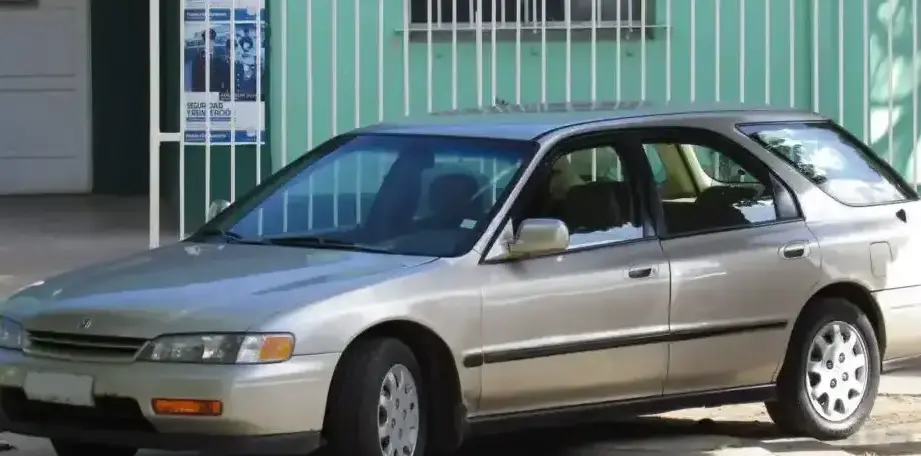
The Honda Accord V Wagon, produced between 1993 and 1998, represented Honda’s entry into the European station wagon market with a vehicle designed for practicality and family use. Specifically, the 2.0i LS 16V (CE2) variant, equipped with a 2.0-liter inline-four engine producing 136 horsepower, occupied a mid-range position within the V Wagon lineup. It offered a balance between performance and fuel efficiency, appealing to buyers seeking a versatile vehicle for both daily commuting and longer journeys. This generation, internally designated CE, was based on the Accord’s fifth generation, sharing its core platform and mechanical components but distinguished by its extended roofline and increased cargo capacity.
Technical Specifications
| Brand | Honda |
| Model | Accord |
| Generation | Accord V Wagon (CE) |
| Type (Engine) | 2.0i LS 16V (CE2) (136 Hp) |
| Start of production | 1993 |
| End of production | 1998 |
| Powertrain Architecture | Internal Combustion engine |
| Body type | Station wagon (estate) |
| Seats | 5 |
| Doors | 5 |
| Fuel consumption (combined) | 9 l/100 km (26.1 US mpg, 31.4 UK mpg, 11.1 km/l) |
| Fuel Type | Petrol (Gasoline) |
| Acceleration 0 – 100 km/h | 10.3 sec |
| Acceleration 0 – 62 mph | 10.3 sec |
| Acceleration 0 – 60 mph | 9.8 sec |
| Maximum speed | 192 km/h (119.3 mph) |
| Weight-to-power ratio | 10 kg/Hp, 99.6 Hp/tonne |
| Weight-to-torque ratio | 7.4 kg/Nm, 134.8 Nm/tonne |
| Power | 136 Hp @ 5600 rpm |
| Power per litre | 68.1 Hp/l |
| Torque | 184 Nm @ 4500 rpm (135.71 lb.-ft. @ 4500 rpm) |
| Engine layout | Front, Transverse |
| Engine displacement | 1997 cm3 (121.86 cu. in.) |
| Number of cylinders | 4 |
| Engine configuration | Inline |
| Cylinder Bore | 85 mm (3.35 in.) |
| Piston Stroke | 88 mm (3.46 in.) |
| Compression ratio | 9.5:1 |
| Number of valves per cylinder | 4 |
| Fuel injection system | Multi-port manifold injection |
| Engine aspiration | Naturally aspirated engine |
| Valvetrain | OHC |
| Engine oil capacity | 3.8 l (4.02 US qt | 3.34 UK qt) |
| Kerb Weight | 1365 kg (3009.31 lbs.) |
| Max. weight | 1880 kg (4144.69 lbs.) |
| Max load | 515 kg (1135.38 lbs.) |
| Trunk (boot) space – minimum | 430 l (15.19 cu. ft.) |
| Trunk (boot) space – maximum | 739 l (26.1 cu. ft.) |
| Fuel tank capacity | 65 l (17.17 US gal | 14.3 UK gal) |
| Length | 4770 mm (187.8 in.) |
| Width | 1780 mm (70.08 in.) |
| Height | 1425 mm (56.1 in.) |
| Wheelbase | 2715 mm (106.89 in.) |
| Front track | 1515 mm (59.65 in.) |
| Rear (Back) track | 1500 mm (59.06 in.) |
| Drivetrain Architecture | The Internal combustion engine (ICE) drives the front wheels of the vehicle. |
| Drive wheel | Front wheel drive |
| Number of gears and type of gearbox | 5 gears, manual transmission |
| Front suspension | Double wishbone |
| Rear suspension | Transverse stabilizer |
| Front brakes | Ventilated discs |
| Rear brakes | Disc |
| Assisting systems | ABS (Anti-lock braking system) |
| Steering type | Steering rack and pinion |
| Power steering | Hydraulic Steering |
| Tires size | 195/60 R15 |
| Wheel rims size | 15 |
Powertrain & Engine Architecture
The heart of the 2.0i LS 16V was Honda’s F20A engine, a 1997cc inline-four cylinder powerplant. This engine featured a single overhead camshaft (SOHC) design operating 16 valves – four per cylinder. Fuel delivery was managed by a multi-point fuel injection system, contributing to improved fuel efficiency and smoother power delivery. The engine’s 9.5:1 compression ratio was a typical value for the era, balancing performance with the ability to run on readily available gasoline. The F20A engine was known for its reliability and relatively simple maintenance requirements. The transmission paired with this engine was a five-speed manual gearbox, providing drivers with direct control over the engine’s power. This configuration was favored for its responsiveness and engaging driving experience.
Driving Characteristics
The 136 horsepower and 184 Nm (136 lb-ft) of torque offered by the 2.0i LS 16V provided adequate performance for everyday driving. Acceleration from 0 to 60 mph took approximately 9.8 seconds, and the car could reach a top speed of around 119 mph. While not a sports car, the Accord Wagon offered sufficient power for overtaking maneuvers and maintaining comfortable cruising speeds on highways. The five-speed manual transmission allowed drivers to keep the engine in its optimal power band, enhancing responsiveness. Compared to the lower-powered 1.6-liter versions, the 2.0i LS 16V offered a noticeable improvement in acceleration and overall drivability. However, it didn’t match the performance of higher-spec Accord models equipped with the more powerful 2.2-liter engine.
Equipment & Trim Levels
The 2.0i LS 16V trim level represented a well-equipped version of the Accord Wagon. Standard features typically included power steering, central locking, electric windows, and an AM/FM radio. Interior upholstery was usually cloth, with a practical and durable finish. Optional extras could include air conditioning, a sunroof, and upgraded audio systems. The dashboard layout was functional and driver-focused, with clear instrumentation and easy-to-use controls. The LS designation indicated a higher level of standard equipment compared to the base models, making it an attractive option for buyers seeking a comfortable and well-appointed wagon.
Chassis & Braking
The Accord V Wagon utilized a front-wheel-drive layout with a double wishbone suspension system at the front and a transverse stabilizer at the rear. This suspension setup provided a good balance between ride comfort and handling. The car was equipped with ventilated disc brakes at the front and solid disc brakes at the rear, offering adequate stopping power for its weight class. An anti-lock braking system (ABS) was included as standard, enhancing safety by preventing wheel lockup during hard braking. The chassis was designed to provide a stable and predictable driving experience, even when fully loaded with passengers and cargo.
Market Reception & Comparison
The Honda Accord V Wagon, and specifically the 2.0i LS 16V variant, was generally well-received by automotive critics. It was praised for its practicality, reliability, and comfortable ride. Fuel economy was considered respectable for its class, averaging around 26.1 US mpg. Compared to other wagons in the European market, such as the Ford Mondeo Estate or the Vauxhall/Opel Vectra Estate, the Accord Wagon offered a more refined driving experience and a reputation for exceptional reliability. However, some critics noted that its styling was somewhat conservative compared to its rivals. The 2.0i LS 16V offered a compelling alternative to the diesel-powered wagons that were popular in Europe, providing a smoother and quieter driving experience.
Legacy
The Honda Accord V Wagon, particularly the 2.0i LS 16V, has proven to be a durable and reliable vehicle. The F20A engine is known for its longevity, and many examples are still on the road today. In the used car market, these wagons are sought after by enthusiasts and practical buyers alike. Maintenance costs are generally reasonable, and parts availability remains good. The Accord V Wagon represents a well-engineered and thoughtfully designed vehicle that continues to offer a practical and enjoyable driving experience, cementing its place as a respected member of the Honda lineage.