Technical Specifications
| Brand | Jaguar |
| Model | E-Pace |
| Generation | E-Pace |
| Type (Engine) | 2.0 P250 (250 Hp) AWD Automatic |
| Start of production | 2018 |
| End of production | October, 2020 |
| Powertrain Architecture | Internal Combustion engine |
| Body type | SUV |
| Seats | 5 |
| Doors | 5 |
| Fuel consumption (urban) | 9.5 l/100 km (24.8 US mpg) |
| Fuel consumption (extra urban) | 6.6 l/100 km (35.6 US mpg) |
| Fuel consumption (combined) | 7.7 l/100 km (30.5 US mpg) |
| CO2 emissions | 174 g/km |
| Fuel Type | Petrol (Gasoline) |
| Acceleration 0 – 100 km/h | 7 sec |
| Acceleration 0 – 62 mph | 7 sec |
| Acceleration 0 – 60 mph | 6.7 sec |
| Maximum speed | 230 km/h (142.92 mph) |
| Emission standard | Euro 5 |
| Weight-to-power ratio | 7.3 kg/Hp |
| Weight-to-torque ratio | 5 kg/Nm |
| Power | 250 Hp @ 5500 rpm |
| Torque | 365 Nm @ 1200-4500 rpm (269.21 lb.-ft. @ 1200-4500 rpm) |
| Engine layout | Front, Longitudinal |
| Engine Model/Code | Ingenium / PT204 |
| Engine displacement | 1998 cm3 (121.93 cu. in.) |
| Number of cylinders | 4 |
| Engine configuration | Inline |
| Cylinder Bore | 83 mm (3.27 in.) |
| Piston Stroke | 92.3 mm (3.63 in.) |
| Compression ratio | 10.5:1 |
| Number of valves per cylinder | 4 |
| Fuel injection system | Direct injection |
| Engine aspiration | Twin-Turbo, Intercooler |
| Valvetrain | DOHC |
| Engine oil capacity | 7 l (7.4 US qt | 6.16 UK qt) |
| Coolant | 11.2 l (11.83 US qt | 9.85 UK qt) |
| Kerb Weight | 1832 kg (4038.87 lbs.) |
| Max. weight | 2400 kg (5291.09 lbs.) |
| Max load | 568 kg (1252.23 lbs.) |
| Trunk (boot) space – minimum | 1234 l (43.58 cu. ft.) |
| Trunk (boot) space – maximum | 2577 l (91.01 cu. ft.) |
| Fuel tank capacity | 68.5 l (18.1 US gal | 15.07 UK gal) |
| Max. roof load | 75 kg (165.35 lbs.) |
| Permitted trailer load with brakes (12%) | 1800 kg (3968.32 lbs.) |
| Permitted trailer load without brakes | 750 kg (1653.47 lbs.) |
| Permitted towbar download | 100 kg (220.46 lbs.) |
| Length | 4395 mm (173.03 in.) |
| Width | 1984 mm (78.11 in.) |
| Width including mirrors | 2088 mm (82.2 in.) |
| Height | 1649 mm (64.92 in.) |
| Wheelbase | 2681 mm (105.55 in.) |
| Front track | 1625-1635 mm (63.98 – 64.37 in.) |
| Rear (Back) track | 1624-1634 mm (63.94 – 64.33 in.) |
| Ride height (ground clearance) | 204 mm (8.03 in.) |
| Drag coefficient (Cd) | 0.34 |
| Minimum turning circle (turning diameter) | 11.46 m (37.6 ft.) |
| Approach angle | 22.8° |
| Departure angle | 29.4° |
| Ramp-over (brakeover) angle | 21.4° |
| Climb angle | 45° |
| Wading depth | 500 mm (19.69 in.) |
| Drive wheel | All wheel drive (4×4) |
| Number of gears and type of gearbox | 9 gears, automatic transmission |
| Front suspension | Independent, type McPherson with coil spring and anti-roll bar |
| Rear suspension | Independent multi-link spring suspension with stabilizer |
| Front brakes | Ventilated discs |
| Rear brakes | Disc |
| Assisting systems | ABS (Anti-lock braking system) |
| Steering type | Steering rack and pinion |
| Power steering | Electric Steering |
| Tires size | 225/65 R17; 235/65 R17; 235/60 R18; 235/55 R19; 245/45 R20; 245/45 R21 |
| Wheel rims size | 7.0J x 17; 8.0J x 18; 8.0J x 19; 8.0J x 20; 8.0J x 21 |
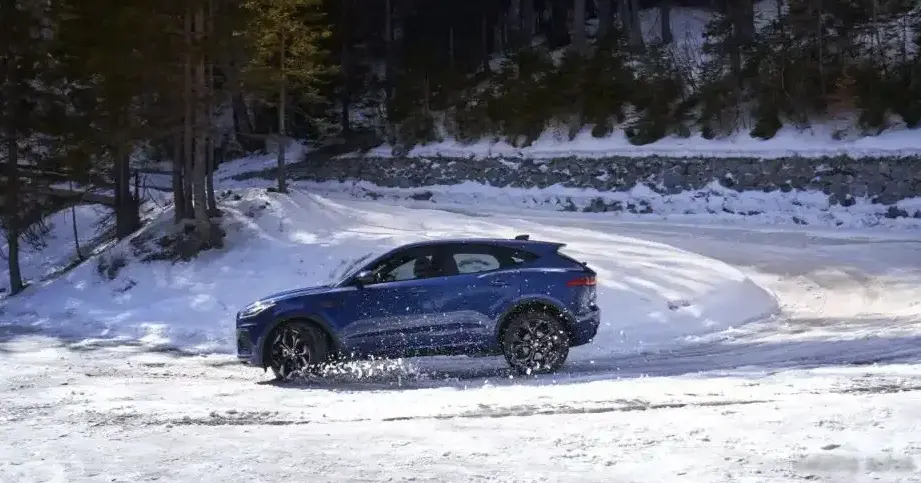
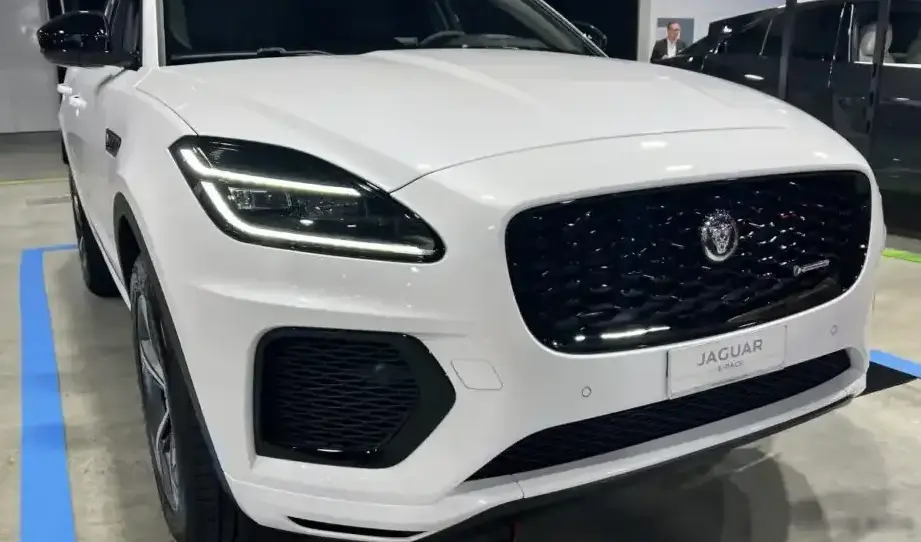
The Jaguar E-Pace 2.0 P250 AWD Automatic, produced from 2018 to October 2020, represents a significant variant within the first generation (X540) of Jaguar’s compact luxury SUV. Positioned as a mid-range offering, it aimed to blend performance with practicality, appealing to buyers seeking a more engaging driving experience than traditionally offered in the segment. The E-Pace marked Jaguar’s entry into the rapidly growing compact SUV market, designed to attract a younger demographic and compete with established rivals like the Audi Q3, BMW X1, and Mercedes-Benz GLA. This specific 2.0 P250 configuration combined a turbocharged four-cylinder engine with a nine-speed automatic transmission and all-wheel drive, offering a balance of power, efficiency, and all-weather capability.
Powertrain & Engine Architecture
The heart of the E-Pace 2.0 P250 is Jaguar Land Rover’s Ingenium engine family, specifically the PT204 2.0-liter turbocharged inline-four. This engine utilizes direct injection and a twin-scroll turbocharger to deliver 250 horsepower at 5500 rpm and 365 Nm (269.21 lb-ft) of torque between 1200 and 4500 rpm. The Ingenium engines were designed for modularity and efficiency, featuring a lightweight aluminum block and cylinder head. The engine’s valvetrain employs a dual overhead camshaft (DOHC) configuration with four valves per cylinder. The nine-speed automatic transmission, sourced from ZF, is a crucial component of this powertrain. It provides smooth and relatively quick shifts, contributing to both performance and fuel economy. The transmission’s wide gear ratio spread allows for both strong acceleration and efficient cruising.
Driving Characteristics
The E-Pace 2.0 P250 offers a respectable driving experience, though it doesn’t quite match the agility of some of its rear-wheel-drive competitors. The all-wheel-drive system provides excellent traction in various conditions, and the nine-speed automatic transmission generally shifts smoothly. Acceleration from 0 to 60 mph takes around 6.7 seconds. Compared to the higher-output 300 hp version of the 2.0-liter Ingenium engine, the P250 feels less urgent, particularly during overtaking maneuvers. However, the broader torque band of the P250 makes it feel responsive in everyday driving situations. The gear ratios are tuned for a balance between acceleration and fuel efficiency, with taller gearing in the upper gears for highway cruising.
Equipment & Trim Levels
The E-Pace 2.0 P250 typically came standard with features such as leather upholstery, a touchscreen infotainment system with navigation, automatic climate control, and a suite of safety features including autonomous emergency braking and lane departure warning. Optional extras included a panoramic sunroof, premium audio systems, adaptive cruise control, and various cosmetic enhancements. Interior trim levels varied, with options for different wood or metal finishes. The standard dashboard configuration featured a digital instrument cluster and a central touchscreen display.
Chassis & Braking
The E-Pace utilizes a McPherson strut front suspension and a multi-link rear suspension, providing a comfortable ride quality. Stabilizer bars are fitted to both axles to reduce body roll during cornering. The braking system consists of ventilated discs at the front and solid discs at the rear. ABS (Anti-lock Braking System) is standard. The E-Pace’s chassis is tuned to prioritize comfort and stability over outright sportiness, reflecting its intended role as a luxury crossover.
Market Reception & Comparison
The Jaguar E-Pace 2.0 P250 received generally positive reviews, with critics praising its stylish design, comfortable interior, and engaging driving dynamics. However, some reviewers noted that the rear seat space was somewhat limited compared to some competitors. Fuel economy was considered average for the segment, with combined figures around 30.5 US mpg. Compared to the more powerful E-Pace variants, the P250 offered a more affordable entry point into the model range, appealing to buyers who prioritized value and efficiency over outright performance. The 1.5L three-cylinder engine was available as a lower-cost option, but the 2.0L P250 offered a significant step up in performance.
Legacy
The Jaguar E-Pace 2.0 P250 has proven to be a relatively reliable vehicle, with the Ingenium engine generally exhibiting good durability. Common issues reported by owners include occasional software glitches with the infotainment system and minor trim imperfections. On the used car market, the E-Pace 2.0 P250 holds its value reasonably well, particularly well-maintained examples with low mileage. The combination of Jaguar’s brand appeal, the capable powertrain, and the stylish design continues to make it an attractive option for buyers seeking a compact luxury SUV.