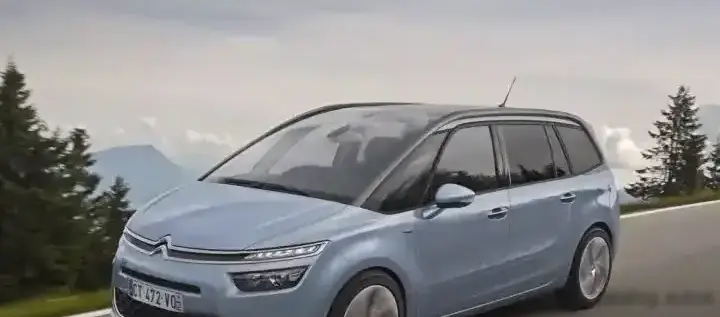
The Citroen C4 II Grand Picasso 1.6 e-HDi, produced between 2013 and 2014, represents a significant iteration of Citroen’s popular MPV (Multi-Purpose Vehicle). This variant, equipped with a 1.6-liter diesel engine producing 116 horsepower and paired with an electronically controlled 6-speed automatic transmission (EGS – Electronically Governed Sequential), was positioned as a fuel-efficient and practical option within the Grand Picasso lineup. It falls within the first phase (Phase I) of the second-generation C4 Picasso, built on the EMP2 platform (Efficient Modular Platform 2) shared with Peugeot and other Stellantis brands. The Grand Picasso, distinguished by its seven-seat configuration, aimed to provide a spacious and versatile vehicle for families.
Technical Specifications
| Brand | Citroen |
| Model | C4 |
| Generation | C4 II Grand Picasso (Phase I, 2013) |
| Type (Engine) | 1.6 e-HDi (116 Hp) EGS |
| Start of production | 2013 |
| End of production | 2014 |
| Powertrain Architecture | Internal Combustion engine |
| Body type | Minivan, MPV |
| Seats | 7 |
| Doors | 5 |
| Fuel consumption (urban) | 4.4-4.5 l/100 km (53.5 – 52.3 US mpg) |
| Fuel consumption (extra urban) | 3.7-3.8 l/100 km (63.6 – 61.9 US mpg) |
| Fuel consumption (combined) | 4 l/100 km (58.8 US mpg) |
| CO2 emissions | 104-105 g/km |
| Fuel Type | Diesel |
| Acceleration 0 – 100 km/h | 12.6 sec |
| Acceleration 0 – 62 mph | 12.6 sec |
| Acceleration 0 – 60 mph | 12 sec |
| Maximum speed | 189 km/h (117.44 mph) |
| Emission standard | Euro 5 |
| Weight-to-power ratio | 11.4 kg/Hp |
| Weight-to-torque ratio | 4.9 kg/Nm |
| Power | 116 Hp @ 3600 rpm |
| Torque | 270 Nm @ 1750 rpm (199.14 lb.-ft. @ 1750 rpm) |
| Engine layout | Front, Transverse |
| Engine Model/Code | 9HC DV6C |
| Engine displacement | 1560 cm3 (95.2 cu. in.) |
| Number of cylinders | 4 |
| Engine configuration | Inline |
| Cylinder Bore | 75 mm (2.95 in.) |
| Piston Stroke | 88.3 mm (3.48 in.) |
| Number of valves per cylinder | 2 |
| Fuel injection system | Diesel Commonrail |
| Engine aspiration | Turbocharger, Intercooler |
| Engine oil capacity | 3.75 l (3.96 US qt | 3.3 UK qt) |
| Kerb Weight | 1320 kg (2910.1 lbs.) |
| Max. weight | 2150 kg (4739.94 lbs.) |
| Max load | 830 kg (1829.84 lbs.) |
| Trunk (boot) space – minimum | 170 l (6 cu. ft.) |
| Trunk (boot) space – maximum | 1843 l (65.08 cu. ft.) |
| Fuel tank capacity | 55 l (14.53 US gal | 12.1 UK gal) |
| Permitted trailer load with brakes (12%) | 1200 kg (2645.55 lbs.) |
| Permitted trailer load without brakes | 695 kg (1532.21 lbs.) |
| Permitted towbar download | 70 kg (154.32 lbs.) |
| Length | 4597 mm (180.98 in.) |
| Width | 1826 mm (71.89 in.) |
| Width with mirrors folded | 1971 mm (77.6 in.) |
| Width including mirrors | 2117 mm (83.35 in.) |
| Height | 1638-1644 mm (64.49 – 64.72 in.) |
| Wheelbase | 2840 mm (111.81 in.) |
| Front track | 1573-1587 mm (61.93 – 62.48 in.) |
| Rear (Back) track | 1576-1590 mm (62.05 – 62.6 in.) |
| Front overhang | 884 mm (34.8 in.) |
| Rear overhang | 873 mm (34.37 in.) |
| Drag coefficient (Cd) | 0.30 |
| Minimum turning circle | 11.3 m (37.07 ft.) |
| Drivetrain Architecture | Front wheel drive |
| Number of gears and type of gearbox | 6 gears, automatic transmission EGS |
| Front suspension | Independent, type McPherson with coil spring and anti-roll bar |
| Rear suspension | Semi-independent, coil spring |
| Front brakes | Ventilated discs |
| Rear brakes | Disc |
| Assisting systems | ABS (Anti-lock braking system) |
| Steering type | Steering rack and pinion |
| Power steering | Electric Steering |
| Tires size | 205/60 R16; 205/55 R17 |
| Wheel rims size | 16; 17 |
Powertrain & Engine Architecture
The heart of this Grand Picasso variant is the 9HC DV6C engine, a 1.6-liter four-cylinder diesel. This engine is part of the DV6 family, a widely used powerplant in PSA Group (Peugeot Citroen) vehicles. The ‘e-HDi’ designation signifies the inclusion of Stop & Start technology, aimed at improving fuel economy in urban driving. The engine utilizes a common rail direct injection system, delivering fuel at high pressure for efficient combustion. A turbocharger with an intercooler enhances power output. The engine produces 116 horsepower at 3600 rpm and 270 Nm (199 lb-ft) of torque at 1750 rpm. The EGS (Electronically Governed Sequential) transmission is a six-speed automated manual gearbox. Unlike a traditional automatic with a torque converter, the EGS uses actuators to shift gears, offering a balance between fuel efficiency and convenience. However, it’s often criticized for being less smooth than conventional automatics.
Driving Characteristics
The 1.6 e-HDi with the EGS transmission delivers adequate, but not exhilarating, performance. Acceleration from 0 to 100 km/h (0-62 mph) takes around 12.6 seconds. The focus is clearly on fuel economy rather than outright speed. The EGS transmission, while improving fuel efficiency, can exhibit noticeable shifts, particularly at lower speeds. The gear ratios are tuned for maximizing fuel efficiency, meaning the engine can feel strained when accelerating quickly or climbing hills. Compared to the more powerful 2.0-liter HDi variants, this 1.6L engine feels noticeably less responsive. However, it provides sufficient power for everyday driving and long-distance cruising, especially when not fully loaded with passengers and luggage.
Equipment & Trim Levels
The 1.6 e-HDi Grand Picasso typically came equipped with a reasonable level of standard features. These included air conditioning, electric front and rear windows, a touchscreen infotainment system, Bluetooth connectivity, and a multi-function steering wheel. Higher trim levels, such as Exclusive, added features like automatic climate control, panoramic sunroof, leather upholstery, and parking sensors. The interior generally featured durable materials and a practical layout. The seven-seat configuration offered flexibility, with the rear seats folding flat into the floor to maximize cargo space.
Chassis & Braking
The C4 II Grand Picasso utilizes a McPherson strut front suspension and a semi-independent coil spring rear suspension. This setup provides a comfortable ride, absorbing bumps and imperfections in the road surface effectively. The front brakes are ventilated discs, while the rear brakes are solid discs. ABS (Anti-lock Braking System) is standard. The steering is electric power-assisted, offering light and precise control. The suspension is tuned for comfort rather than sporty handling, prioritizing a smooth and stable ride for passengers.
Market Reception & Comparison
The Citroen C4 II Grand Picasso 1.6 e-HDi was generally well-received by critics for its fuel efficiency, spacious interior, and practicality. However, the EGS transmission was a common point of criticism, with some reviewers finding it jerky and less refined than traditional automatic gearboxes. Compared to the more powerful diesel variants, the 1.6L engine was seen as adequate for most drivers but lacking in performance. Fuel economy figures of around 4.0 l/100 km (58.8 US mpg) were highly competitive in its class. The Grand Picasso competed with other MPVs such as the Renault Scenic, Ford C-Max, and Volkswagen Touran.
Legacy
The 1.6 e-HDi engine, while generally reliable, can be susceptible to issues with the diesel particulate filter (DPF) if not driven on longer journeys regularly. The EGS transmission, while efficient, requires careful maintenance and can be prone to occasional issues with the actuators. In the used car market, the C4 II Grand Picasso 1.6 e-HDi represents a relatively affordable and practical option for families. Its fuel efficiency and spacious interior continue to be attractive features. However, potential buyers should be aware of the potential issues with the DPF and EGS transmission and ensure the vehicle has been properly maintained.