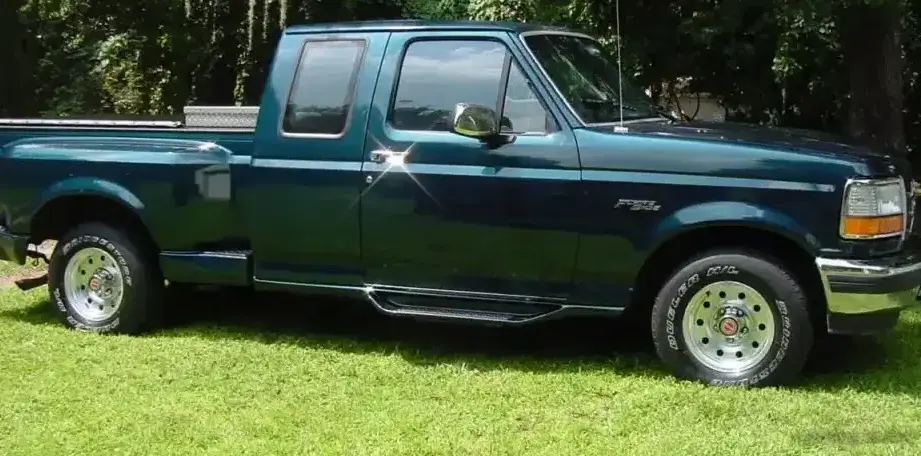
The Ford F-Series F-150 IX SuperCab, equipped with the 5.0-liter V8 engine producing 185 horsepower and paired with a four-speed automatic transmission and a 4×4 drivetrain, was a significant offering in the American pickup truck market from 1991 to 1993. This variant occupied a middle ground within the F-150 lineup, providing a balance between capability, comfort, and affordability. It represented a continuation of Ford’s long-standing dominance in the full-size pickup segment, catering to buyers who needed a versatile vehicle for both work and personal use. The “IX” designation denoted a specific trim level and feature package within the broader F-150 range.
Technical Specifications
| Brand | Ford |
| Model | F-Series F-100/F-150 |
| Generation | F-Series F-150 IX SuperCab |
| Type (Engine) | 5.0 V8 (185 Hp) 4×4 Automatic |
| Start of production | August, 1991 |
| End of production | 1993 |
| Powertrain Architecture | Internal Combustion engine |
| Body type | Pick-up |
| Seats | 5-6 |
| Doors | 2 |
| Fuel Type | Petrol (Gasoline) |
| Power | 185 Hp |
| Power per litre | 37.4 Hp/l |
| Torque | 366 Nm / 269.95 lb.-ft. |
| Engine layout | Front, Longitudinal |
| Engine displacement | 4942 cm3 / 301.58 cu. in. |
| Number of cylinders | 8 |
| Engine configuration | V-engine |
| Number of valves per cylinder | 2 |
| Fuel injection system | Multi-port manifold injection |
| Engine aspiration | Naturally aspirated engine |
| Engine oil capacity | 4.7 l / 4.97 US qt | 4.14 UK qt |
| Max. weight | 2835 kg / 6250.11 lbs. |
| Fuel tank capacity | 131-141 l / 34.61 – 37.25 US gal | 28.82 – 31.02 UK gal |
| Length | 5565-5977 mm / 219.09 – 235.31 in. |
| Width | 2007 mm / 79.02 in. |
| Height | 1877 mm / 73.9 in. |
| Wheelbase | 3531-3937 mm / 139.02 – 155 in. |
| Wading depth | 848 mm / 33.39 in. |
| Drivetrain Architecture | The Internal combustion engine (ICE) drives the rear wheels permanently, and the front wheels are driven through an electrically or mechanically operated clutch if necessary. |
| Drive wheel | All wheel drive (4×4) |
| Number of gears and type of gearbox | 4 gears, automatic transmission |
| Front suspension | Independent coil spring |
| Rear suspension | Leaf spring |
| Front brakes | Disc |
| Rear brakes | Drum |
| Power steering | Electric Steering |
| Tires size | 235/75 R15 |
| Wheel rims size | 15 |
Powertrain & Engine Architecture
The heart of this F-150 variant was the 302 cubic inch (4.9-liter) Ford Windsor V8 engine. This engine, internally designated as the 5.0L, was a staple of Ford’s lineup for decades, known for its robust construction and relative simplicity. The 185 horsepower output was achieved through a two-barrel, multi-port fuel injection system. This system, while not as sophisticated as later sequential fuel injection setups, provided a significant improvement over carbureted engines in terms of fuel efficiency and emissions. The engine featured a cast iron block and cylinder heads, with a two-valve-per-cylinder configuration. The automatic transmission was a Ford AOD (Automatic Overdrive) four-speed unit. The AOD was chosen for its ability to provide both adequate torque multiplication for towing and hauling, as well as an overdrive gear for improved highway fuel economy. The 4×4 system employed a transfer case allowing the driver to switch between two-wheel drive and four-wheel drive modes, with a low-range gear for off-road or heavy-duty applications.
Driving Characteristics
The 185 hp 5.0L V8, coupled with the AOD automatic transmission, delivered a driving experience that prioritized usability over outright performance. Acceleration was adequate for everyday driving, but not particularly brisk. The AOD transmission’s gear ratios were tuned for towing and hauling, meaning that the truck didn’t feel particularly sporty. The overdrive gear helped to keep engine RPMs down at highway speeds, contributing to a more comfortable and fuel-efficient cruising experience. Compared to the available 300 cubic inch inline-six engine, the V8 offered significantly more power and torque, making it a better choice for those who frequently towed trailers or carried heavy loads. However, it lacked the responsiveness of the higher-output 351 Windsor V8 option. The 4×4 system provided enhanced traction in slippery conditions, making the truck capable in both on- and off-road environments.
Equipment & Trim Levels
The F-150 IX SuperCab trim level offered a step up in comfort and convenience compared to the base models. Standard features typically included a SuperCab extended cab configuration, providing additional seating and storage space. Interior appointments included cloth upholstery, a basic AM/FM radio, and manual windows and locks. The IX package often included features like upgraded interior trim, color-matched exterior components, and a tilt steering wheel. Optional extras included air conditioning, power windows and locks, a cruise control system, and a premium sound system. The SuperCab’s rear seats were typically bench-style, offering seating for up to three passengers, although legroom could be limited.
Chassis & Braking
The F-150 IX SuperCab utilized a body-on-frame construction, typical of pickup trucks of the era. The front suspension consisted of independent coil springs, providing a relatively comfortable ride. The rear suspension employed leaf springs, which were well-suited for carrying heavy loads. The braking system featured disc brakes on the front wheels and drum brakes on the rear wheels. Power steering was standard, making the truck easier to maneuver, especially at low speeds. The tires were typically 235/75R15 size, providing a good balance between on-road comfort and off-road traction. The chassis was designed to withstand the stresses of heavy-duty use, and the truck’s robust construction contributed to its longevity.
Market Reception & Comparison
The F-150 IX SuperCab with the 5.0L V8 and automatic transmission was generally well-received by critics and buyers alike. It was praised for its versatility, reliability, and comfortable ride. However, some reviewers noted that the engine’s horsepower output was somewhat modest compared to competing trucks. Fuel economy was considered average for a full-size pickup truck of the time. Compared to the six-cylinder models, the V8 offered a significant performance advantage, but at the cost of slightly lower fuel efficiency. Compared to the higher-output V8 options, the 185 hp engine provided a more affordable entry point into the F-150 lineup, appealing to buyers who didn’t require maximum towing or hauling capacity.
Legacy
The 5.0L Windsor V8 engine and AOD automatic transmission combination proved to be remarkably durable and reliable. Many of these trucks are still on the road today, a testament to their robust construction and relatively simple design. The powertrain is generally considered to be relatively easy to maintain, with parts readily available. In the used car market, these F-150s are often sought after by enthusiasts and those looking for a dependable and affordable pickup truck. While not the most powerful or technologically advanced F-150 variant, the 185 hp 5.0L automatic model represents a sweet spot in the lineup, offering a good balance of capability, comfort, and value. Its enduring popularity is a reflection of Ford’s success in creating a truck that met the needs of a wide range of buyers.