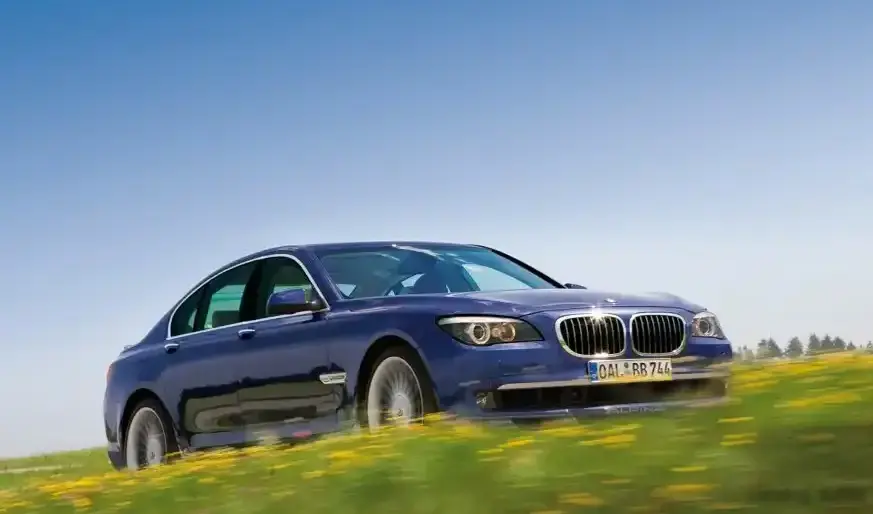
The Alpina B7 (F01) 4.4 V8 Biturbo, produced between 2013 and 2015, represents a high-performance iteration of the BMW 7 Series (F01) sedan. Alpina, a renowned German automotive engineering company, independently refined the 7 Series, focusing on enhanced power, dynamic handling, and luxurious appointments. This model occupied the very top tier of the 7 Series lineup, positioned above even the BMW 760Li, and catered to buyers seeking a unique blend of performance and exclusivity. The F01 generation B7 was the first to utilize Alpina’s own direct injection system and twin-turbocharged 4.4-liter V8 engine, setting a new standard for the brand.
Technical Specifications
| Brand | Alpina |
| Model | B7 |
| Generation | B7 (F01) |
| Type (Engine) | 4.4 V8 (540 Hp) Allrad BITURBO |
| Start of production | 2013 |
| End of production | 2015 |
| Powertrain Architecture | Internal Combustion engine |
| Body type | Sedan |
| Seats | 5 |
| Doors | 4 |
| Fuel consumption (economy) – urban | 14.3 l/100 km (16.4 US mpg, 19.8 UK mpg, 7 km/l) |
| Fuel consumption (economy) – extra urban | 8.2 l/100 km (28.7 US mpg, 34.4 UK mpg, 12.2 km/l) |
| Fuel consumption (economy) – combined | 10.4 l/100 km (22.6 US mpg, 27.2 UK mpg, 9.6 km/l) |
| Fuel Type | Petrol (Gasoline) |
| Acceleration 0 – 100 km/h | 4.5 sec |
| Acceleration 0 – 62 mph | 4.5 sec |
| Acceleration 0 – 60 mph | 4.3 sec |
| Maximum speed | 310 km/h (192.63 mph) |
| Emission standard | Euro 5 |
| Weight-to-power ratio | 3.9 kg/Hp, 253.5 Hp/tonne |
| Weight-to-torque ratio | 2.9 kg/Nm, 342.7 Nm/tonne |
| Power | 540 Hp @ 5200-6250 rpm |
| Power per litre | 122.9 Hp/l |
| Torque | 730 Nm @ 2800-5000 rpm (538.42 lb.-ft. @ 2800-5000 rpm) |
| Engine layout | Front, Longitudinal |
| Engine displacement | 4395 cm3 (268.2 cu. in.) |
| Number of cylinders | 8 |
| Engine configuration | V-engine |
| Cylinder Bore | 89 mm (3.5 in.) |
| Piston Stroke | 88.3 mm (3.48 in.) |
| Compression ratio | 10:1 |
| Fuel injection system | Direct injection |
| Engine aspiration | Twin-Turbo, Intercooler |
| Kerb Weight | 2130 kg (4695.85 lbs.) |
| Max. weight | 2750 kg (6062.71 lbs.) |
| Max load | 620 kg (1366.87 lbs.) |
| Trunk (boot) space – minimum | 500 l (17.66 cu. ft.) |
| Fuel tank capacity | 80 l (21.13 US gal, 17.6 UK gal) |
| Length | 5092 mm (200.47 in.) |
| Width | 1902 mm (74.88 in.) |
| Height | 1491 mm (58.7 in.) |
| Wheelbase | 3070 mm (120.87 in.) |
| Front track | 1621 mm (63.82 in.) |
| Rear (Back) track | 1628 mm (64.09 in.) |
| Drive wheel | All wheel drive (4×4) |
| Number of gears and type of gearbox | 8 gears, automatic transmission |
Powertrain & Engine Architecture
The heart of the B7 (F01) is Alpina’s meticulously engineered 4.4-liter twin-turbocharged V8 engine. Based on the BMW N63 engine, Alpina significantly modified the internals, including bespoke pistons, connecting rods, and a revised crankshaft. Crucially, Alpina developed its own direct injection system, optimized for higher performance and efficiency. The engine utilizes two twin-scroll turbochargers, providing minimal turbo lag and a broad torque curve. Intercoolers are strategically placed to manage intake temperatures. The engine produces 540 horsepower at 5,200-6,250 rpm and a substantial 730 Nm (538 lb-ft) of torque between 2,800 and 5,000 rpm. The transmission is an 8-speed automatic, also sourced from BMW, but recalibrated by Alpina for quicker shifts and more responsive behavior. The all-wheel-drive system (xDrive in BMW terminology) is standard, providing excellent traction in all weather conditions.
Driving Characteristics
The B7’s driving experience is a unique blend of luxury and performance. The 540 hp and 730 Nm of torque deliver effortless acceleration, with 0-60 mph times consistently around 4.3 seconds. The 8-speed automatic transmission is well-matched to the engine, providing smooth and quick gear changes. While not as overtly sporty as some dedicated performance sedans, the B7 offers a refined and powerful driving experience. The Alpina-tuned suspension provides a comfortable ride while maintaining excellent body control. The all-wheel-drive system inspires confidence, particularly in inclement weather. Compared to the standard 7 Series or even the 760Li, the B7 feels noticeably more responsive and engaging.
Equipment & Trim Levels
The B7 came exceptionally well-equipped as standard. Interior appointments included exclusive Alpina leather upholstery, wood trim with Alpina badging, and unique instrument cluster graphics. Standard features also included a premium sound system, navigation, heated and ventilated front seats, and a comprehensive suite of driver-assistance systems. Optional extras included a rear-seat entertainment system, individual rear seats, and a variety of exterior customization options, including bespoke paint colors and interior trim combinations. The B7’s interior was designed to be both luxurious and driver-focused, with a comfortable and ergonomic layout.
Chassis & Braking
The B7’s chassis builds upon the BMW 7 Series platform, but with significant Alpina-specific modifications. The suspension features stiffer springs and dampers, along with reinforced stabilizer bars, to reduce body roll and improve handling. The B7 utilizes BMW’s Integral Active Steering system, which provides variable steering ratios for enhanced agility at low speeds and stability at high speeds. Braking duties are handled by large, ventilated disc brakes on all four wheels. The B7’s braking system is more than adequate for its performance capabilities, providing strong and consistent stopping power.
Market Reception & Comparison
The Alpina B7 (F01) was generally well-received by automotive critics. It was praised for its powerful engine, refined ride, and luxurious interior. Critics noted that the B7 offered a unique alternative to the standard 7 Series and other high-performance luxury sedans. Fuel economy, while not a primary concern for B7 buyers, was respectable for a vehicle of its size and performance, averaging around 22.6 US mpg combined. Compared to the BMW 760Li, the B7 offered a more focused driving experience and a higher level of exclusivity. Reliability was generally good, benefiting from the underlying BMW engineering and Alpina’s meticulous attention to detail.
Legacy
The Alpina B7 (F01) represents a significant milestone in the company’s history. It was the first B7 to utilize Alpina’s own direct injection system and twin-turbocharged V8 engine, establishing a new benchmark for performance and refinement. On the used car market, the F01 B7 remains a desirable and relatively rare vehicle. The 4.4-liter twin-turbo V8 engine has proven to be reasonably reliable, although regular maintenance is essential. The B7’s combination of luxury, performance, and exclusivity continues to appeal to discerning buyers seeking a unique and rewarding driving experience. The F01 generation laid the groundwork for subsequent B7 models, which have continued to push the boundaries of performance and luxury.