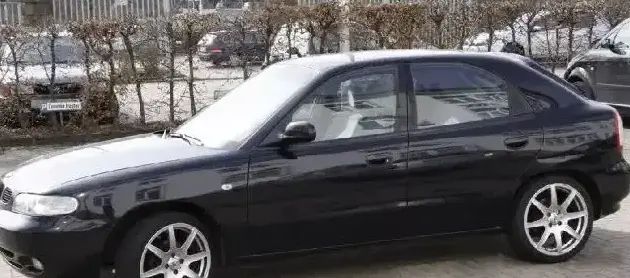
The Daewoo Nubira III 1.8 i 16V, produced between 2003 and 2005, represented a significant step forward for the Korean automaker in the compact sedan segment. Positioned as a mid-range offering within the Nubira III lineup (internally designated J100), this variant aimed to balance affordability with a reasonable level of performance and features. It was primarily marketed in Europe and select international markets following Daewoo’s acquisition by General Motors, and served as a key model in establishing the Chevrolet brand in those regions. The Nubira III, built on the GM Delta platform, was a re-engineered version of the previous Nubira, offering improved refinement and build quality.
Technical Specifications
| Brand | Daewoo |
| Model | Nubira |
| Generation | Nubira III |
| Type (Engine) | 1.8 i 16V (122 Hp) |
| Start of production | 2003 |
| End of production | 2005 |
| Powertrain Architecture | Internal Combustion engine |
| Body type | Sedan |
| Seats | 5 |
| Doors | 4 |
| Fuel consumption (urban) | 9.8 l/100 km (24 US mpg, 28.8 UK mpg, 10.2 km/l) |
| Fuel consumption (extra urban) | 6.2 l/100 km (37.9 US mpg, 45.6 UK mpg, 16.1 km/l) |
| Fuel consumption (combined) | 7.5 l/100 km (31.4 US mpg, 37.7 UK mpg, 13.3 km/l) |
| Fuel Type | Petrol (Gasoline) |
| Acceleration 0 – 100 km/h | 9.5 sec |
| Acceleration 0 – 62 mph | 9.5 sec |
| Acceleration 0 – 60 mph | 9 sec |
| Maximum speed | 194 km/h (120.55 mph) |
| Emission standard | Euro 3 |
| Weight-to-power ratio | 9.9 kg/Hp, 101.2 Hp/tonne |
| Weight-to-torque ratio | 7.3 kg/Nm, 136.9 Nm/tonne |
| Power | 122 Hp @ 5800 rpm |
| Power per litre | 67.8 Hp/l |
| Torque | 165 Nm @ 4000 rpm (121.7 lb.-ft. @ 4000 rpm) |
| Engine layout | Front, Transverse |
| Engine Model/Code | T18SED |
| Engine displacement | 1799 cm3 (109.78 cu. in.) |
| Number of cylinders | 4 |
| Engine configuration | Inline |
| Cylinder Bore | 81.6 mm (3.21 in.) |
| Piston Stroke | 86 mm (3.39 in.) |
| Compression ratio | 9.8:1 |
| Number of valves per cylinder | 4 |
| Fuel injection system | Multi-port manifold injection |
| Engine aspiration | Naturally aspirated engine |
| Valvetrain | DOHC |
| Engine oil capacity | 4 l (4.23 US qt | 3.52 UK qt) |
| Coolant | 7.5 l (7.93 US qt | 6.6 UK qt) |
| Kerb Weight | 1205 kg (2656.57 lbs.) |
| Max. weight | 1680 kg (3703.77 lbs.) |
| Max load | 475 kg (1047.2 lbs.) |
| Trunk (boot) space – minimum | 404 l (14.27 cu. ft.) |
| Fuel tank capacity | 60 l (15.85 US gal | 13.2 UK gal) |
| Length | 4500 mm (177.17 in.) |
| Width | 1725 mm (67.91 in.) |
| Height | 1445 mm (56.89 in.) |
| Wheelbase | 2600 mm (102.36 in.) |
| Front track | 1480 mm (58.27 in.) |
| Rear (Back) track | 1480 mm (58.27 in.) |
| Minimum turning circle | 10.4 m (34.12 ft.) |
| Drivetrain Architecture | ICE, Front wheel drive |
| Drive wheel | Front wheel drive |
| Number of gears | 5 gears, manual transmission |
| Front suspension | Spring Strut |
| Rear suspension | Double wishbone |
| Front brakes | Ventilated discs |
| Rear brakes | Disc |
| Assisting systems | ABS (Anti-lock braking system) |
| Steering type | Steering rack and pinion |
| Tires size | 205/45 R16 |
| Wheel rims size | 6.5J x 16 |
Powertrain & Engine Architecture
The heart of the Nubira III 1.8 i 16V is the T18SED engine, a 1.8-liter inline-four cylinder gasoline engine. This engine, part of Daewoo’s (later GM’s) ‘Family I’ series, featured a double overhead camshaft (DOHC) valvetrain with four valves per cylinder. The multi-port fuel injection system delivered fuel directly to each intake port, optimizing combustion efficiency. The engine produced 122 horsepower at 5800 rpm and 165 Nm (121.7 lb-ft) of torque at 4000 rpm. The 9.8:1 compression ratio was a compromise between performance and the ability to run on readily available fuel grades. The engine’s design prioritized reliability and ease of maintenance over outright performance. The 5-speed manual transmission was the standard offering, providing a balance between fuel economy and driver control. While an automatic transmission was available, it was often criticized for its sluggish shifts and impact on fuel consumption.
Driving Characteristics
The Nubira III 1.8 i 16V offered adequate, but not exhilarating, performance. Acceleration from 0 to 60 mph took approximately 9 seconds, and the top speed was around 120 mph. The engine felt relatively smooth at cruising speeds, but lacked the punch of higher-output variants. The 5-speed manual transmission allowed drivers to keep the engine in its optimal power band, but the gear ratios were somewhat widely spaced. Compared to the more powerful 2.0-liter engines available in the Nubira lineup, the 1.8L felt noticeably less responsive. However, it offered a more economical driving experience, particularly in urban environments. The automatic transmission version suffered from noticeable performance degradation, with slower acceleration and a tendency to hunt for gears.
Equipment & Trim Levels
The 1.8 i 16V trim typically included features such as power windows, central locking, air conditioning, and an integrated audio system. Interior upholstery was generally cloth, with options for upgraded materials available. Dashboard design was functional and straightforward, prioritizing usability over aesthetics. Optional extras included alloy wheels, a sunroof, and upgraded audio systems. The Nubira III aimed to provide a good value proposition, offering a reasonable level of equipment for its price point. Safety features included ABS brakes, but airbags were often limited to the driver and front passenger.
Chassis & Braking
The Nubira III utilized a front-wheel-drive layout with a MacPherson strut suspension in the front and a double wishbone suspension in the rear. This suspension setup provided a comfortable ride, but handling was not particularly sporty. The front brakes were ventilated discs, while the rear brakes were solid discs. ABS (Anti-lock Braking System) was standard, enhancing braking performance and stability. The chassis was designed to provide a balance between rigidity and weight reduction. The relatively modest power output of the 1.8L engine meant that the braking system was generally adequate for everyday driving.
Market Reception & Comparison
The Nubira III 1.8 i 16V was generally well-received as a practical and affordable family sedan. Critics praised its spacious interior, comfortable ride, and reasonable fuel economy. However, it was often criticized for its bland styling and lack of driving excitement. Compared to rivals like the Ford Focus and Opel Astra, the Nubira III offered a more competitive price point, but lacked the brand recognition and refinement of its European competitors. The 1.8L engine offered a good balance between performance and fuel economy, making it a popular choice for drivers who prioritized practicality over sportiness. The automatic transmission version was often viewed as a less desirable option due to its performance drawbacks.
Legacy
The Daewoo Nubira III 1.8 i 16V, while not a groundbreaking vehicle, played an important role in establishing the Chevrolet brand in Europe and other international markets. The T18SED engine proved to be relatively reliable, and many examples are still on the road today. However, finding parts can sometimes be challenging due to the vehicle’s age and the discontinuation of the Daewoo brand. In the used car market, the Nubira III 1.8 i 16V represents an affordable and practical option for budget-conscious buyers. Its simplicity and relatively low maintenance costs make it an attractive choice for those seeking a dependable and economical mode of transportation.