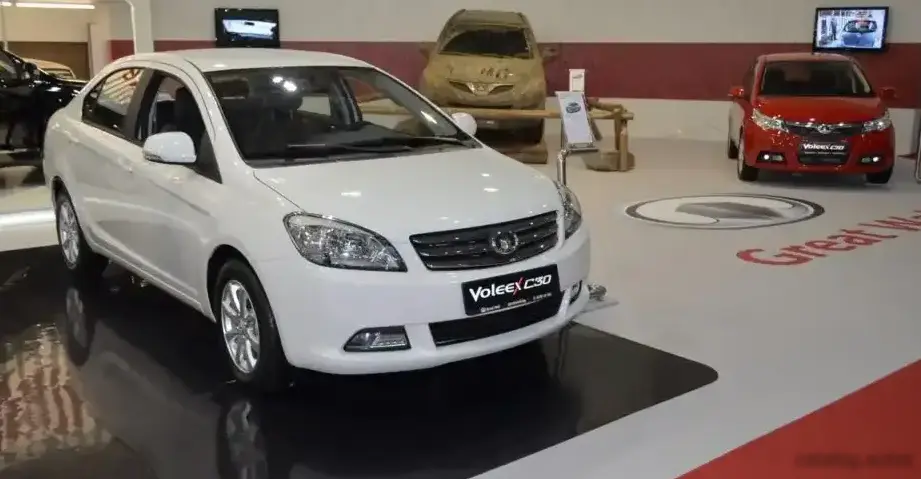
The Great Wall Voleex C30 1.5, producing 97 horsepower, was a compact sedan manufactured by the Chinese automaker Great Wall Motors from 2010 to 2016. Positioned as an entry-level offering within the Voleex C30 range, it aimed to provide affordable transportation with a focus on practicality. The C30 represented Great Wall’s attempt to move upmarket and compete with established brands in the global automotive market, particularly in developing nations. This variant, with its 1.5-liter engine and typically a 5-speed manual transmission, was a key component of that strategy.
Technical Specifications
| Brand | Great Wall |
| Model | Voleex |
| Generation | Voleex C30 |
| Type (Engine) | 1.5 (97 Hp) |
| Start of production | 2010 |
| End of production | 2016 |
| Powertrain Architecture | Internal Combustion engine |
| Body type | Sedan |
| Seats | 5 |
| Doors | 4 |
| Fuel consumption (combined) | 7.1 l/100 km (33.1 US mpg, 39.8 UK mpg, 14.1 km/l) |
| Fuel Type | Petrol (Gasoline) |
| Acceleration 0 – 100 km/h | 11.3 sec |
| Acceleration 0 – 62 mph | 11.3 sec |
| Acceleration 0 – 60 mph | 10.7 sec |
| Maximum speed | 183 km/h (113.71 mph) |
| Emission standard | Euro 5 |
| Power | 97 Hp |
| Power per litre | 64.8 Hp/l |
| Torque | 138 Nm (101.78 lb.-ft.) |
| Engine layout | Front, Transverse |
| Engine displacement | 1497 cm3 (91.35 cu. in.) |
| Number of cylinders | 4 |
| Engine configuration | Inline |
| Fuel injection system | Multi-port manifold injection |
| Engine aspiration | Naturally aspirated engine |
| Trunk (boot) space – minimum | 510 l (18.01 cu. ft.) |
| Fuel tank capacity | 40 l (10.57 US gal | 8.8 UK gal) |
| Length | 4452 mm (175.28 in.) |
| Width | 1705 mm (67.13 in.) |
| Height | 1480 mm (58.27 in.) |
| Wheelbase | 2610 mm (102.76 in.) |
| Front track | 1471 mm (57.91 in.) |
| Rear (Back) track | 1457 mm (57.36 in.) |
| Minimum turning circle | 10.5 m (34.45 ft.) |
| Drivetrain | Front wheel drive |
| Number of gears and type of gearbox | 5 gears, manual transmission |
| Assisting systems | ABS (Anti-lock braking system) |
| Steering type | Steering rack and pinion |
Powertrain & Engine Architecture
The Voleex C30 1.5 was powered by a 1.5-liter inline-four cylinder gasoline engine. This engine, typically designated with internal codes depending on the specific year of manufacture, featured a multi-point fuel injection system. The engine’s design prioritized fuel efficiency over outright performance, reflecting the target market’s needs. The engine utilized a single overhead camshaft (SOHC) valvetrain, a relatively simple and cost-effective design. The 5-speed manual transmission was the most common pairing for this engine, offering a direct connection between the engine and the front wheels. While an automatic transmission was offered in some markets, it was less prevalent and often came with a slight performance penalty.
Driving Characteristics
The 97 horsepower output of the 1.5-liter engine resulted in modest acceleration. The 0-60 mph time of around 10.7 seconds, while adequate for everyday driving, was noticeably slower than higher-powered variants of the C30, or competing vehicles with larger engines. The 5-speed manual transmission provided reasonable control, but the gear ratios were tuned for economy rather than sporty driving. The engine felt somewhat strained at higher RPMs, and the overall driving experience was best described as comfortable and practical rather than engaging. Compared to a potential turbocharged variant (which wasn’t widely available), the 1.5L felt lacking in low-end torque, requiring more frequent downshifts for overtaking maneuvers.
Equipment & Trim Levels
The Voleex C30 1.5 typically came with a basic level of standard equipment. This generally included power windows, central locking, and an air conditioning system. Interior upholstery was typically cloth, and the dashboard featured a functional, if somewhat basic, design. Optional extras could include alloy wheels, a radio/CD player with MP3 compatibility, and upgraded interior trim. The trim level for the 1.5L engine was generally the base model, focusing on affordability and essential features. Higher trim levels, often paired with larger engines, offered more luxurious appointments like leather seats and a more sophisticated infotainment system.
Chassis & Braking
The Voleex C30 utilized a front-wheel-drive chassis with a MacPherson strut suspension in the front and a torsion beam suspension in the rear. This suspension setup was chosen for its cost-effectiveness and ability to provide a comfortable ride. Braking was typically accomplished with disc brakes in the front and drum brakes in the rear. Anti-lock Braking System (ABS) was standard, enhancing safety. The steering system employed a rack and pinion setup, providing reasonably precise steering feel. Stabilizer bars were included to reduce body roll during cornering, but the overall handling characteristics were geared towards comfort and stability rather than sporty performance.
Market Reception & Comparison
The Voleex C30 1.5 received mixed reviews. Critics generally praised its affordability and practicality, but noted its lack of refinement and relatively low performance. Fuel economy was a strong point, with the 7.1 l/100 km combined consumption being competitive for its class. Compared to other trims in the C30 lineup, the 1.5L offered the lowest price point but also the least amount of power and features. It was often seen as a sensible choice for budget-conscious buyers who prioritized fuel efficiency and reliability over driving excitement. In comparison to established competitors from brands like Toyota or Honda, the Voleex C30 1.5 often fell short in terms of build quality and brand reputation.
Legacy
The Great Wall Voleex C30 1.5, while not a groundbreaking vehicle, played a role in establishing Great Wall Motors as a contender in the global automotive market. The 1.5-liter engine proved to be reasonably reliable, and parts availability remains adequate in regions where the C30 was sold. On the used car market, the C30 1.5 is typically offered at very affordable prices, making it an attractive option for first-time car buyers or those seeking a low-cost commuter vehicle. However, potential buyers should be aware of the vehicle’s basic features and limited performance. The C30’s legacy lies in its contribution to the growth of the Chinese automotive industry and its demonstration of the increasing competitiveness of Chinese automakers on the world stage.