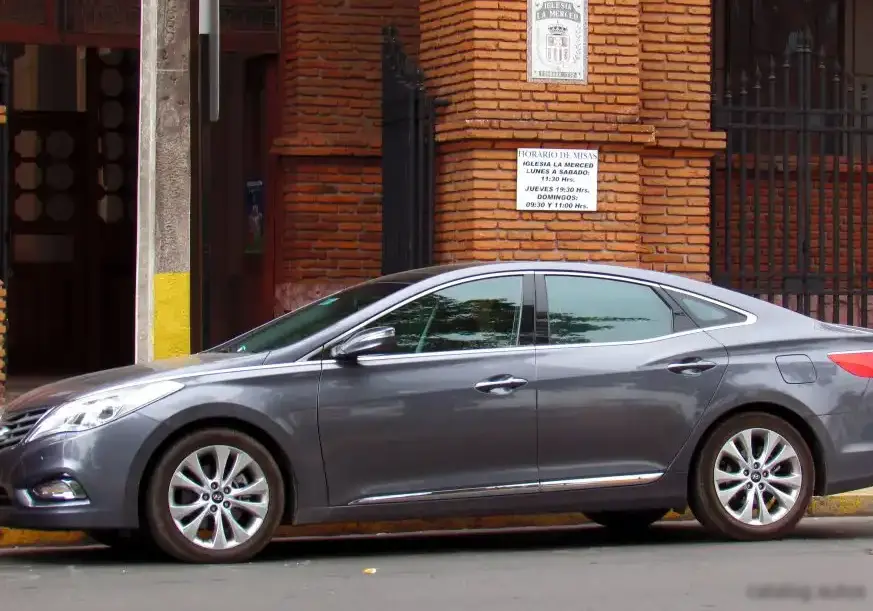
The Hyundai Grandeur, marketed as the Azera in North America, represents Hyundai’s flagship sedan. The fourth generation, designated TG, was produced from 2007 to 2010 and marked a significant step forward in Hyundai’s design and engineering capabilities. Within the TG generation, the 2.7-liter V6 engine paired with a five-speed automatic transmission occupied a middle ground in the lineup, offering a balance between performance and affordability. This variant aimed to provide a more refined driving experience than the base four-cylinder models, while remaining more accessible than the range-topping 3.8-liter V6.
Technical Specifications
| Brand | Hyundai |
| Model | Grandeur/Azera |
| Generation | Grandeur/Azera IV (TG) |
| Type (Engine) | 2.7 V6 (192 Hp) Automatic |
| Start of production | 2007 |
| End of production | 2010 |
| Powertrain Architecture | Internal Combustion engine |
| Body type | Sedan |
| Seats | 5 |
| Doors | 4 |
| Fuel consumption (urban) | 14.7 l/100 km (16 US mpg, 19.2 UK mpg, 6.8 km/l) |
| Fuel consumption (extra urban) | 7.2 l/100 km (32.7 US mpg, 39.2 UK mpg, 13.9 km/l) |
| Fuel consumption (combined) | 9.9 l/100 km (23.8 US mpg, 28.5 UK mpg, 10.1 km/l) |
| Fuel Type | Petrol (Gasoline) |
| Acceleration 0 – 100 km/h | 9.2 sec |
| Acceleration 0 – 62 mph | 9.2 sec |
| Acceleration 0 – 60 mph | 8.7 sec |
| Maximum speed | 216 km/h (134.22 mph) |
| Emission standard | Euro 4 |
| Weight-to-power ratio | 8.3 kg/Hp, 119.8 Hp/tonne |
| Weight-to-torque ratio | 6.4 kg/Nm, 156 Nm/tonne |
| Power | 192 Hp @ 6000 rpm |
| Power per litre | 72.3 Hp/l |
| Torque | 250 Nm @ 4200 rpm (184.39 lb.-ft. @ 4200 rpm) |
| Engine layout | Front, Transverse |
| Engine Model/Code | Mu / G6EA |
| Engine displacement | 2656 cm3 (162.08 cu. in.) |
| Number of cylinders | 6 |
| Engine configuration | V-engine |
| Cylinder Bore | 86.7 mm (3.41 in.) |
| Piston Stroke | 75 mm (2.95 in.) |
| Compression ratio | 10.4:1 |
| Number of valves per cylinder | 4 |
| Fuel injection system | Multi-port manifold injection |
| Engine aspiration | Naturally aspirated engine |
| Valvetrain | DOHC |
| Engine oil capacity | 4.5 l (4.76 US qt | 3.96 UK qt) |
| Kerb Weight | 1603 kg (3534.01 lbs.) |
| Max. weight | 1928 kg (4250.51 lbs.) |
| Max load | 325 kg (716.5 lbs.) |
| Trunk (boot) space – minimum | 523 l (18.47 cu. ft.) |
| Fuel tank capacity | 75 l (19.81 US gal | 16.5 UK gal) |
| Length | 4895 mm (192.72 in.) |
| Width | 1865 mm (73.43 in.) |
| Height | 1490 mm (58.66 in.) |
| Wheelbase | 2780 mm (109.45 in.) |
| Front track | 1580 mm (62.2 in.) |
| Rear (Back) track | 1565 mm (61.61 in.) |
| Ride height (ground clearance) | 162 mm (6.38 in.) |
| Drag coefficient (Cd) | 0.29 |
| Minimum turning circle (turning diameter) | 12.5 m (41.01 ft.) |
| Drivetrain Architecture | The Internal combustion engine (ICE) drives the front wheels of the vehicle. |
| Drive wheel | Front wheel drive |
| Number of gears and type of gearbox | 5 gears, automatic transmission |
| Front suspension | Double wishbone |
| Rear suspension | Independent multi-link suspension |
| Front brakes | Ventilated discs |
| Rear brakes | Disc |
| Assisting systems | ABS (Anti-lock braking system) |
| Steering type | Steering rack and pinion |
| Power steering | Hydraulic Steering |
| Tires size | 205/60 R16 H |
| Wheel rims size | 6.5J x 16 |
Powertrain & Engine Architecture
The heart of this Grandeur variant is the Hyundai Mu engine, specifically the G6EA 2.7-liter V6. This engine utilizes a 60-degree V-configuration, contributing to a smoother power delivery and reduced vibrations compared to inline engines. The engine employs multi-port fuel injection (MPI), delivering fuel directly into the intake ports just before the intake valves. This system, while not as advanced as direct injection, was effective for its time and contributed to reasonable fuel efficiency. The engine features a double overhead camshaft (DOHC) valvetrain, operating four valves per cylinder, optimizing airflow for improved performance. The five-speed automatic transmission, a common choice for this class of vehicle, was designed for smooth and comfortable shifts. It wasn’t known for particularly sporty performance, but prioritized ease of use and refinement.
Driving Characteristics
The 2.7-liter V6 with the automatic transmission delivered adequate, but not exhilarating, performance. Acceleration from 0-60 mph took approximately 8.7 seconds, making it competitive with other mid-size sedans of the era. The automatic transmission’s gear ratios were tuned for comfort and fuel economy, resulting in a somewhat relaxed driving experience. While the engine provided sufficient power for highway cruising and everyday driving, it lacked the punch of the 3.8-liter V6 option. The automatic transmission, while smooth, could feel hesitant during quick acceleration or when attempting to downshift for passing maneuvers. Compared to the manual transmission options available in other markets, the automatic version felt less engaging and offered slightly reduced fuel economy.
Equipment & Trim Levels
The 2.7-liter automatic Grandeur/Azera typically came standard with features such as air conditioning, power windows and locks, a CD player with an auxiliary input, and basic safety equipment like ABS and airbags. Higher trim levels added features like leather upholstery, a sunroof, upgraded audio systems, and automatic climate control. The interior design was generally considered comfortable and spacious, with a focus on providing a premium feel. Optional extras included navigation systems, heated seats, and premium sound systems.
Chassis & Braking
The TG Grandeur/Azera utilized a front-wheel-drive layout with a double wishbone suspension in the front and an independent multi-link suspension in the rear. This suspension setup provided a comfortable ride quality, absorbing bumps and irregularities in the road effectively. Braking duties were handled by ventilated discs in the front and solid discs in the rear, equipped with ABS to prevent wheel lockup during hard braking. The steering was hydraulic power-assisted, offering a reasonable level of feedback and ease of use. Stabilizer bars were included both front and rear to reduce body roll during cornering.
Market Reception & Comparison
The 2.7-liter Grandeur/Azera was generally well-received by critics as a comfortable and well-equipped mid-size sedan. However, it wasn’t often considered a standout performer in its class. Compared to the 3.8-liter V6 version, the 2.7-liter offered better fuel economy but lacked the same level of acceleration. Against competitors like the Toyota Camry and Honda Accord, the Grandeur/Azera offered a more luxurious interior and a longer warranty, but its brand reputation was still developing at the time. Fuel economy figures were respectable for the segment, averaging around 23.8 US mpg in combined driving.
Legacy
The 2.7-liter V6 engine in the TG Grandeur/Azera proved to be relatively reliable, with few widespread mechanical issues reported. The automatic transmission, while not known for its sporty character, also demonstrated good durability. Today, these vehicles can be found on the used car market at affordable prices. They represent a good value for buyers seeking a comfortable and spacious sedan with a proven track record of reliability. However, potential buyers should be aware that parts availability may be limited compared to more popular models. The TG generation Grandeur/Azera played a crucial role in establishing Hyundai as a serious contender in the global automotive market, demonstrating the brand’s commitment to quality and innovation.