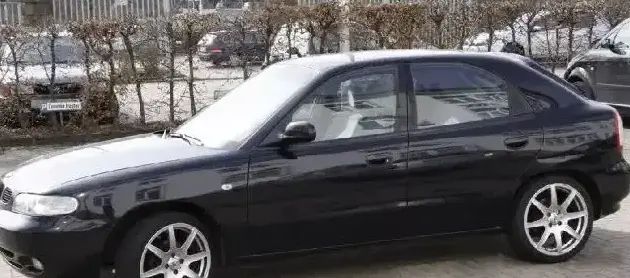
The Daewoo Nubira, known as the J200 in its third generation (2003-2005), represented a significant step forward for the Korean automaker in terms of design and refinement. This generation, while short-lived due to Daewoo’s financial difficulties and subsequent acquisition by General Motors, offered a compelling package in the compact sedan segment. The 1.8 i 16V variant, producing 123 horsepower, was positioned as a mainstream offering within the Nubira III lineup, aiming to balance affordability with acceptable performance and features. It served as a bridge between the base models and the more powerful, though less common, engine options.
Technical Specifications
| Brand | Daewoo |
| Model | Nubira |
| Generation | Nubira III |
| Type (Engine) | 1.8 i 16V (123 Hp) |
| Start of production | 2003 |
| End of production | 2005 |
| Powertrain Architecture | Internal Combustion engine |
| Body type | Sedan |
| Seats | 5 |
| Doors | 4 |
| Fuel consumption (urban) | 9.8 l/100 km (24 US mpg) |
| Fuel consumption (extra urban) | 6.2 l/100 km (37.9 US mpg) |
| Fuel consumption (combined) | 7.5 l/100 km (31.4 US mpg) |
| Fuel Type | Petrol (Gasoline) |
| Acceleration 0 – 100 km/h | 9.5 sec |
| Acceleration 0 – 62 mph | 9.5 sec |
| Acceleration 0 – 60 mph | 9 sec |
| Maximum speed | 194 km/h (120.55 mph) |
| Weight-to-power ratio | 9.8 kg/Hp |
| Weight-to-torque ratio | 7.3 kg/Nm |
| Power | 123 Hp @ 5800 rpm |
| Torque | 165 Nm @ 4000 rpm (121.7 lb.-ft. @ 4000 rpm) |
| Engine layout | Front, Transverse |
| Engine Model/Code | T18SED |
| Engine displacement | 1799 cm3 (109.78 cu. in.) |
| Number of cylinders | 4 |
| Engine configuration | Inline |
| Cylinder Bore | 81.6 mm (3.21 in.) |
| Piston Stroke | 86 mm (3.39 in.) |
| Compression ratio | 9.8:1 |
| Number of valves per cylinder | 4 |
| Fuel injection system | Multi-port manifold injection |
| Engine aspiration | Naturally aspirated engine |
| Valvetrain | DOHC |
| Engine oil capacity | 4 l (4.23 US qt | 3.52 UK qt) |
| Coolant capacity | 7.5 l (7.93 US qt | 6.6 UK qt) |
| Kerb Weight | 1210 kg (2667.59 lbs.) |
| Max. weight | 1695 kg (3736.84 lbs.) |
| Max load | 485 kg (1069.24 lbs.) |
| Trunk (boot) space – minimum | 404 l (14.27 cu. ft.) |
| Fuel tank capacity | 60 l (15.85 US gal | 13.2 UK gal) |
| Length | 4500 mm (177.17 in.) |
| Width | 1725 mm (67.91 in.) |
| Height | 1445 mm (56.89 in.) |
| Wheelbase | 2600 mm (102.36 in.) |
| Front track | 1480 mm (58.27 in.) |
| Rear (Back) track | 1480 mm (58.27 in.) |
| Drivetrain Architecture | Front wheel drive |
| Drive wheel | Front wheel drive |
| Number of gears | 5 gears, manual transmission |
| Front suspension | Spring Strut |
| Rear suspension | Double wishbone |
| Front brakes | Ventilated discs |
| Rear brakes | Disc |
| Assisting systems | ABS (Anti-lock braking system) |
| Steering type | Steering rack and pinion |
| Tires size | 205/45 R16 |
| Wheel rims size | 6.5J x 16 |
Powertrain & Engine Architecture
The Nubira III 1.8 i 16V was powered by the T18SED engine, a 1.8-liter inline-four cylinder gasoline engine. This engine featured a double overhead camshaft (DOHC) valvetrain and multi-point fuel injection. The engine’s 16 valves (four per cylinder) contributed to its relatively efficient breathing and power output for its displacement. The T18SED engine was a fairly conventional design, prioritizing reliability and affordability over cutting-edge technology. It produced 123 horsepower at 5800 rpm and 165 Nm (121.7 lb-ft) of torque at 4000 rpm. The engine’s design focused on providing adequate power for everyday driving situations, rather than outright performance. The engine was paired with a 5-speed manual transmission in most markets, though a 4-speed automatic transmission was also available, impacting performance and fuel economy.
Driving Characteristics
The 1.8L Nubira offered a comfortable, if not particularly exciting, driving experience. Acceleration from 0 to 60 mph took around 9 seconds, which was adequate for the time but not competitive with sportier rivals. The engine delivered its peak torque at 4000 rpm, meaning that most of the usable power was available in the mid-range. The 5-speed manual transmission allowed drivers to keep the engine in its optimal power band, while the optional automatic transmission, while convenient, resulted in a noticeable decrease in responsiveness. The suspension was tuned for comfort, providing a relatively smooth ride over most road surfaces. Handling was predictable but lacked the sharpness of more focused compact cars.
Equipment & Trim Levels
The 1.8 i 16V Nubira typically came equipped with features considered standard for its class, including air conditioning, power windows, power steering, and an AM/FM radio. Higher trim levels added features such as alloy wheels, a CD player, and upgraded interior upholstery. Interior materials were generally durable but not luxurious. The dashboard layout was functional and straightforward, prioritizing ease of use over aesthetic appeal. Optional extras included a sunroof, and upgraded sound system, and anti-lock brakes (ABS), which were not standard on all models.
Chassis & Braking
The Nubira III utilized a front-wheel-drive layout with a MacPherson strut suspension in the front and a multi-link double wishbone suspension in the rear. This suspension setup provided a good balance between ride comfort and handling. Braking duties were handled by ventilated disc brakes in the front and solid disc brakes in the rear. ABS was often an optional extra, and its inclusion significantly improved braking performance and safety. The chassis was designed to provide a stable and predictable driving experience, prioritizing safety and comfort over sporty handling.
Market Reception & Comparison
The Daewoo Nubira III 1.8 i 16V was generally well-received as a practical and affordable compact sedan. Critics praised its spacious interior, comfortable ride, and reasonable fuel economy. However, it was often criticized for its unremarkable performance and somewhat bland styling. Compared to other trims in the Nubira lineup, the 1.8L model offered a good balance between price and performance. The base engine was considered underpowered, while the more powerful engines were more expensive and less fuel-efficient. Against competitors like the Honda Civic, Toyota Corolla, and Ford Focus, the Nubira offered a competitive price point but lacked the brand recognition and refinement of its Japanese and American rivals.
Legacy
The Daewoo Nubira III, despite its short production run, has developed a modest following among enthusiasts and budget-conscious buyers. The 1.8L engine, while not particularly powerful, is known for its reliability and relatively low maintenance costs. Parts availability can be a challenge, as Daewoo no longer exists as an independent brand, but many components are interchangeable with those from General Motors vehicles. Today, well-maintained Nubira III models can be found for very affordable prices, making them an attractive option for those seeking a reliable and economical used car. The car represents a transitional period for the Korean automotive industry, showcasing its growing capabilities while still lacking the polish of established manufacturers.