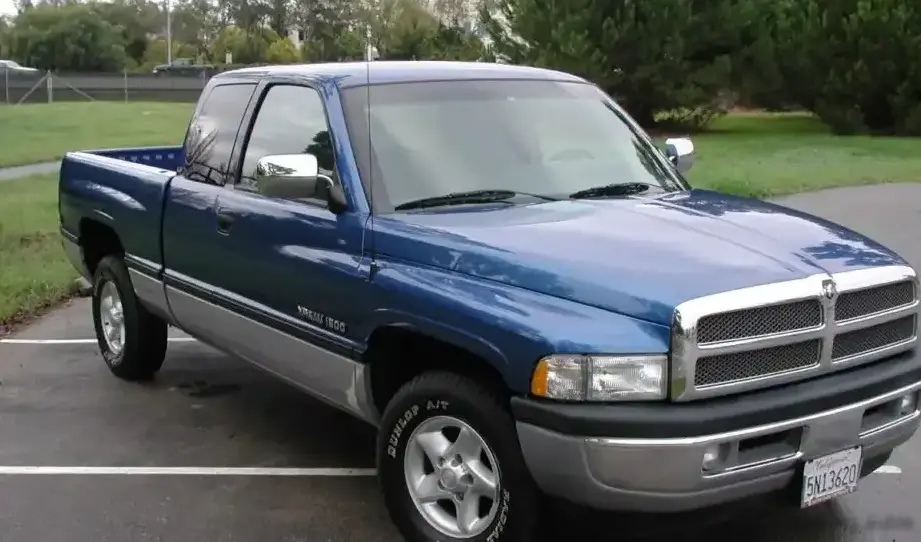
The Dodge Ram 1500 Club Cab Short Bed (BR/BE) with the 5.2 V8 engine and four-speed automatic transmission was a popular configuration within the second generation of the Ram pickup truck, produced from 1993 to 1998. This model represented a significant step forward for Dodge in terms of styling, comfort, and capability, moving away from the more utilitarian designs of previous generations. The Club Cab configuration, offering a small rear seat, broadened the Ram’s appeal to families and those needing occasional passenger space alongside their hauling needs. This particular variant, with its 220 horsepower V8 and four-wheel drive, occupied a middle ground in the Ram 1500 lineup, offering a balance of power, practicality, and affordability.
Technical Specifications
| Brand | Dodge |
| Model | RAM |
| Generation | Ram 1500 Club Cab Short Bed (BR/BE) |
| Type (Engine) | 5.2 V8 (220 Hp) 4×4 Automatic |
| Start of production | 1993 |
| End of production | 1998 |
| Powertrain Architecture | Internal Combustion engine |
| Body type | Pick-up |
| Seats | 6 |
| Doors | 2 |
| Fuel Type | Petrol (Gasoline) |
| Power | 220 Hp @ 4400 rpm |
| Power per litre | 42.2 Hp/l |
| Torque | 407 Nm @ 3200 rpm / 300.19 lb.-ft. @ 3200 rpm |
| Engine layout | Front, Longitudinal |
| Engine Model/Code | 318 Magnum |
| Engine displacement | 5211 cm3 / 317.99 cu. in. |
| Number of cylinders | 8 |
| Engine configuration | V-engine |
| Cylinder Bore | 99.31 mm / 3.91 in. |
| Piston Stroke | 84.07 mm / 3.31 in. |
| Compression ratio | 9.1:1 |
| Number of valves per cylinder | 2 |
| Fuel injection system | Multi-port manifold injection |
| Engine aspiration | Naturally aspirated engine |
| Valvetrain | OHV |
| Engine oil capacity | 4.7 l / 4.97 US qt | 4.14 UK qt |
| Coolant | 19 l / 20.08 US qt | 16.72 UK qt |
| Max. weight | 2903 kg / 6400.02 lbs. |
| Fuel tank capacity | 98 l / 25.89 US gal | 21.56 UK gal |
| Permitted trailer load with brakes (12%) | 3538 kg / 7799.95 lbs. |
| Length | 5591 mm / 220.12 in. |
| Width | 2017 mm / 79.41 in. |
| Height | 1895 mm / 74.61 in. |
| Wheelbase | 3531 mm / 139.02 in. |
| Approach angle | 30.6° |
| Departure angle | 26.9° |
| Ramp-over (brakeover) angle | 18.4° |
| Drivetrain Architecture | The Internal combustion engine (ICE) drives the rear wheels permanently, and the front wheels are driven through an electrically or mechanically operated clutch if necessary. |
| Drive wheel | All wheel drive (4×4) |
| Number of gears and type of gearbox | 4 gears, automatic transmission |
| Front suspension | Dependent spring suspension with anti-roll bar, Trailing arm |
| Rear suspension | Leaf spring |
| Front brakes | Disc |
| Rear brakes | Drum |
| Assisting systems | ABS (Anti-lock braking system) |
| Steering type | Steering rack and pinion |
| Power steering | Hydraulic Steering |
| Tires size | 225/75 R16 |
| Wheel rims size | 7J x 16 |
Powertrain & Engine Architecture
The heart of this Ram 1500 variant was the 318 Magnum V8 engine, a 5.2-liter (318 cubic inch) powerplant known for its durability and relatively simple design. This engine utilized an overhead valve (OHV) configuration with two valves per cylinder. The Magnum name signified an upgrade over previous Dodge V8s, featuring improved cylinder heads for better airflow and a revised intake manifold. Fuel delivery was handled by a multi-port fuel injection system, providing precise fuel metering for improved efficiency and performance. The 318 Magnum produced 220 horsepower at 4,400 rpm and 300 lb-ft of torque at 3,200 rpm. The engine’s longitudinal mounting allowed for a rear-wheel-drive configuration, with the four-wheel-drive system engaging the front wheels as needed. The four-speed automatic transmission, a Chrysler-built A727 variant, was a robust unit, though not known for its fuel efficiency by modern standards. It provided smooth, if somewhat deliberate, shifts, prioritizing durability over outright performance.
Driving Characteristics
The 1993-1998 Dodge Ram 1500 5.2L V8 with the automatic transmission offered a comfortable and capable driving experience. While not a performance-oriented truck, the 220 horsepower engine provided adequate power for everyday driving and towing. Acceleration was respectable, but noticeably slower than the available 360 cubic inch V8 or the manual transmission equipped models. The automatic transmission’s gear ratios were geared towards torque delivery, making it well-suited for hauling and towing. The four-wheel-drive system provided enhanced traction in slippery conditions, making it a capable work truck. The ride quality, while improved over earlier Rams, was still typical of a body-on-frame pickup truck – firm and occasionally bumpy, especially when unladen. Steering was hydraulic, providing reasonable ease of use, but lacked the precision of more modern steering systems.
Equipment & Trim Levels
The Club Cab configuration added a small rear seat, increasing passenger capacity to six. Standard features on the Ram 1500 typically included air conditioning, a basic AM/FM radio, and cloth upholstery. The BR/BE trim level generally represented a mid-range offering, often including features like power windows and locks, and upgraded interior trim. Optional extras included a premium sound system, cruise control, a sliding rear window, and various towing packages. The interior design was functional and straightforward, prioritizing durability and ease of use over luxury. The dashboard layout was relatively simple, with clearly labeled controls.
Chassis & Braking
The Ram 1500 utilized a traditional body-on-frame construction, providing a robust and durable platform. The front suspension employed a dependent spring setup with an anti-roll bar, while the rear suspension utilized leaf springs. This configuration was designed to handle heavy loads and provide a stable ride. Braking duties were handled by disc brakes at the front and drum brakes at the rear. An anti-lock braking system (ABS) was included as a standard safety feature. The truck’s relatively high ground clearance and approach/departure angles made it reasonably capable off-road, although it wasn’t designed as a dedicated off-roader.
Market Reception & Comparison
The Dodge Ram 1500, particularly the Club Cab models, were well-received by the American truck-buying public. Critics praised the truck’s bold styling, comfortable interior, and improved ride quality compared to previous generations. The 5.2L V8 automatic combination was considered a good all-around choice, offering a balance of power, fuel economy, and reliability. Compared to the larger 360 V8, the 5.2L offered slightly better fuel economy, while the manual transmission versions provided quicker acceleration. The 5.2L was generally considered more reliable than some of the earlier Dodge engines, but still required regular maintenance. Against competitors like the Ford F-150 and Chevrolet Silverado, the Ram 1500 offered a compelling package, often at a competitive price point.
Legacy
The 1993-1998 Dodge Ram 1500, and specifically the 5.2L V8 automatic variant, remains a popular choice among truck enthusiasts and those seeking a reliable and affordable work truck. The 318 Magnum engine is known for its durability and relatively simple maintenance requirements. While fuel economy is not a strong point by modern standards, the truck’s robust construction and readily available parts make it a practical and cost-effective option. Today, well-maintained examples command reasonable prices in the used car market, and the truck continues to be a common sight on American roads, a testament to its enduring appeal and reliability.