
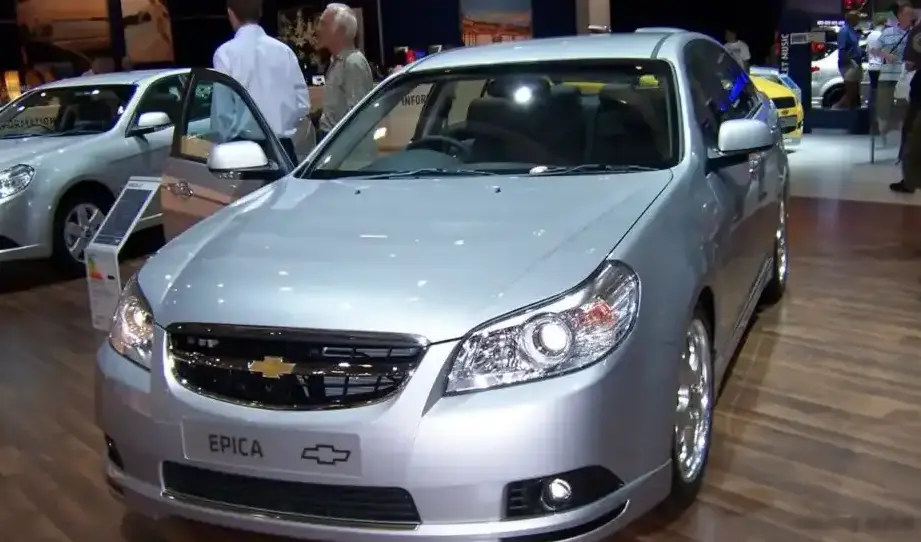
The Chevrolet Epica 2.0 D Automatic, produced between 2006 and 2010, represented a mid-range offering within the Epica lineup. The Epica itself was Chevrolet’s entry into the mid-size sedan segment, intended to provide a more spacious and refined alternative to the Cobalt and Optra. Positioned above the base 1.8L gasoline engine option, the 2.0 D offered a diesel powertrain aimed at buyers prioritizing fuel efficiency and torque. This variant was primarily marketed in Europe and other international markets where diesel engines held significant popularity. The Epica was built upon the GM Delta platform, shared with other vehicles like the Opel Vectra and Saab 9-3, but with a focus on rear passenger space and comfort.
Technical Specifications
| Brand | Chevrolet |
| Model | Epica |
| Generation | Epica |
| Type (Engine) | 2.0 D (150 Hp) Automatic |
| Start of production | 2006 |
| End of production | 2010 |
| Powertrain Architecture | Internal Combustion engine |
| Body type | Sedan |
| Seats | 5 |
| Doors | 4 |
| Fuel consumption (urban) | 10.2 l/100 km (23.1 US mpg, 27.7 UK mpg, 9.8 km/l) |
| Fuel consumption (extra urban) | 6 l/100 km (39.2 US mpg, 47.1 UK mpg, 16.7 km/l) |
| Fuel consumption (combined) | 7.6 l/100 km (30.9 US mpg, 37.2 UK mpg, 13.2 km/l) |
| CO2 emissions | 197 g/km |
| Fuel Type | Diesel |
| Acceleration 0 – 100 km/h | 10.6 sec |
| Acceleration 0 – 62 mph | 10.6 sec |
| Acceleration 0 – 60 mph | 10.1 sec |
| Maximum speed | 205 km/h (127.38 mph) |
| Emission standard | Euro 4 |
| Weight-to-power ratio | 10.5 kg/Hp, 95.5 Hp/tonne |
| Weight-to-torque ratio | 4.9 kg/Nm, 203.8 Nm/tonne |
| Power | 150 Hp @ 4000 rpm |
| Power per litre | 75.3 Hp/l |
| Torque | 320 Nm @ 2000 rpm (236.02 lb.-ft. @ 2000 rpm) |
| Engine layout | Front, Transverse |
| Engine Model/Code | LLW |
| Engine displacement | 1991 cm3 (121.5 cu. in.) |
| Number of cylinders | 4 |
| Engine configuration | Inline |
| Cylinder Bore | 83 mm (3.27 in.) |
| Piston Stroke | 92 mm (3.62 in.) |
| Compression ratio | 17.5:1 |
| Number of valves per cylinder | 4 |
| Fuel injection system | Diesel Commonrail |
| Engine aspiration | Turbocharger, Intercooler |
| Valvetrain | SOHC |
| Engine oil capacity | 6.5 l (6.87 US qt | 5.72 UK qt) |
| Coolant | 8 l (8.45 US qt | 7.04 UK qt) |
| Kerb Weight | 1570-1625 kg (3461.26 – 3582.51 lbs.) |
| Max. weight | 2055 kg (4530.5 lbs.) |
| Max load | 430-485 kg (947.99 – 1069.24 lbs.) |
| Trunk (boot) space – minimum | 480 l (16.95 cu. ft.) |
| Fuel tank capacity | 65 l (17.17 US gal | 14.3 UK gal) |
| Permitted trailer load with brakes (12%) | 1200 kg (2645.55 lbs.) |
| Permitted trailer load without brakes | 700 kg (1543.24 lbs.) |
| Permitted towbar download | 75 kg (165.35 lbs.) |
| Length | 4805 mm (189.17 in.) |
| Width | 1810 mm (71.26 in.) |
| Height | 1450 mm (57.09 in.) |
| Wheelbase | 2700 mm (106.3 in.) |
| Front track | 1550 mm (61.02 in.) |
| Rear (Back) track | 1545 mm (60.83 in.) |
| Drag coefficient (Cd) | 0.318 |
| Minimum turning circle (turning diameter) | 10.78 m (35.37 ft.) |
| Drivetrain Architecture | The Internal combustion engine (ICE) drives the front wheels of the vehicle. |
| Drive wheel | Front wheel drive |
| Number of gears and type of gearbox | 6 gears, automatic transmission |
| Front suspension | Independent, type McPherson with coil spring and anti-roll bar |
| Rear suspension | Independent multi-link spring suspension with stabilizer |
| Front brakes | Ventilated discs, 278 mm |
| Rear brakes | Disc, 276 mm |
| Assisting systems | ABS (Anti-lock braking system) |
| Steering type | Steering rack and pinion |
| Power steering | Hydraulic Steering |
| Tires size | 205/65 R15; 205/60 R16; 215/50 R17; 215/45 R18 |
| Wheel rims size | 6J x 15; 6J x 16; 7J x 17; 7J x 18 |
Powertrain & Engine Architecture
The Chevrolet Epica 2.0 D utilized the LLW engine code, a 1.991-liter inline-four cylinder diesel engine. This engine featured a turbocharger with an intercooler to boost power and efficiency. The LLW engine employed a common rail direct injection system, delivering fuel directly into the combustion chamber at extremely high pressure for optimized combustion. The engine’s single overhead camshaft (SOHC) configuration operated four valves per cylinder. The high compression ratio of 17.5:1 was typical for diesel engines, contributing to their thermal efficiency. Paired with the engine was a six-speed automatic transmission, designed to balance fuel economy with acceptable acceleration. This transmission featured adaptive shift logic, attempting to learn the driver’s style and adjust gear changes accordingly.
Driving Characteristics
The 2.0 D Automatic Epica offered a distinctly different driving experience compared to the gasoline-powered variants. While the gasoline engines prioritized responsiveness, the diesel focused on torque delivery. The 320 Nm (236 lb-ft) of torque available at 2000 rpm provided ample pulling power for everyday driving and overtaking maneuvers. However, the 150 horsepower output meant acceleration was not particularly brisk, with a 0-60 mph time of around 10.1 seconds. The automatic transmission, while smooth, could sometimes feel hesitant during downshifts. Compared to a manual transmission equipped Epica, the automatic version sacrificed some driver engagement and fuel economy. The gear ratios were tuned for comfortable cruising rather than outright performance.
Equipment & Trim Levels
The 2.0 D Automatic trim typically included standard features such as air conditioning, power windows and locks, a CD player with MP3 compatibility, and alloy wheels. Higher trim levels, often denoted by “SE” or “LT” designations, added features like leather upholstery, a sunroof, automatic climate control, and upgraded audio systems. Safety features included ABS brakes and dual front airbags. Optional extras could include rear parking sensors, a navigation system, and heated front seats. Interior upholstery was generally cloth on base models, with leather available as an upgrade. The dashboard layout was functional and straightforward, prioritizing ease of use over stylistic flair.
Chassis & Braking
The Epica 2.0 D featured an independent suspension setup at all four wheels. The front suspension utilized a McPherson strut design with coil springs and an anti-roll bar, while the rear employed a multi-link setup, also with a stabilizer bar. This suspension configuration aimed to provide a comfortable ride while maintaining reasonable handling characteristics. Braking duties were handled by ventilated discs at the front and solid discs at the rear. ABS (Anti-lock Braking System) was standard, enhancing braking performance and stability, particularly on slippery surfaces. The hydraulic power steering provided light and easy steering feel, making it suitable for urban driving.
Market Reception & Comparison
The Chevrolet Epica 2.0 D Automatic received mixed reviews. Critics generally praised its spacious interior, comfortable ride, and fuel efficiency. However, the engine was often criticized for being somewhat noisy and lacking the refinement of some of its European competitors. Compared to the 1.8L gasoline version, the 2.0 D offered significantly better fuel economy and more torque, but at the expense of acceleration. Against rivals like the Ford Mondeo, Volkswagen Passat, and Opel Vectra, the Epica offered a competitive price point but often lagged behind in terms of brand prestige and overall driving experience. Reliability reports were generally positive, with the diesel engine proving to be durable, although common rail injection systems can be prone to issues if not properly maintained.
Legacy
The Chevrolet Epica, and specifically the 2.0 D Automatic variant, has become a relatively affordable used car option. The LLW diesel engine, when properly maintained, has proven to be quite durable, although preventative maintenance regarding the fuel system is crucial. The Epica’s spacious interior and comfortable ride continue to appeal to buyers seeking a practical and economical mid-size sedan. While it may not possess the sporting credentials of some of its rivals, the 2.0 D Automatic Epica remains a viable option for those prioritizing fuel efficiency, torque, and value for money. Parts availability can be a concern in some regions, but generally, components are still accessible through aftermarket suppliers.
