
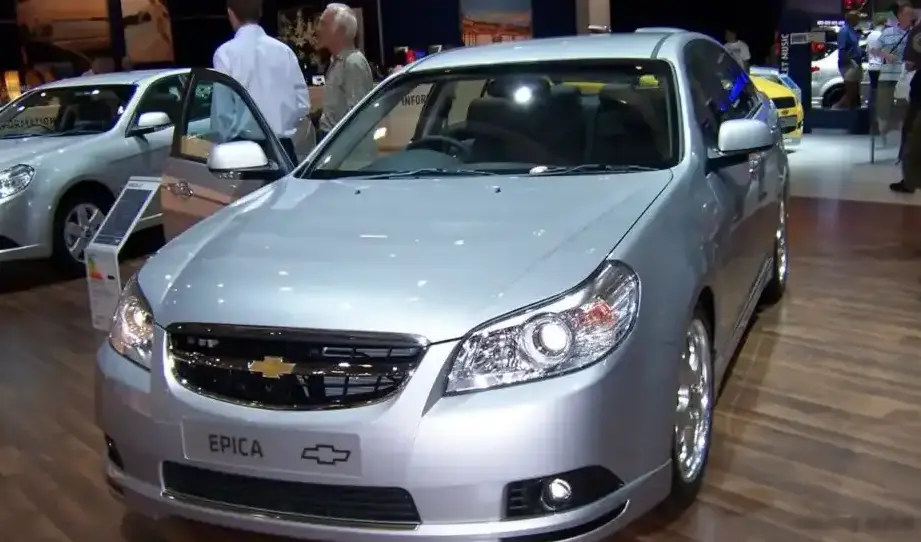
The Chevrolet Epica 2.0i 24V, produced from 2006 to 2011, represented Chevrolet’s entry into the mid-size sedan segment, primarily aimed at international markets. Developed under the leadership of Daewoo Motors before its acquisition by General Motors, the Epica was intended to offer a more sophisticated and spacious alternative to existing offerings. This particular 2.0-liter variant, producing 143 horsepower, served as a core model within the Epica lineup, positioned as a balance between affordability and acceptable performance. It was largely sold in Europe, South America, and parts of Asia, and was not a significant seller in the North American market.
Technical Specifications
| Brand | Chevrolet |
| Model | Epica |
| Generation | Epica |
| Type (Engine) | 2.0 i 24V (143 Hp) |
| Start of production | 2006 |
| End of production | 2011 |
| Powertrain Architecture | Internal Combustion engine |
| Body type | Sedan |
| Seats | 5 |
| Doors | 4 |
| Fuel consumption (urban) | 11.4 l/100 km (20.6 US mpg) |
| Fuel consumption (extra urban) | 6.3 l/100 km (37.3 US mpg) |
| Fuel consumption (combined) | 8.2 l/100 km (28.7 US mpg) |
| Fuel Type | Petrol (Gasoline) |
| Acceleration 0 – 100 km/h | 9.9 sec |
| Acceleration 0 – 62 mph | 9.9 sec |
| Acceleration 0 – 60 mph | 9.4 sec |
| Maximum speed | 207 km/h (128.62 mph) |
| Weight-to-power ratio | 10.5 kg/Hp |
| Weight-to-torque ratio | 7.7 kg/Nm |
| Power | 143 Hp @ 6300 rpm |
| Torque | 195 Nm @ 4600 rpm (143.82 lb.-ft. @ 4600 rpm) |
| Engine layout | Front, Transverse |
| Engine Model/Code | LBM, LF3 |
| Engine displacement | 1993 cm3 (121.62 cu. in.) |
| Number of cylinders | 6 |
| Engine configuration | Inline |
| Cylinder Bore | 75 mm (2.95 in.) |
| Piston Stroke | 75.2 mm (2.96 in.) |
| Compression ratio | 9.9:1 |
| Number of valves per cylinder | 4 |
| Fuel injection system | Multi-port manifold injection |
| Engine aspiration | Naturally aspirated |
| Valvetrain | DOHC |
| Engine oil capacity | 6.4 l (6.76 US qt | 5.63 UK qt) |
| Coolant capacity | 8 l (8.45 US qt | 7.04 UK qt) |
| Kerb Weight | 1500 kg (3306.93 lbs.) |
| Max. weight | 1985 kg (4376.18 lbs.) |
| Max load | 485 kg (1069.24 lbs.) |
| Trunk (boot) space | 435 l (15.36 cu. ft.) |
| Fuel tank capacity | 65 l (17.17 US gal | 14.3 UK gal) |
| Length | 4804 mm (189.13 in.) |
| Width | 1807 mm (71.14 in.) |
| Height | 1449 mm (57.05 in.) |
| Wheelbase | 2700 mm (106.3 in.) |
| Front track | 1550 mm (61.02 in.) |
| Rear track | 1545 mm (60.83 in.) |
| Drivetrain Architecture | Front wheel drive |
| Number of gears | 5 |
| Gearbox type | Manual transmission |
| Front suspension | Spring Strut |
| Rear suspension | Transverse stabilizer |
| Front brakes | Ventilated discs |
| Rear brakes | Disc |
| Assisting systems | ABS (Anti-lock braking system) |
| Steering type | Steering rack and pinion |
| Tires size | 205/60 R16 |
| Wheel rims size | 6J X 16 |
INTRODUCTION
The Chevrolet Epica, launched in 2006, was a mid-size sedan designed to replace the Daewoo Nubira and Leganza. Built on the GM Delta platform (also known as the 1HX0/A3 platform), it aimed to provide a more modern and comfortable driving experience. The 2.0i 24V variant, equipped with a naturally aspirated inline-six engine and a five-speed manual transmission, was a popular choice for buyers seeking a balance between fuel efficiency and reasonable performance. It occupied a middle ground in the Epica range, slotting below the more powerful 2.5-liter V6 models and above any potential base-level engine options depending on the specific market.
Powertrain & Engine Architecture
The heart of the Epica 2.0i 24V is the LBM/LF3 engine, a 1,993 cc (121.62 cubic inches) inline-six cylinder powerplant. This engine utilizes a double overhead camshaft (DOHC) valvetrain with four valves per cylinder, contributing to its 24-valve configuration. Fuel delivery is managed by a multi-port fuel injection system, providing precise fuel metering for optimal combustion. The engine’s 9.9:1 compression ratio strikes a balance between efficiency and power output. The five-speed manual transmission was the standard offering for this trim, providing drivers with direct control over gear selection. The transmission’s gear ratios were tuned for a blend of acceleration and highway cruising, though it wasn’t particularly sporty in its feel. The engine code variations (LBM and LF3) often related to minor regional differences in calibration or emissions control equipment.
Driving Characteristics
The Epica 2.0i 24V offered a comfortable, rather than exhilarating, driving experience. With 143 horsepower and 195 Nm (143.82 lb-ft) of torque, acceleration was adequate for everyday driving, with a 0-60 mph time of around 9.4 seconds. However, it lacked the punch of the V6 models. The five-speed manual transmission allowed for reasonable control, but the gear ratios weren’t particularly close-ratio, meaning frequent shifting wasn’t necessary but wasn’t particularly engaging either. Compared to the automatic transmission option, the manual provided better fuel economy and a more connected feel. The suspension was tuned for comfort, absorbing bumps and imperfections in the road well, but this came at the expense of sharp handling. The steering was light and easy, making it suitable for urban driving but lacking in feedback.
Equipment & Trim Levels
The Epica 2.0i 24V typically came equipped with a reasonable level of standard features. These generally included air conditioning, power windows and locks, a basic audio system (often with CD player), and standard safety equipment like dual front airbags and ABS brakes. Interior upholstery was typically cloth, with options for leather upgrades available on higher trim levels. Optional extras could include a sunroof, upgraded audio systems, alloy wheels, and rear parking sensors. The dashboard layout was functional and straightforward, prioritizing ease of use over stylistic flair. Trim levels varied by market, but generally, the 2.0i 24V represented a mid-range offering, with more luxurious features reserved for the V6 models.
Chassis & Braking
The Epica utilized a front-engine, front-wheel-drive layout. The front suspension employed a MacPherson strut design, while the rear suspension featured a multi-link setup with a transverse stabilizer bar. This configuration aimed to provide a comfortable ride and reasonable handling. Braking duties were handled by ventilated discs at the front and solid discs at the rear, providing adequate stopping power for the vehicle’s weight. ABS (Anti-lock Braking System) was standard, enhancing safety during emergency braking situations. The chassis was designed for rigidity and crash safety, meeting the standards of the time.
Market Reception & Comparison
The Chevrolet Epica 2.0i 24V received mixed reviews from automotive critics. It was generally praised for its spacious interior, comfortable ride, and reasonable price point. However, it was often criticized for its uninspired styling, lack of driving excitement, and somewhat dated technology. Compared to its siblings, the 2.5-liter V6 Epica offered significantly more power and a more refined driving experience, but at a higher price. The 2.0i 24V offered better fuel economy than the V6, making it a more practical choice for budget-conscious buyers. Reliability was generally considered average, with some reports of minor electrical issues and occasional problems with the fuel injection system.
Legacy
The Chevrolet Epica, while not a resounding success in terms of sales, served as an important stepping stone for Chevrolet in certain international markets. The 2.0i 24V powertrain, while not particularly groundbreaking, proved to be reasonably durable and reliable. On the used car market today, Epica 2.0i 24V models are relatively affordable and can represent a good value for buyers seeking a spacious and comfortable sedan. However, potential buyers should be aware of the car’s age and potential maintenance needs. Parts availability can be a concern in some regions, and finding qualified mechanics familiar with the Epica may require some effort. Despite its shortcomings, the Epica 2.0i 24V remains a testament to Chevrolet’s efforts to compete in the global mid-size sedan segment.
