
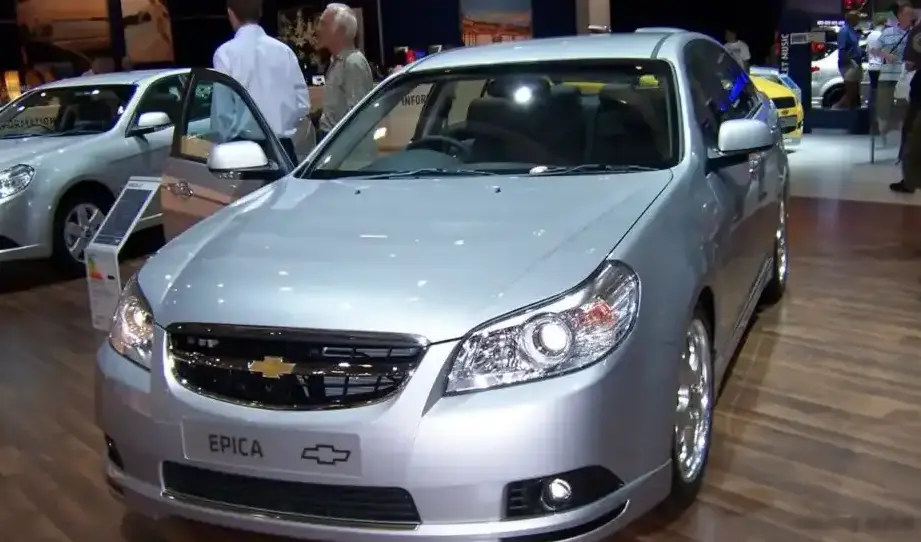
The Chevrolet Epica 2.5i 24V, produced from 2006 to 2011, represented Chevrolet’s entry into the mid-size sedan segment, primarily aimed at international markets. Developed under the leadership of Daewoo Motors before its acquisition by General Motors, the Epica was intended to offer a more sophisticated and spacious alternative to existing models. This particular 2.5-liter variant, producing 154 horsepower, served as a mid-range offering within the Epica lineup, positioned between the base 2.0-liter engine and potential higher-performance options in some markets. The Epica was built on the GM J-platform, shared with other vehicles like the Buick Regal and Opel Vectra, and was sold under various Chevrolet names globally.
Technical Specifications
| Brand | Chevrolet |
| Model | Epica |
| Generation | Epica |
| Type (Engine) | 2.5 i 24V (154 Hp) |
| Start of production | 2006 |
| End of production | 2011 |
| Powertrain Architecture | Internal Combustion engine |
| Body type | Sedan |
| Seats | 5 |
| Doors | 4 |
| Fuel consumption (urban) | 13.8 l/100 km (17 US mpg, 20.5 UK mpg) |
| Fuel consumption (extra urban) | 6.6 l/100 km (35.6 US mpg, 42.8 UK mpg) |
| Fuel consumption (combined) | 9.3 l/100 km (25.3 US mpg, 30.4 UK mpg) |
| Fuel Type | Petrol (Gasoline) |
| Acceleration 0 – 100 km/h | 9.9 sec |
| Acceleration 0 – 62 mph | 9.9 sec |
| Acceleration 0 – 60 mph | 9.4 sec |
| Maximum speed | 208 km/h (129.25 mph) |
| Weight-to-power ratio | 10.6 kg/Hp |
| Weight-to-torque ratio | 6.9 kg/Nm |
| Power | 154 Hp @ 5800 rpm |
| Torque | 237 Nm @ 4000 rpm (174.8 lb.-ft. @ 4000 rpm) |
| Engine layout | Front, Transverse |
| Engine Model/Code | LBK, LF4 |
| Engine displacement | 2492 cm3 (152.07 cu. in.) |
| Number of cylinders | 6 |
| Engine configuration | Inline |
| Cylinder Bore | 77 mm (3.03 in.) |
| Piston Stroke | 89.2 mm (3.51 in.) |
| Compression ratio | 9.9:1 |
| Number of valves per cylinder | 4 |
| Fuel injection system | Multi-port manifold injection |
| Engine aspiration | Naturally aspirated |
| Valvetrain | DOHC |
| Engine oil capacity | 6.4 l (6.76 US qt | 5.63 UK qt) |
| Coolant capacity | 8 l (8.45 US qt | 7.04 UK qt) |
| Kerb Weight | 1630 kg (3593.53 lbs.) |
| Max. weight | 1985 kg (4376.18 lbs.) |
| Max load | 355 kg (782.64 lbs.) |
| Trunk (boot) space – minimum | 435 l (15.36 cu. ft.) |
| Fuel tank capacity | 65 l (17.17 US gal | 14.3 UK gal) |
| Length | 4804 mm (189.13 in.) |
| Width | 1807 mm (71.14 in.) |
| Height | 1449 mm (57.05 in.) |
| Wheelbase | 2700 mm (106.3 in.) |
| Front track | 1550 mm (61.02 in.) |
| Rear track | 1545 mm (60.83 in.) |
| Drivetrain Architecture | Front wheel drive |
| Number of gears | 5 |
| Gearbox type | Automatic transmission |
| Front suspension | Spring Strut |
| Rear suspension | Transverse stabilizer |
| Front brakes | Ventilated discs |
| Rear brakes | Disc |
| Assisting systems | ABS (Anti-lock braking system) |
| Steering type | Steering rack and pinion |
| Tires size | 215/50 R17 |
| Wheel rims size | 7J X 17 |
Powertrain & Engine Architecture
The Chevrolet Epica 2.5i utilized the LBK or LF4 engine code, a 2.5-liter inline-six cylinder engine. This engine featured a double overhead camshaft (DOHC) valvetrain and multi-port fuel injection. The inline-six configuration, while less common in modern vehicles, offered inherent smoothness and balance. The engine’s 9.9:1 compression ratio was a compromise between performance and the ability to run on readily available fuel grades. The five-speed automatic transmission was a crucial component of this variant, designed to provide comfortable and convenient shifting. While not a sport-oriented transmission, it was geared for relaxed cruising and acceptable acceleration. The transmission’s shift logic prioritized smoothness over aggressive downshifts, catering to the target audience seeking a comfortable driving experience.
Driving Characteristics
The 154 horsepower and 174.8 lb-ft of torque delivered by the 2.5-liter engine, coupled with the five-speed automatic, resulted in a driving experience focused on comfort and usability rather than outright performance. Acceleration from 0-60 mph took approximately 9.4 seconds, which was adequate for everyday driving but noticeably slower than comparable vehicles equipped with manual transmissions or more powerful engines. The automatic transmission’s gear ratios were optimized for fuel efficiency and smooth transitions, but this came at the expense of responsiveness. Compared to a potential V6 or a turbocharged variant, the 2.5i automatic felt less eager to accelerate, particularly when overtaking or climbing hills. However, the engine provided sufficient power for highway cruising and city driving, and the automatic transmission minimized driver fatigue.
Equipment & Trim Levels
The 2.5i trim level of the Epica typically included standard features such as air conditioning, power windows and locks, a basic audio system, and cloth upholstery. Higher trim levels, available in some markets, added features like leather seats, a sunroof, upgraded audio systems, and alloy wheels. The interior design was generally functional and spacious, prioritizing comfort over luxury. Optional extras often included a CD changer, upgraded speakers, and various cosmetic enhancements. Safety features typically included dual front airbags and ABS brakes, although the availability of additional safety equipment varied depending on the market.
Chassis & Braking
The Epica’s chassis featured a MacPherson strut front suspension and a multi-link rear suspension, designed to provide a comfortable ride and stable handling. The front suspension utilized coil springs and a stabilizer bar, while the rear suspension also incorporated a stabilizer bar to reduce body roll. Braking duties were handled by ventilated discs at the front and solid discs at the rear, equipped with an Anti-lock Braking System (ABS) to enhance safety. The brake system was adequate for the vehicle’s weight and performance, but it lacked the stopping power of more performance-oriented vehicles. The Epica’s tires were typically 215/50 R17, providing a good balance between ride comfort and handling.
Market Reception & Comparison
The Chevrolet Epica 2.5i was generally well-received as a comfortable and spacious mid-size sedan, offering good value for money. Critics praised its roomy interior and smooth ride, but some noted its unremarkable performance and somewhat bland styling. Compared to other vehicles in its class, such as the Toyota Camry or Honda Accord, the Epica offered a more affordable price point but lacked the same level of refinement and brand recognition. Fuel economy was average for its class, with combined fuel consumption around 25.3 US mpg. Reliability was generally considered to be acceptable, although some owners reported issues with the automatic transmission and electrical components.
Legacy
The Chevrolet Epica, while not a sales success in many markets, provided a valuable learning experience for General Motors. The 2.5-liter inline-six engine proved to be reasonably durable, although long-term reliability of the automatic transmission could be a concern. On the used car market, the Epica 2.5i represents an affordable option for buyers seeking a spacious and comfortable sedan. Maintenance costs are generally reasonable, but sourcing parts can sometimes be challenging depending on the region. The Epica’s legacy lies in its role as a transitional vehicle for Chevrolet, bridging the gap between its older models and its more modern offerings.
