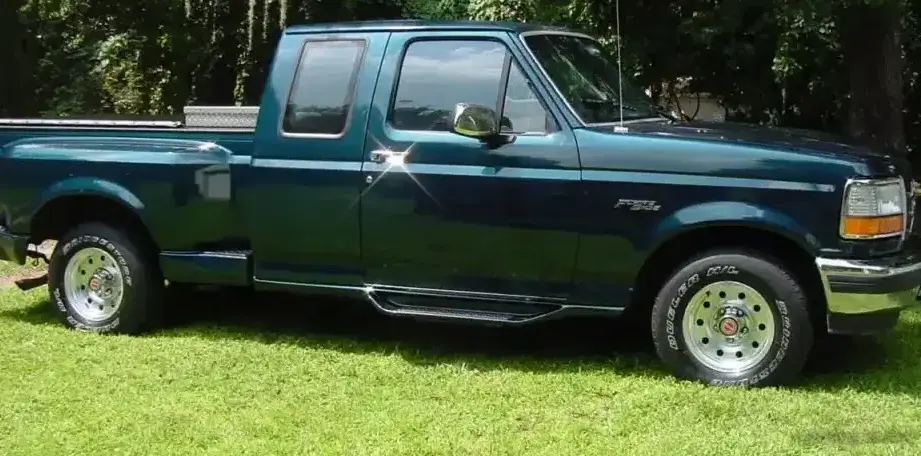
The Ford F-Series F-150 IX SuperCab, equipped with the 5.8-liter V8 engine and automatic transmission, represents a significant iteration of America’s best-selling vehicle. Produced from 1991 through 1997, this variant occupied a middle ground within the ninth generation (1987-1997) F-Series lineup, offering a balance between capability and affordability. It was positioned as a step up from the base inline-six engine options, appealing to buyers needing more power for towing and hauling, but who didn’t require the higher cost and complexity of the larger 351 Windsor V8. The SuperCab configuration, with its extended cab, provided increased passenger space, making it a popular choice for families and work crews.
Technical Specifications
| Brand | Ford |
| Model | F-Series F-150 |
| Generation | F-Series F-150 IX SuperCab |
| Type (Engine) | 5.8 V8 (210 Hp) Automatic |
| Start of production | August, 1991 |
| End of production | 1997 |
| Powertrain Architecture | Internal Combustion engine |
| Body type | Pick-up |
| Seats | 5-6 |
| Doors | 2 |
| Fuel Type | Petrol (Gasoline) |
| Power | 210 Hp |
| Power per litre | 36.2 Hp/l |
| Torque | 427 Nm / 314.94 lb.-ft. |
| Engine layout | Front, Longitudinal |
| Engine displacement | 5800 cm3 / 353.94 cu. in. |
| Number of cylinders | 8 |
| Engine configuration | V-engine |
| Number of valves per cylinder | 2 |
| Fuel injection system | Multi-port manifold injection |
| Engine aspiration | Naturally aspirated engine |
| Engine oil capacity | 4.7 l / 4.97 US qt | 4.14 UK qt |
| Coolant | 15.5 l / 16.38 US qt | 13.64 UK qt |
| Max. weight | 2835 kg / 6250.11 lbs. |
| Fuel tank capacity | 131-141 l / 34.61 – 37.25 US gal | 28.82 – 31.02 UK gal |
| Length | 5565-5977 mm / 219.09 – 235.31 in. |
| Width | 2007 mm / 79.02 in. |
| Height | 1821 mm / 71.69 in. |
| Wheelbase | 3531-3937 mm / 139.02 – 155 in. |
| Wading depth | 780 mm / 30.71 in. |
| Drivetrain Architecture | The Internal combustion engine (ICE) drives the rear wheels of the vehicle. |
| Drive wheel | Rear wheel drive |
| Number of gears and type of gearbox | 4 gears, automatic transmission |
| Front suspension | Independent coil spring |
| Rear suspension | Leaf spring |
| Front brakes | Disc |
| Rear brakes | Drum |
| Power steering | Electric Steering |
| Tires size | 235/75 R15 |
| Wheel rims size | 15 |
Powertrain & Engine Architecture
The heart of this F-150 variant is the 351 Windsor V8 engine, a 5.8-liter (351 cubic inch) powerplant. This engine, a mainstay of Ford trucks for decades, utilizes a cast iron block and cylinder heads. The 210 horsepower and 315 lb-ft of torque were delivered through a four-speed automatic transmission, typically the AOD (Automatic Overdrive) unit. The AOD provided both automatic shifting and a torque converter for smooth operation, along with an overdrive gear for improved fuel economy at highway speeds. Fuel delivery was managed by a multi-port fuel injection system, a significant upgrade from the carbureted engines of earlier F-Series models. This system improved efficiency and reduced emissions. The engine featured a traditional pushrod valvetrain with two valves per cylinder, contributing to its robust and relatively simple design. The 351 Windsor’s design prioritized low-end torque, making it well-suited for truck applications where pulling power was more important than high-revving performance.
Driving Characteristics
The 5.8L V8 and AOD automatic combination offered a comfortable and capable driving experience. While not a performance-oriented setup, it provided ample power for everyday driving, towing, and hauling. Acceleration was adequate, but not brisk, with a 0-60 mph time estimated around 9-10 seconds. The automatic transmission’s gear ratios were optimized for torque delivery, making it well-suited for work applications. Compared to the manual transmission versions of the 5.8L, the automatic traded some responsiveness for ease of use. Against the larger 351 Windsor, the 5.8L offered a noticeable step down in power, but also a reduction in fuel consumption and overall vehicle cost. The leaf spring rear suspension, while providing a robust load-carrying capacity, resulted in a firmer ride, particularly when unladen. Steering felt relatively heavy, typical of trucks of this era, but provided a solid on-center feel.
Equipment & Trim Levels
The F-150 IX SuperCab 5.8L Automatic typically came standard with features like air conditioning, a basic AM/FM radio, and cloth upholstery. The SuperCab configuration added a second row of seating, increasing passenger capacity. Optional extras included power windows and locks, a sliding rear window, upgraded sound systems, and various trim packages. Interior color schemes were generally conservative, with options like gray, blue, and brown. The dashboard layout was functional and straightforward, prioritizing practicality over aesthetics. The trim level sat between the base models with the inline-six engine and the more luxurious trims equipped with the larger V8s. The “IX” designation indicated a mid-range trim package, offering a step up in features and comfort compared to the base XL model.
Chassis & Braking
The F-150 IX SuperCab utilized a body-on-frame construction, providing a durable and robust platform. The front suspension consisted of independent coil springs, offering a reasonable level of ride comfort. The rear suspension employed leaf springs, designed to handle heavy loads. Braking duties were handled by disc brakes at the front and drum brakes at the rear. Power steering was standard, making maneuvering the large truck easier. Tire size was typically 235/75R15, providing a good balance of ride comfort and load-carrying capacity. The chassis was designed to withstand the rigors of truck use, with a focus on durability and reliability. Frame construction was heavy-duty, designed to withstand significant twisting forces from hauling and towing.
Market Reception & Comparison
The F-150 IX SuperCab 5.8L Automatic was generally well-received by buyers seeking a versatile and capable truck. Critics praised its comfortable ride, spacious interior (thanks to the SuperCab), and adequate power. However, some noted that the 5.8L engine lacked the outright performance of the larger V8 options. Fuel economy was typical for a full-size truck of the era, averaging around 14-16 mpg in mixed driving. Compared to the 302 Windsor V8, the 5.8L offered a more affordable entry point, while still providing sufficient power for many tasks. Compared to the diesel options, it offered a lower initial cost but higher fuel consumption. The combination of the SuperCab and automatic transmission appealed to families and those who preferred the convenience of an automatic.
Legacy
The 351 Windsor engine, in general, is known for its durability and relative simplicity, making it a popular choice for rebuilds and modifications. The AOD automatic transmission, while reliable, can be prone to wear and tear with age, particularly if not properly maintained. Today, the F-150 IX SuperCab 5.8L Automatic represents a classic American truck, appreciated for its ruggedness and practicality. Well-maintained examples are sought after by collectors and enthusiasts. Parts availability remains good, making it relatively easy to keep these trucks on the road. The combination of the V8 engine, automatic transmission, and SuperCab configuration continues to appeal to those seeking a capable and comfortable full-size pickup. These trucks are often seen as representing a sweet spot in the F-150 lineage, offering a blend of classic styling, robust construction, and reasonable running costs.