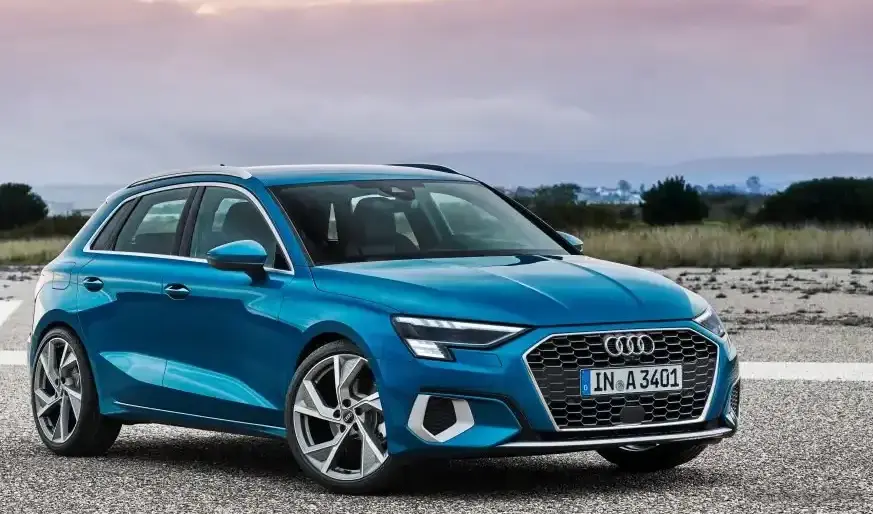
The Audi A3 Sportback (8Y) 35 TDI, produced from 2020 to 2024, represents a key offering within the fourth generation (8Y) of Audi’s popular compact hatchback. Positioned as a diesel-powered variant, the 35 TDI aimed to balance fuel efficiency with respectable performance, catering to European markets where diesel engines remained prevalent. This model occupied a mid-range position in the A3 Sportback lineup, slotting below the more powerful petrol variants like the 40 TFSI and above the entry-level 30 TDI. It was designed to appeal to drivers seeking a practical, economical, and refined daily driver.
Technical Specifications
| Brand | Audi |
| Model | A3 |
| Generation | A3 Sportback (8Y) |
| Type (Engine) | 35 TDI (150 Hp) |
| Start of production | 2020 |
| End of production | 2024 |
| Powertrain Architecture | Internal Combustion engine |
| Body type | Hatchback |
| Seats | 5 |
| Doors | 5 |
| Combined fuel consumption (WLTP) | 4.2-4.7 l/100 km (56 – 50 US mpg, 67.3 – 60.1 UK mpg, 23.8 – 21.3 km/l) |
| CO2 emissions (WLTP) | 111-124 g/km |
| Fuel Type | Diesel |
| Acceleration 0 – 100 km/h | 8.5 sec |
| Acceleration 0 – 62 mph | 8.5 sec |
| Acceleration 0 – 60 mph | 8.1 sec |
| Maximum speed | 222 km/h (137.94 mph) |
| Emission standard | Euro 6d-ISC-FCM |
| Weight-to-power ratio | 9.3 kg/Hp, 107.5 Hp/tonne |
| Weight-to-torque ratio | 4.1 kg/Nm, 243.7 Nm/tonne |
| Power | 150 Hp @ 3250-4200 rpm |
| Power per litre | 76.2 Hp/l |
| Torque | 340 Nm @ 1600-3000 rpm (250.77 lb.-ft. @ 1600-3000 rpm) |
| Engine layout | Front, Transverse |
| Engine Model/Code | EA288 evo / DTSA |
| Engine displacement | 1968 cm3 (120.09 cu. in.) |
| Number of cylinders | 4 |
| Engine configuration | Inline |
| Cylinder Bore | 81 mm (3.19 in.) |
| Piston Stroke | 95.5 mm (3.76 in.) |
| Compression ratio | 16:1 |
| Number of valves per cylinder | 4 |
| Fuel injection system | Diesel Commonrail |
| Engine aspiration | Turbocharger, Intercooler |
| Engine oil capacity | 5.5 l (5.81 US qt | 4.84 UK qt) |
| Coolant | 11.7 l (12.36 US qt | 10.29 UK qt) |
| Kerb Weight | 1395 kg (3075.45 lbs.) |
| Max. weight | 1950 kg (4299.01 lbs.) |
| Max load | 555 kg (1223.57 lbs.) |
| Trunk (boot) space – minimum | 380 l (13.42 cu. ft.) |
| Trunk (boot) space – maximum | 1200 l (42.38 cu. ft.) |
| Fuel tank capacity | 50 l (13.21 US gal | 11 UK gal) |
| AdBlue tank | 12 l (3.17 US gal | 2.64 UK gal) |
| Max. roof load | 75 kg (165.35 lbs.) |
| Permitted trailer load with brakes (8%) | 1800 kg (3968.32 lbs.) |
| Permitted trailer load with brakes (12%) | 1600 kg (3527.4 lbs.) |
| Permitted trailer load without brakes | 730 kg (1609.37 lbs.) |
| Permitted towbar download | 80 kg (176.37 lbs.) |
| Length | 4343 mm (170.98 in.) |
| Width | 1816 mm (71.5 in.) |
| Width including mirrors | 1984 mm (78.11 in.) |
| Height | 1449 mm (57.05 in.) |
| Wheelbase | 2636 mm (103.78 in.) |
| Front track | 1554 mm (61.18 in.) |
| Rear (Back) track | 1525 mm (60.04 in.) |
| Front overhang | 905 mm (35.63 in.) |
| Rear overhang | 802 mm (31.57 in.) |
| Drag coefficient (Cd) | 0.29 |
| Minimum turning circle (turning diameter) | 11.1 m (36.42 ft.) |
| Approach angle | 14.1° |
| Departure angle | 23.9° |
| Drivetrain Architecture | The Internal combustion engine (ICE) drives the front wheels of the vehicle. |
| Drive wheel | Front wheel drive |
| Number of gears and type of gearbox | 6 gears, manual transmission |
| Front suspension | Independent, type McPherson with coil spring and anti-roll bar |
| Rear suspension | Independent multi-link suspension |
| Front brakes | Ventilated discs |
| Rear brakes | Disc |
| Assisting systems | ABS (Anti-lock braking system) |
| Steering type | Worm-reduction unit |
| Power steering | Electric Steering |
| Tires size | 205/55 R16 |
| Wheel rims size | 7J x 16 |
Powertrain & Engine Architecture
The heart of the A3 35 TDI is the Volkswagen Group’s EA288 evo series diesel engine, specifically the DTSA code variant. This 1.968-liter inline-four cylinder engine utilizes a turbocharger with an intercooler to deliver 150 horsepower at 3250-4200 rpm and 340 Nm (250.77 lb.-ft.) of torque between 1600-3000 rpm. The engine employs a common rail direct injection system, enabling precise fuel delivery and contributing to both performance and efficiency. The EA288 evo featured improvements over its predecessor, including reduced internal friction and optimized combustion chamber design. The 6-speed manual transmission was standard, providing a direct connection to the engine and allowing for driver control.
Driving Characteristics
The A3 35 TDI with the manual transmission offered a balanced driving experience. While not overtly sporty, the engine provided sufficient torque for confident overtaking and comfortable cruising. The 6-speed gearbox was well-matched to the engine’s powerband, allowing for smooth shifts and efficient use of the available torque. Acceleration from 0-100 km/h (0-62 mph) took approximately 8.5 seconds. Compared to the more powerful 40 TFSI petrol variant, the 35 TDI felt less eager to rev, but it compensated with superior fuel economy and a broader, more accessible torque curve. The manual transmission provided a more engaging driving experience than the optional S tronic dual-clutch transmission, though the latter offered quicker shifts and greater convenience.
Equipment & Trim Levels
The A3 Sportback 35 TDI typically came equipped with a respectable level of standard features. These included Audi’s MMI infotainment system with a 7-inch touchscreen display, Bluetooth connectivity, air conditioning, and a leather-wrapped multifunction steering wheel. Safety features such as ABS, electronic stability control, and multiple airbags were also standard. Higher trim levels, such as Sport and S line, added features like sport seats, larger alloy wheels, LED headlights, and a more comprehensive infotainment system. Optional extras included a panoramic sunroof, a premium sound system, and advanced driver-assistance systems like adaptive cruise control and lane-keeping assist.
Chassis & Braking
The A3 Sportback 35 TDI utilized a MacPherson strut front suspension and a multi-link rear suspension, providing a comfortable and controlled ride. The suspension was tuned to prioritize comfort over outright sportiness, but it still offered decent handling characteristics. The braking system consisted of ventilated front discs and solid rear discs, providing adequate stopping power for everyday driving. ABS (Anti-lock Braking System) was standard. The car’s relatively modest weight, at around 1395 kg (3075.45 lbs), contributed to its nimble handling and reasonable braking performance.
Market Reception & Comparison
The Audi A3 35 TDI was generally well-received by automotive critics. It was praised for its fuel efficiency, comfortable ride, and refined interior. However, some reviewers noted that the engine lacked the outright performance of its petrol counterparts. Compared to other diesel-powered hatchbacks in its class, such as the Volkswagen Golf TDI and the Skoda Octavia TDI, the A3 35 TDI offered a more premium interior and a more sophisticated driving experience, but at a higher price point. Fuel economy was a key selling point, with the A3 35 TDI achieving between 4.2 and 4.7 liters per 100 kilometers (56-50 US mpg) on the WLTP cycle.
Legacy
The EA288 evo engine, found in the A3 35 TDI, has proven to be a relatively reliable powertrain when properly maintained. Common issues include diesel particulate filter (DPF) clogging, particularly on vehicles used primarily for short trips, and occasional problems with the turbocharger. However, these issues are generally not catastrophic and can often be addressed with preventative maintenance and timely repairs. On the used car market, the A3 35 TDI remains a popular choice for buyers seeking a fuel-efficient and practical hatchback. Its reputation for reliability and its comfortable driving experience contribute to its continued desirability. The 8Y generation A3, including the 35 TDI variant, represents a significant step forward in terms of technology and refinement compared to its predecessors, solidifying Audi’s position as a leader in the premium compact segment.