Technical Specifications
| Brand | Citroen |
| Model | C4 |
| Generation | C4 II Grand Picasso (Phase II, 2016) |
| Type (Engine) | 1.6 BlueHDI (120 Hp) S&S Automatic |
| Start of production | 2016 |
| End of production | 2018 |
| Powertrain Architecture | Internal Combustion engine |
| Body type | Minivan, MPV |
| Seats | 7 |
| Doors | 5 |
| Fuel consumption (urban) | 4.6 l/100 km (51.1 US mpg, 61.4 UK mpg, 21.7 km/l) |
| Fuel consumption (extra urban) | 3.7 l/100 km (63.6 US mpg, 76.3 UK mpg, 27 km/l) |
| Fuel consumption (combined) | 4 l/100 km (58.8 US mpg, 70.6 UK mpg, 25 km/l) |
| CO2 emissions | 106 g/km |
| Fuel Type | Diesel |
| Acceleration 0 – 100 km/h | 11.5 sec |
| Acceleration 0 – 62 mph | 11.5 sec |
| Acceleration 0 – 60 mph | 10.9 sec |
| Maximum speed | 188 km/h (116.82 mph) |
| Emission standard | Euro 6 |
| Weight-to-power ratio | 11.3 kg/Hp, 88.3 Hp/tonne |
| Weight-to-torque ratio | 4.5 kg/Nm, 220.8 Nm/tonne |
| Power | 120 Hp @ 3500 rpm |
| Power per litre | 76.9 Hp/l |
| Torque | 300 Nm @ 1750 rpm (221.27 lb.-ft. @ 1750 rpm) |
| Engine layout | Front, Transverse |
| Engine Model/Code | BHZ DV6FC |
| Engine displacement | 1560 cm3 (95.2 cu. in.) |
| Number of cylinders | 4 |
| Engine configuration | Inline |
| Cylinder Bore | 75 mm (2.95 in.) |
| Piston Stroke | 88.3 mm (3.48 in.) |
| Compression ratio | 16:1 |
| Number of valves per cylinder | 2 |
| Fuel injection system | Diesel Commonrail |
| Engine aspiration | Turbocharger, Intercooler |
| Engine oil capacity | 3.75 l (3.96 US qt | 3.3 UK qt) |
| Kerb Weight | 1359 kg (2996.08 lbs.) |
| Max. weight | 2205 kg (4861.19 lbs.) |
| Max load | 846 kg (1865.11 lbs.) |
| Trunk (boot) space – minimum | 165 l (5.83 cu. ft.) |
| Trunk (boot) space – maximum | 2181 l (77.02 cu. ft.) |
| Fuel tank capacity | 55 l (14.53 US gal | 12.1 UK gal) |
| AdBlue tank | 17 l (4.49 US gal | 3.74 UK gal) |
| Max. roof load | 80 kg (176.37 lbs.) |
| Permitted trailer load with brakes (12%) | 1200 kg (2645.55 lbs.) |
| Permitted trailer load without brakes | 675 kg (1488.12 lbs.) |
| Permitted towbar download | 70 kg (154.32 lbs.) |
| Length | 4602 mm (181.18 in.) |
| Width | 1826 mm (71.89 in.) |
| Width with mirrors folded | 1971 mm (77.6 in.) |
| Width including mirrors | 2117 mm (83.35 in.) |
| Height | 1638-1644 mm (64.49 – 64.72 in.) |
| Wheelbase | 2840 mm (111.81 in.) |
| Front track | 1573-1587 mm (61.93 – 62.48 in.) |
| Rear (Back) track | 1576-1590 mm (62.05 – 62.6 in.) |
| Front overhang | 889 mm (35 in.) |
| Rear overhang | 873 mm (34.37 in.) |
| Minimum turning circle | 11.3 m (37.07 ft.) |
| Drivetrain Architecture | Front wheel drive |
| Number of gears and type of gearbox | 6 gears, automatic transmission |
| Front suspension | Independent, type McPherson with coil spring and anti-roll bar |
| Rear suspension | Semi-independent, coil spring |
| Front brakes | Ventilated discs |
| Rear brakes | Disc |
| Assisting systems | ABS (Anti-lock braking system) |
| Steering type | Steering rack and pinion |
| Power steering | Electric Steering |
| Tires size | 205/60 R16; 205/55 R17 |
| Wheel rims size | 16; 17 |
Introduction
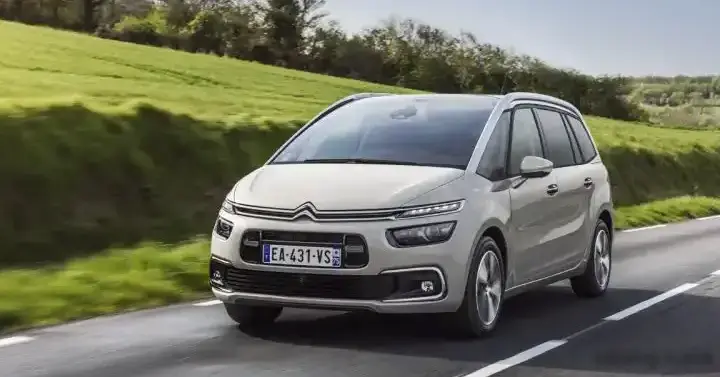
The Citroen C4 II Grand Picasso, specifically the Phase II model produced from 2016 to 2018, represented a significant evolution of Citroen’s popular MPV (Multi-Purpose Vehicle). The 1.6 BlueHDi 120 horsepower variant with an automatic transmission was a key offering within the range, positioned as a balance between fuel efficiency, practicality, and comfortable driving. This version catered to families and drivers prioritizing economy and ease of use over outright performance. It falls within the second generation of the C4 Picasso (internally known as the B7 platform), which debuted in 2013, with the Phase II facelift bringing styling updates and technological enhancements. This particular configuration aimed to provide a refined and economical experience within the larger C4 Grand Picasso lineup.
Powertrain & Engine Architecture
The heart of this C4 Grand Picasso variant is the 1.6-liter BlueHDi engine, specifically the BHZ DV6FC code. This engine is a member of the PSA Group’s (Peugeot Citroen) DV engine family, known for its efficiency and relatively compact size. It’s a four-cylinder, inline diesel engine featuring a turbocharger with an intercooler to enhance power and efficiency. The engine utilizes a common rail direct fuel injection system, delivering fuel directly into the cylinders at high pressure for optimized combustion. The 16:1 compression ratio is typical for diesel engines, contributing to their thermal efficiency. The engine also incorporates a Diesel Particulate Filter (DPF) and utilizes an AdBlue system (Selective Catalytic Reduction) to reduce NOx emissions, ensuring compliance with Euro 6 emission standards. The six-speed automatic transmission is a conventional torque converter type, prioritizing smooth shifts and ease of driving over ultimate performance. The Start & Stop system further contributes to fuel savings by automatically shutting off the engine when the vehicle is stationary. This engine represented a move towards smaller displacement, turbocharged diesel engines for improved fuel economy and reduced emissions.
Driving Characteristics
The 120 horsepower output, coupled with 300 Nm (221 lb-ft) of torque, provides adequate performance for everyday driving. Acceleration from 0-60 mph takes around 10.9 seconds, and top speed is around 116 mph. However, it’s not a particularly sporty vehicle. The automatic transmission, while smooth, can feel somewhat hesitant during quick acceleration or overtaking maneuvers. The gear ratios are tuned for fuel economy rather than outright speed. Compared to the more powerful 150 hp BlueHDi variant, this version feels noticeably slower, especially when fully loaded with passengers and luggage. The 1.6 BlueHDi offers a more relaxed driving experience than the petrol engines available in the C4 Grand Picasso range, with readily available low-end torque making it easy to navigate urban traffic. The automatic transmission, while not offering the engagement of a manual, provides a comfortable and convenient driving experience for those prioritizing ease of use.
Equipment & Trim Levels
The 1.6 BlueHDi 120 S&S Automatic typically came with a good level of standard equipment. This included air conditioning, a touchscreen infotainment system with Bluetooth connectivity, cruise control, and electric windows. Higher trim levels added features like navigation, panoramic sunroof, leather upholstery, and parking sensors. Interior upholstery was generally cloth, although leather options were available. The dashboard layout was modern and functional, with a focus on ergonomics. Safety features included ABS, ESP (Electronic Stability Program), and multiple airbags. The C4 Grand Picasso aimed to offer a family-friendly interior with ample storage space and comfortable seating.
Chassis & Braking
The C4 Grand Picasso utilizes a McPherson strut front suspension and a semi-independent coil spring rear suspension. This setup provides a comfortable ride quality, absorbing bumps and imperfections in the road effectively. The front brakes are ventilated discs, while the rear brakes are solid discs. The steering is electric power-assisted, offering light and precise control. Stabilizer bars are fitted to both the front and rear axles to reduce body roll during cornering. The weight distribution is fairly balanced, contributing to stable handling. The suspension tuning prioritized comfort over sporty handling, making it well-suited for long journeys and everyday driving.
Market Reception & Comparison
The 1.6 BlueHDi 120 S&S Automatic was well-received by critics as a practical and economical MPV. Its fuel economy of around 58.8 US mpg combined was a major selling point. Compared to the 150 hp BlueHDi variant, it offered lower running costs but at the expense of performance. The petrol engines, while offering a smoother driving experience, generally lacked the fuel efficiency of the diesel options. Reliability was generally good, although some owners reported issues with the DPF system, a common problem with modern diesel engines. The C4 Grand Picasso competed with other MPVs such as the Renault Scenic and Ford C-Max, offering a compelling combination of space, practicality, and fuel efficiency.
Legacy
The 1.6 BlueHDi engine has proven to be a relatively reliable powertrain, although regular maintenance, including DPF regeneration, is crucial. In the used car market, the C4 Grand Picasso 1.6 BlueHDi 120 S&S Automatic remains a popular choice for families seeking a spacious, economical, and comfortable MPV. Its combination of practicality, fuel efficiency, and reasonable running costs continues to make it a compelling option, even as newer models have emerged. The availability of spare parts is good, and the relatively simple mechanical design makes it relatively easy to maintain. This variant represents a sweet spot in the C4 Grand Picasso range, offering a good balance of affordability, economy, and usability for families.