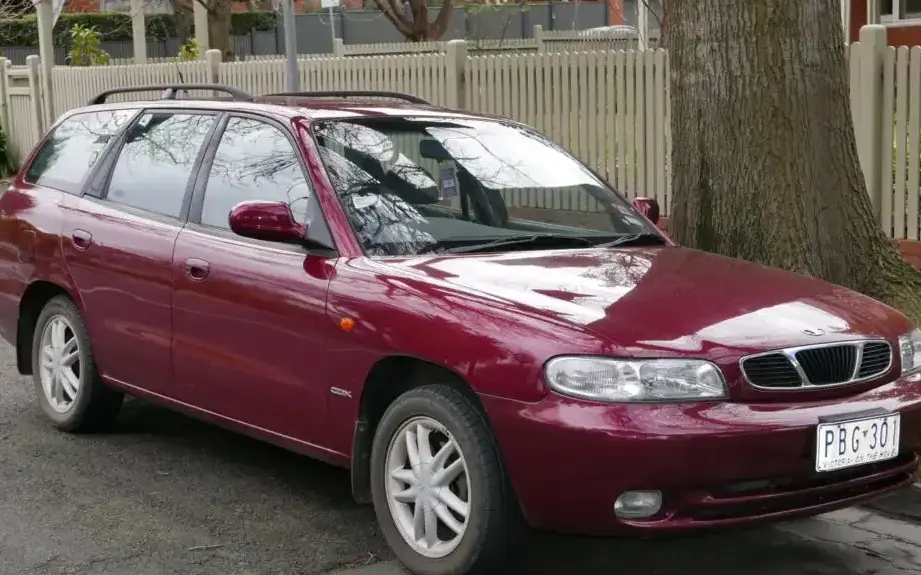
The Daewoo Nubira Wagon, specifically the KLAJ generation produced between 1997 and 2001, represented Daewoo’s entry into the competitive compact station wagon segment. Positioned as a practical and affordable family vehicle, the 1.6 i 16V variant with an automatic transmission was a key offering aimed at buyers prioritizing ease of use and fuel efficiency over outright performance. This model was primarily sold in European and Asian markets, where the station wagon body style remained popular. The Nubira Wagon was built on the J-platform, shared with other GM vehicles of the era, and aimed to provide a spacious and well-equipped vehicle at a competitive price point.
Technical Specifications
| Brand | Daewoo |
| Model | Nubira |
| Generation | Nubira Wagon (KLAJ) |
| Type (Engine) | 1.6 i 16V (106 Hp) Automatic |
| Start of production | 1997 |
| End of production | 2001 |
| Powertrain Architecture | Internal Combustion engine |
| Body type | Station wagon (estate) |
| Seats | 5 |
| Doors | 5 |
| Fuel consumption (urban) | 13.6 l/100 km (17.3 US mpg) |
| Fuel consumption (extra urban) | 6.9 l/100 km (34.1 US mpg) |
| Fuel Type | Petrol (Gasoline) |
| Acceleration 0 – 100 km/h | 13 sec |
| Acceleration 0 – 62 mph | 13 sec |
| Acceleration 0 – 60 mph | 12.4 sec |
| Maximum speed | 170 km/h (105.63 mph) |
| Weight-to-power ratio | 10.8 kg/Hp |
| Weight-to-torque ratio | 7.9 kg/Nm |
| Power | 106 Hp @ 6000 rpm |
| Torque | 145 Nm @ 3400 rpm (106.95 lb.-ft. @ 3400 rpm) |
| Engine layout | Front, Transverse |
| Engine Model/Code | A16DMS |
| Engine displacement | 1598 cm3 (97.52 cu. in.) |
| Number of cylinders | 4 |
| Engine configuration | Inline |
| Cylinder Bore | 79 mm (3.11 in.) |
| Piston Stroke | 81.5 mm (3.21 in.) |
| Compression ratio | 9:1 |
| Number of valves per cylinder | 4 |
| Fuel injection system | Multi-port manifold injection |
| Engine aspiration | Naturally aspirated engine |
| Valvetrain | DOHC |
| Engine oil capacity | 3.75 l (3.96 US qt | 3.3 UK qt) |
| Kerb Weight | 1140 kg (2513.27 lbs.) |
| Max. weight | 1860 kg (4100.6 lbs.) |
| Max load | 720 kg (1587.33 lbs.) |
| Trunk (boot) space – minimum | 412 l (14.55 cu. ft.) |
| Trunk (boot) space – maximum | 840 l (29.66 cu. ft.) |
| Fuel tank capacity | 62 l (16.38 US gal | 13.64 UK gal) |
| Length | 4550 mm (179.13 in.) |
| Width | 1720 mm (67.72 in.) |
| Height | 1470 mm (57.87 in.) |
| Wheelbase | 2570 mm (101.18 in.) |
| Front track | 1464 mm (57.64 in.) |
| Rear (Back) track | 1454 mm (57.24 in.) |
| Drivetrain Architecture | Front wheel drive |
| Number of gears and type of gearbox | 4 gears, automatic transmission |
| Front suspension | Coil spring |
| Rear suspension | Coil spring |
| Front brakes | Ventilated discs |
| Rear brakes | Drum |
| Steering type | Steering rack and pinion |
| Power steering | Hydraulic Steering |
| Tires size | 185/65 R14 |
| Wheel rims size | 5.5J x 14 |
Powertrain & Engine Architecture
The heart of the Nubira Wagon 1.6 Automatic was the A16DMS engine, a 1.6-liter inline-four cylinder gasoline engine. This engine featured a double overhead camshaft (DOHC) valvetrain with four valves per cylinder, contributing to improved breathing and efficiency. It utilized a multi-port fuel injection system, delivering fuel directly to each intake port for precise fuel metering. The A16DMS produced 106 horsepower at 6000 rpm and 145 Nm (107 lb-ft) of torque at 3400 rpm. The engine’s 9:1 compression ratio was a compromise between performance and the fuel quality available in various markets. Paired with the engine was a four-speed automatic transmission, designed for smooth and convenient operation. This transmission wasn’t known for its sportiness, prioritizing comfort and fuel economy over rapid shifts.
Driving Characteristics
The 1.6L automatic Nubira Wagon offered a comfortable, but not particularly exciting, driving experience. Acceleration from 0-60 mph took around 12.4 seconds, and top speed was limited to 105.63 mph. The automatic transmission, while smooth, resulted in noticeable power loss compared to the available five-speed manual version. Gear ratios were tuned for fuel efficiency, meaning the engine often felt strained during overtaking maneuvers or when climbing hills. The suspension, tuned for comfort, provided a relatively soft ride, absorbing bumps well but also resulting in some body roll during cornering. Steering was light and easy, making it suitable for city driving, but lacked the precision desired by more enthusiastic drivers.
Equipment & Trim Levels
The 1.6L Automatic Nubira Wagon typically came with a reasonable level of standard equipment. This included power steering, central locking, electric front windows, and an AM/FM radio. Interior upholstery was typically cloth, with a relatively simple dashboard layout. Optional extras included air conditioning, alloy wheels, and a more advanced audio system. Trim levels varied by market, but generally, the 1.6 Automatic represented a mid-range offering, positioned above the base models but below the more powerful 2.0L variants.
Chassis & Braking
The Nubira Wagon’s chassis featured a MacPherson strut front suspension and a coil spring rear suspension. The front brakes were ventilated discs, providing adequate stopping power, while the rear brakes were drums, a cost-saving measure common in this class of vehicle. The car’s weight of approximately 1140 kg (2513 lbs) contributed to its relatively modest performance. Stabilizer bars were fitted to both the front and rear axles to reduce body roll, but their effectiveness was limited by the soft suspension tuning.
Market Reception & Comparison
The Nubira Wagon 1.6 Automatic was generally well-received as a practical and affordable family car. Critics praised its spacious interior and comfortable ride, but noted its lack of performance and somewhat unrefined engine. Compared to its siblings, such as the 2.0L models, the 1.6L Automatic offered significantly less power and acceleration. However, it also delivered better fuel economy and was generally more affordable to purchase and maintain. Compared to competitors like the Ford Focus Wagon or the Opel/Vauxhall Astra Estate, the Nubira Wagon offered a similar level of practicality and affordability, but often lacked the brand recognition and perceived quality of its European rivals.
Legacy
The A16DMS engine, while not known for being particularly groundbreaking, proved to be reasonably reliable. With proper maintenance, these engines can last for many years. The four-speed automatic transmission is also generally durable, although it can be prone to wear and tear over time. Today, the Nubira Wagon 1.6 Automatic is a relatively rare sight on the roads. Its affordability and practicality make it an attractive option for budget-conscious buyers, but its age and lack of modern features limit its appeal. Parts availability can be a challenge in some markets, but many components are still available through aftermarket suppliers. The Nubira Wagon represents a snapshot of Daewoo’s ambition to establish itself as a major player in the global automotive market, and while it didn’t achieve widespread success, it remains a fondly remembered vehicle for those who owned and drove one.