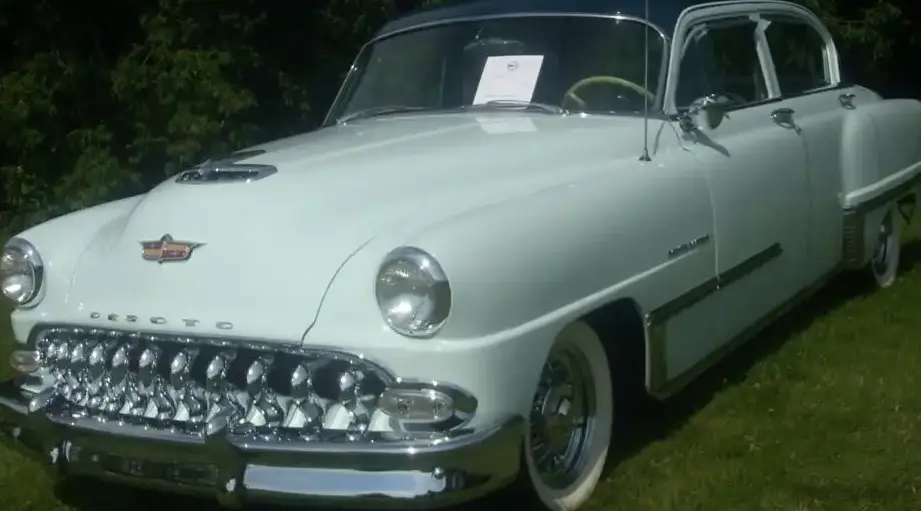
The DeSoto Powermaster Six 8-Passenger, produced for the 1952 and 1953 model years, represented a significant offering in the full-size American automobile market. Positioned as a practical and spacious family vehicle, it was part of the broader Powermaster line, DeSoto’s top-tier offering. This particular variant, equipped with the 4.1-liter (250.6 cubic inch) inline-six engine producing 116 horsepower, aimed to balance affordability with the comfort and capacity demanded by large families during the post-war era. It competed directly with similar offerings from Chevrolet, Ford, and Plymouth, all vying for a share of the burgeoning American automotive landscape.
Technical Specifications
| Brand | DeSoto |
| Model | Powermaster Six |
| Generation | Powermaster Six 8-Passenger |
| Type (Engine) | 4.1 (116 Hp) |
| Start of production | 1952 |
| End of production | 1953 |
| Powertrain Architecture | Internal Combustion engine |
| Body type | Sedan |
| Seats | 8 |
| Doors | 4 |
| Fuel Type | Petrol (Gasoline) |
| Power | 116 Hp @ 3600 rpm |
| Power per litre | 28.3 Hp/l |
| Torque | 282 Nm @ 1600 rpm |
| Torque (lb-ft) | 207.99 lb.-ft. @ 1600 rpm |
| Engine displacement | 4106 cm3 |
| Engine displacement (cu. in.) | 250.56 cu. in. |
| Number of cylinders | 6 |
| Engine configuration | Inline |
| Cylinder Bore | 87.31 mm |
| Cylinder Bore (in.) | 3.44 in. |
| Piston Stroke | 114.3 mm |
| Piston Stroke (in.) | 4.5 in. |
| Compression ratio | 7:1 |
| Number of valves per cylinder | 2 |
| Fuel injection system | Carburettor |
| Engine aspiration | Naturally aspirated engine |
| Engine oil capacity | 4.7 l |
| Engine oil capacity (US qt) | 4.97 US qt |
| Engine oil capacity (UK qt) | 4.14 UK qt |
| Coolant capacity | 15.1 l |
| Coolant capacity (US qt) | 15.96 US qt |
| Coolant capacity (UK qt) | 13.29 UK qt |
| Fuel tank capacity | 64 l |
| Fuel tank capacity (US gal) | 16.91 US gal |
| Fuel tank capacity (UK gal) | 14.08 UK gal |
| Length | 5699 mm |
| Length (in.) | 224.37 in. |
| Width | 1963 mm |
| Width (in.) | 77.28 in. |
| Height | 1620 mm |
| Height (in.) | 63.78 in. |
| Wheelbase | 3543 mm |
| Wheelbase (in.) | 139.49 in. |
| Front track | 1430 mm |
| Front track (in.) | 56.3 in. |
| Rear track | 1513 mm |
| Rear track (in.) | 59.57 in. |
| Drag coefficient (Cd) | 0.60 |
| Minimum turning circle | 13.5 m |
| Minimum turning circle (ft) | 44.29 ft. |
| Drivetrain Architecture | Rear wheel drive |
| Drive wheel | Rear wheel drive |
| Number of gears | 3 |
| Type of gearbox | Manual transmission |
| Front suspension | Independent coil spring |
| Rear suspension | Leaf spring |
| Front brakes | Drum, 305 mm |
| Rear brakes | Drum, 305 mm |
Powertrain & Engine Architecture
The heart of the Powermaster Six 8-Passenger was DeSoto’s 4.1-liter inline-six engine. This engine, designated within the Chrysler corporation as part of the “Hemi” family due to its hemispherical combustion chambers (though not a true Hemi in the later, high-performance sense), was a robust and relatively simple design. It featured a cast iron block and cylinder head, with two valves per cylinder operated by a single overhead camshaft. Fuel delivery was managed by a Carter carburetor, a common setup for the era. The 7:1 compression ratio was typical for the time, balancing performance with the availability of regular gasoline. The three-speed manual transmission was the standard offering, providing a straightforward driving experience. While not particularly powerful by modern standards, the engine delivered adequate torque at low RPMs, making it suitable for hauling passengers and navigating the roads of the early 1950s.
Driving Characteristics
The 116 horsepower and 208 lb-ft of torque provided by the 4.1-liter engine translated to a comfortable, if not exhilarating, driving experience. The Powermaster Six 8-Passenger was not designed for speed; its focus was on providing a smooth and reliable ride for families. The three-speed manual transmission required deliberate shifting, and acceleration was modest. Compared to the more powerful V8 options available in other DeSoto models, or even competing vehicles from other manufacturers, the six-cylinder version felt noticeably less responsive. However, the lower power output also contributed to better fuel economy, a consideration for many buyers at the time. The rear-wheel-drive configuration and leaf spring rear suspension provided a stable platform, but the ride could be somewhat firm, especially on rough roads.
Equipment & Trim Levels
The Powermaster Six 8-Passenger was generally equipped with a fairly standard set of features for a full-size American car of the early 1950s. The interior typically featured cloth upholstery, though optional upgrades to vinyl were available. A large, wrap-around windshield provided excellent visibility. Standard equipment included a heater, though air conditioning was an optional extra. The dashboard was relatively simple, with a speedometer, fuel gauge, and ammeter. Radio was also an optional feature. The spacious interior was the primary selling point, comfortably accommodating eight passengers. Exterior trim was relatively restrained, with chrome accents on the bumpers, grille, and window frames.
Chassis & Braking
The Powermaster Six 8-Passenger utilized a body-on-frame construction, typical of the era. The front suspension employed independent coil springs, providing a more comfortable ride compared to a solid axle. The rear suspension relied on leaf springs, which were robust and capable of handling heavy loads. Braking was accomplished via drum brakes on all four wheels, measuring 305mm in diameter. While adequate for the time, the drum brakes lacked the stopping power of modern disc brakes. Steering was manual, requiring considerable effort at low speeds.
Market Reception & Comparison
The DeSoto Powermaster Six 8-Passenger was generally well-received by critics and consumers alike. It was praised for its spacious interior, comfortable ride, and reliable engine. However, it was often criticized for its lack of power compared to competing models. The 1.8L automatic transmission was not available on this model, only a 3-speed manual. Fuel economy was considered average for the time. Compared to the more expensive DeSoto Deluxe and Adventurer models, the Powermaster Six offered a more affordable entry point into the DeSoto lineup. It appealed to families who prioritized space and practicality over performance and luxury.
Legacy
The DeSoto Powermaster Six 8-Passenger, while not a particularly rare or highly sought-after classic car today, represents an important chapter in American automotive history. The 4.1-liter inline-six engine proved to be a durable and reliable powerplant, and many examples are still on the road today. The Powermaster Six 8-Passenger serves as a reminder of a time when American cars were large, comfortable, and designed to accommodate the needs of growing families. Its simple mechanical design makes it relatively easy to maintain and repair, appealing to enthusiasts who enjoy working on classic vehicles. While not a performance icon, it remains a charming and historically significant automobile.