Technical Specifications
| Brand | Citroen |
| Model | C4 |
| Generation | C4 II Hatchback (Phase I, 2010) |
| Type (Engine) | 1.2 PureTech (130 Hp) |
| Start of production | 2014 |
| End of production | 2015 |
| Powertrain Architecture | Internal Combustion engine |
| Body type | Hatchback |
| Seats | 5 |
| Doors | 5 |
| Fuel consumption (urban) | 6.1 l/100 km (38.6 US mpg, 46.3 UK mpg, 16.4 km/l) |
| Fuel consumption (extra urban) | 4.3 l/100 km (54.7 US mpg, 65.7 UK mpg, 23.3 km/l) |
| Fuel consumption (combined) | 4.9 l/100 km (48 US mpg, 57.6 UK mpg, 20.4 km/l) |
| CO2 emissions | 114 g/km |
| Fuel Type | Petrol (Gasoline) |
| Acceleration 0 – 100 km/h | 9.9 sec |
| Acceleration 0 – 62 mph | 9.9 sec |
| Acceleration 0 – 60 mph | 9.4 sec |
| Maximum speed | 190 km/h (118.06 mph) |
| Emission standard | Euro 6 |
| Weight-to-power ratio | 9.3 kg/Hp, 107.9 Hp/tonne |
| Weight-to-torque ratio | 5.2 kg/Nm, 190.9 Nm/tonne |
| Power | 130 Hp @ 5500 rpm |
| Power per litre | 108.4 Hp/l |
| Torque | 230 Nm @ 1750 rpm (169.64 lb.-ft. @ 1750 rpm) |
| Engine layout | Front, Transverse |
| Engine Model/Code | HNY EB2DTS |
| Engine displacement | 1199 cm3 (73.17 cu. in.) |
| Number of cylinders | 3 |
| Engine configuration | Inline |
| Cylinder Bore | 75 mm (2.95 in.) |
| Piston Stroke | 90.5 mm (3.56 in.) |
| Compression ratio | 11:1 |
| Number of valves per cylinder | 4 |
| Fuel injection system | Direct injection |
| Engine aspiration | Turbocharger, Intercooler |
| Valvetrain | DOHC |
| Engine oil capacity | 3.5 l (3.7 US qt | 3.08 UK qt) |
| Kerb Weight | 1205 kg (2656.57 lbs.) |
| Max. weight | 1820 kg (4012.41 lbs.) |
| Max load | 615 kg (1355.84 lbs.) |
| Trunk (boot) space – minimum | 380 l (13.42 cu. ft.) |
| Trunk (boot) space – maximum | 1183 l (41.78 cu. ft.) |
| Fuel tank capacity | 60 l (15.85 US gal | 13.2 UK gal) |
| Max. roof load | 55 kg (121.25 lbs.) |
| Permitted trailer load with brakes (8%) | 1550 kg (3417.17 lbs.) |
| Permitted trailer load without brakes | 640 kg (1410.96 lbs.) |
| Permitted towbar download | 75 kg (165.35 lbs.) |
| Length | 4329 mm (170.43 in.) |
| Width | 1789 mm (70.43 in.) |
| Width including mirrors | 2050 mm (80.71 in.) |
| Height | 1489-1502 mm (58.62 – 59.13 in.) |
| Wheelbase | 2608 mm (102.68 in.) |
| Front track | 1522-1536 mm (59.92 – 60.47 in.) |
| Rear (Back) track | 1515-1529 mm (59.65 – 60.2 in.) |
| Front overhang | 935 mm (36.81 in.) |
| Rear overhang | 786 mm (30.94 in.) |
| Drag coefficient (Cd) | 0.30 |
| Minimum turning circle (turning diameter) | 10.7 m (35.1 ft.) |
| Drivetrain Architecture | The Internal combustion engine (ICE) drives the front wheels of the vehicle. |
| Drive wheel | Front wheel drive |
| Number of gears and type of gearbox | 6 gears, manual transmission |
| Front suspension | Independent, type McPherson with coil spring and anti-roll bar |
| Rear suspension | Semi-independent, coil spring |
| Front brakes | Ventilated discs |
| Rear brakes | Disc |
| Assisting systems | ABS (Anti-lock braking system) |
| Steering type | Steering rack and pinion |
| Tires size | 225/45 R17; 225/40 R18 |
| Wheel rims size | 17; 18 |
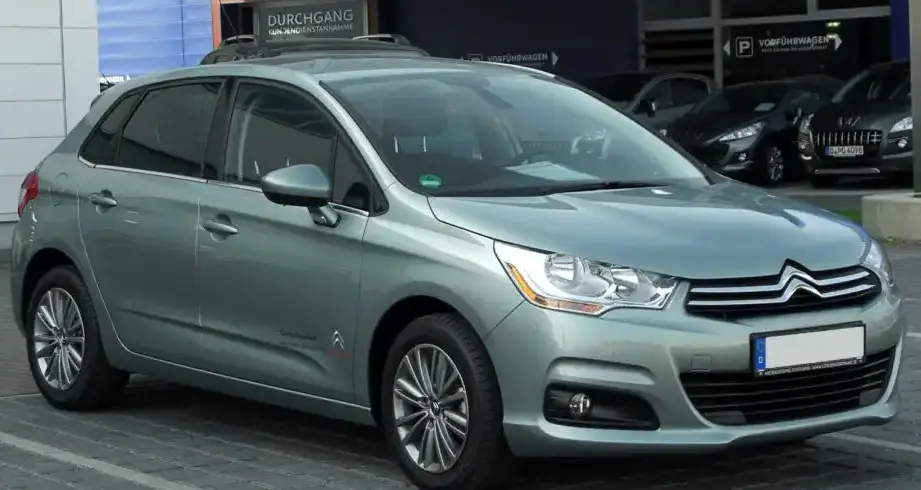
The Citroen C4 II Hatchback, specifically the 1.2 PureTech 130 horsepower variant, represents a significant step in Citroen’s evolution of the compact family car. Introduced during the Phase I refresh of the second-generation C4 (launched in 2010), production of this particular engine and trim combination ran from 2014 to 2015. Positioned as a mid-range offering within the C4 lineup, it aimed to balance fuel efficiency with respectable performance, appealing to buyers seeking a practical and comfortable daily driver. This model occupied a space between the base-level engines and the more powerful, but less economical, options.
Powertrain & Engine Architecture
The heart of this C4 variant is the 1.2-liter PureTech engine, specifically the HNY (ET3A) EB2DTS code. This engine is a three-cylinder, inline petrol engine featuring direct fuel injection and a single turbocharger with an intercooler. The direct injection system, operating at pressures up to 200 bar, ensures precise fuel delivery for optimal combustion. The engine utilizes a dual overhead camshaft (DOHC) valvetrain with four valves per cylinder, contributing to its efficient breathing. The turbocharger provides a boost in power and torque, mitigating the inherent limitations of a small-displacement engine. The engine is transversely mounted at the front of the vehicle, driving the front wheels. The 6-speed manual transmission was the standard offering for this trim, providing a balance between fuel economy and driver control.
Driving Characteristics
The 130 horsepower and 230 Nm (169.64 lb-ft) of torque delivered by the 1.2 PureTech engine provided adequate performance for everyday driving. Acceleration from 0-60 mph took approximately 9.4 seconds, and a top speed of 190 km/h (118 mph) was achievable. While not a sports car, the engine offered a surprisingly responsive feel, particularly in the mid-range thanks to the turbocharger. Compared to the lower-powered 1.0-liter PureTech variants, the 1.2 offered a noticeable improvement in both acceleration and overtaking ability. However, it lacked the punch of the more expensive diesel options or the higher-output petrol engines. The 6-speed manual transmission was well-matched to the engine’s characteristics, offering precise shifts and allowing the driver to keep the engine in its optimal power band. The gear ratios were tuned for fuel efficiency, but still provided enough flexibility for spirited driving.
Equipment & Trim Levels
The 1.2 PureTech 130 hp model typically came equipped with a reasonable level of standard features. These included air conditioning, electric front windows, a CD/radio system with USB connectivity, and ABS brakes. Higher trim levels, such as Exclusive or Sport, added features like alloy wheels, automatic climate control, rear parking sensors, and a touchscreen infotainment system. Interior upholstery was typically cloth, with options for upgraded materials available. The dashboard layout was functional and modern for its time, with a focus on ergonomics. Optional extras included navigation systems, panoramic sunroofs, and leather upholstery.
Chassis & Braking
The C4 II utilized a McPherson strut front suspension and a semi-independent coil spring rear suspension. This setup provided a comfortable ride quality, absorbing bumps and imperfections in the road surface effectively. The front brakes were ventilated discs, providing ample stopping power, while the rear brakes were solid discs. ABS (Anti-lock Braking System) was standard, enhancing safety during emergency braking situations. Stabilizer bars were fitted to both the front and rear axles to reduce body roll during cornering. The chassis was designed to balance comfort and handling, prioritizing ride quality over outright sportiness.
Market Reception & Comparison
The Citroen C4 II 1.2 PureTech 130 hp received generally positive reviews from automotive critics. It was praised for its fuel efficiency, comfortable ride, and surprisingly punchy engine. However, some critics noted that the three-cylinder engine could be a little rough at idle and lacked the refinement of larger engines. Compared to the 1.6-liter petrol and 1.6/2.0-liter diesel variants, the 1.2 PureTech offered a compelling balance of performance and economy. The diesel models provided superior fuel economy and torque, but were more expensive to purchase and maintain. The 1.6-liter petrol offered more power, but at the expense of fuel efficiency.
Legacy
The 1.2 PureTech engine has proven to be a relatively reliable powertrain, although early versions did experience some issues with timing chain wear. Regular maintenance, including oil changes and timing chain inspections, is crucial for ensuring long-term reliability. In the used car market, the C4 II 1.2 PureTech 130 hp represents a good value proposition, offering a comfortable and economical driving experience. Its relatively low running costs and readily available parts make it an attractive option for budget-conscious buyers. The engine’s fuel efficiency and decent performance continue to make it a viable choice for daily commuting and family transportation.