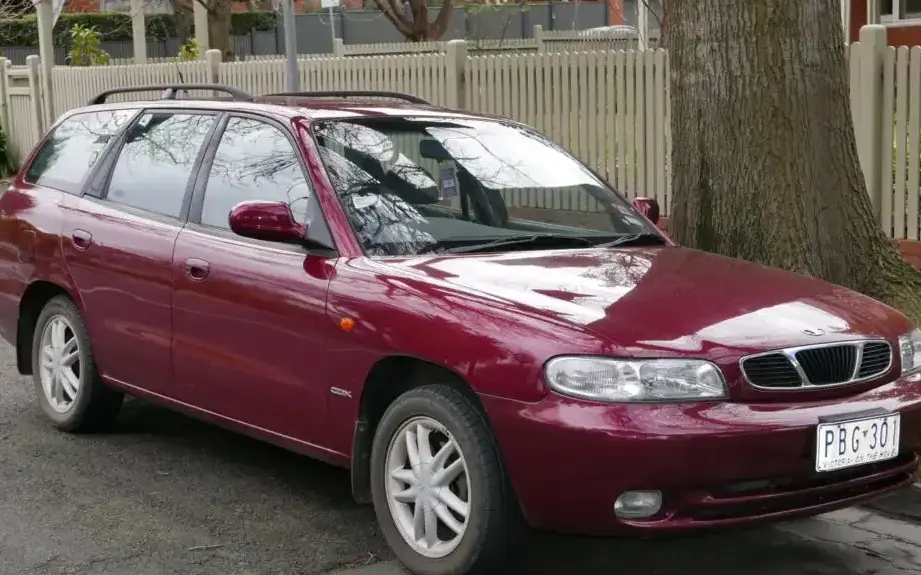
The Daewoo Nubira Wagon, specifically the KLAJ variant equipped with the 2.0-liter 16-valve engine and a four-speed automatic transmission, was produced from 1997 to 2001. This model represented Daewoo’s entry into the competitive compact station wagon segment, primarily aimed at providing a practical and affordable family vehicle. The Nubira Wagon (KLAJ) was part of the first generation Nubira (J100 series), sharing its platform with the sedan and hatchback versions. It was positioned as a more versatile alternative to the sedan, offering increased cargo capacity and practicality without a significant price premium.
Technical Specifications
| Brand | Daewoo |
| Model | Nubira |
| Generation | Nubira Wagon (KLAJ) |
| Type (Engine) | 2.0 16V (133 Hp) Automatic |
| Start of production | 1997 |
| End of production | 2001 |
| Powertrain Architecture | Internal Combustion engine |
| Body type | Station wagon (estate) |
| Seats | 5 |
| Doors | 5 |
| Fuel consumption (urban) | 15.1 l/100 km (15.6 US mpg, 18.7 UK mpg, 6.6 km/l) |
| Fuel consumption (extra urban) | 7.4 l/100 km (31.8 US mpg, 38.2 UK mpg, 13.5 km/l) |
| Fuel Type | Petrol (Gasoline) |
| Acceleration 0 – 100 km/h | 11 sec |
| Acceleration 0 – 62 mph | 11 sec |
| Acceleration 0 – 60 mph | 10.5 sec |
| Maximum speed | 180 km/h (111.85 mph) |
| Weight-to-power ratio | 8.9 kg/Hp, 112.7 Hp/tonne |
| Weight-to-torque ratio | 6.4 kg/Nm, 155.9 Nm/tonne |
| Power | 133 Hp @ 5400 rpm |
| Power per litre | 66.6 Hp/l |
| Torque | 184 Nm @ 4400 rpm (135.71 lb.-ft. @ 4400 rpm) |
| Engine layout | Front, Transverse |
| Engine Model/Code | X20SED |
| Engine displacement | 1998 cm3 (121.93 cu. in.) |
| Number of cylinders | 4 |
| Engine configuration | Inline |
| Cylinder Bore | 86 mm (3.39 in.) |
| Piston Stroke | 86 mm (3.39 in.) |
| Compression ratio | 9.6:1 |
| Number of valves per cylinder | 4 |
| Fuel injection system | Multi-port manifold injection |
| Engine aspiration | Naturally aspirated engine |
| Valvetrain | DOHC |
| Engine oil capacity | 4 l (4.23 US qt | 3.52 UK qt) |
| Coolant capacity | 7 l (7.4 US qt | 6.16 UK qt) |
| Kerb Weight | 1180 kg (2601.45 lbs.) |
| Max. weight | 1860 kg (4100.6 lbs.) |
| Max load | 680 kg (1499.14 lbs.) |
| Trunk (boot) space – minimum | 412 l (14.55 cu. ft.) |
| Trunk (boot) space – maximum | 1448 l (51.14 cu. ft.) |
| Fuel tank capacity | 62 l (16.38 US gal | 13.64 UK gal) |
| Length | 4550 mm (179.13 in.) |
| Width | 1720 mm (67.72 in.) |
| Height | 1470 mm (57.87 in.) |
| Wheelbase | 2570 mm (101.18 in.) |
| Front track | 1464 mm (57.64 in.) |
| Rear track | 1454 mm (57.24 in.) |
| Drivetrain Architecture | Front wheel drive |
| Number of gears | 4 |
| Gearbox type | Automatic transmission |
| Front suspension | Coil spring |
| Rear suspension | Coil spring |
| Front brakes | Ventilated discs |
| Rear brakes | Disc |
| Assisting systems | ABS (Anti-lock braking system) |
| Steering type | Steering rack and pinion |
| Power steering | Hydraulic Steering |
Powertrain & Engine Architecture
The KLAJ Nubira Wagon’s 2.0-liter inline-four engine, designated X20SED, was a relatively conventional design for its time. It featured a cast iron block and an aluminum cylinder head with dual overhead camshafts (DOHC) and four valves per cylinder. This configuration allowed for improved breathing and higher engine speeds compared to older single overhead cam designs. Fuel delivery was handled by a multi-port fuel injection system, providing precise fuel metering for optimal combustion. The engine produced 133 horsepower at 5400 rpm and 184 Nm (136 lb-ft) of torque at 4400 rpm. The four-speed automatic transmission was a standard unit, offering smooth but not particularly quick shifts. It was designed for comfort and ease of use rather than performance.
Driving Characteristics
The 2.0-liter automatic Nubira Wagon offered adequate, but not exhilarating, performance. Acceleration from 0 to 60 mph took around 10.5 to 11 seconds, and top speed was limited to approximately 112 mph. The automatic transmission, while providing convenience, did detract from the engine’s available power. The gear ratios were tuned for fuel economy and smooth cruising, resulting in a somewhat sluggish response during overtaking maneuvers. Compared to the five-speed manual transmission option, the automatic version felt noticeably slower. The suspension provided a comfortable ride, but the car wasn’t particularly sporty in handling. It was geared towards providing a stable and predictable driving experience for everyday use.
Equipment & Trim Levels
The Nubira Wagon KLAJ typically came with a reasonable level of standard equipment. This included power windows, power steering, central locking, and an AM/FM radio. Air conditioning was often standard, but could be optional depending on the specific market. Interior upholstery was typically cloth, with a relatively simple dashboard layout. Optional extras included alloy wheels, a sunroof, and upgraded audio systems. The trim level was generally considered mid-range within the Nubira lineup, offering a good balance of features and affordability.
Chassis & Braking
The Nubira Wagon utilized a front-wheel-drive layout with independent coil spring suspension at the front and a coil spring rear suspension. The front brakes were ventilated discs, providing good stopping power, while the rear brakes were solid discs. Anti-lock Braking System (ABS) was standard, enhancing safety by preventing wheel lockup during hard braking. The chassis was designed for comfort and practicality, prioritizing ride quality over sporty handling. Stabilizer bars were included to reduce body roll during cornering, but the car’s overall handling characteristics were more suited to everyday driving than aggressive maneuvers.
Market Reception & Comparison
The Daewoo Nubira Wagon was generally well-received as a practical and affordable family vehicle. Critics praised its spacious interior, large cargo area, and reasonable price. However, the automatic transmission was often criticized for its sluggish performance. Compared to other station wagons in its class, such as the Ford Focus Wagon or the Opel/Vauxhall Astra Estate, the Nubira Wagon offered a competitive level of space and practicality at a lower price point. Fuel economy was average for the class, and reliability was generally considered acceptable, although Daewoo’s reputation at the time was still developing.
Legacy
The Daewoo Nubira Wagon, while not a groundbreaking vehicle, played a role in establishing Daewoo (later Chevrolet) as a viable competitor in the compact car segment. The 2.0-liter engine and four-speed automatic transmission combination proved to be reasonably reliable, although long-term maintenance can be challenging due to the limited availability of parts. Today, the Nubira Wagon is a relatively rare sight on the roads, but it remains a popular choice among enthusiasts looking for an affordable and practical classic car. Its simple mechanical design makes it relatively easy to maintain for those with mechanical skills, and its spacious interior and large cargo area continue to be appealing features.