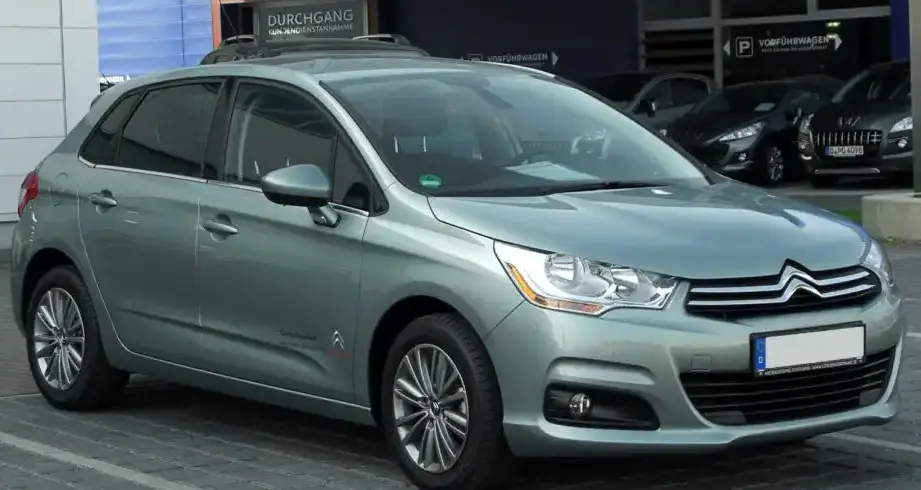
The Citroen C4 II Hatchback, specifically the 1.4 VTi variant producing 95 horsepower, was a key model in Citroen’s lineup from 2010 to 2015. Positioned as an entry-level offering within the second generation C4 range (internally designated as the B7 platform), this version aimed to provide affordable and efficient transportation for families and individuals. It represented a balance between practicality, comfort, and running costs, appealing to a broad segment of the European market. This variant was primarily sold in Europe, where compact hatchbacks are highly popular, and served as a stepping stone into the C4 range for budget-conscious buyers.
Technical Specifications
| Brand | Citroen |
| Model | C4 |
| Generation | C4 II Hatchback (Phase I, 2010) |
| Type (Engine) | 1.4 VTi (95 Hp) |
| Start of production | 2010 |
| End of production | 2015 |
| Powertrain Architecture | Internal Combustion engine |
| Body type | Hatchback |
| Seats | 5 |
| Doors | 5 |
| Fuel consumption (urban) | 8.2 l/100 km (28.7 US mpg, 34.4 UK mpg, 12.2 km/l) |
| Fuel consumption (extra urban) | 4.9 l/100 km (48 US mpg, 57.6 UK mpg, 20.4 km/l) |
| Fuel consumption (combined) | 6.1 l/100 km (38.6 US mpg, 46.3 UK mpg, 16.4 km/l) |
| CO2 emissions | 140 g/km |
| Fuel Type | Petrol (Gasoline) |
| Acceleration 0 – 100 km/h | 11.9 sec |
| Acceleration 0 – 62 mph | 11.9 sec |
| Acceleration 0 – 60 mph | 11.3 sec |
| Maximum speed | 182 km/h (113.09 mph) |
| Emission standard | Euro 5 |
| Weight-to-power ratio | 12.6 kg/Hp, 79.2 Hp/tonne |
| Weight-to-torque ratio | 8.9 kg/Nm, 112.5 Nm/tonne |
| Power | 95 Hp @ 6000 rpm |
| Power per litre | 68 Hp/l |
| Torque | 135 Nm @ 4000 rpm (99.57 lb.-ft. @ 4000 rpm) |
| Engine layout | Front, Transverse |
| Engine Model/Code | 8FP EP3C |
| Engine displacement | 1397 cm3 (85.25 cu. in.) |
| Number of cylinders | 4 |
| Engine configuration | Inline |
| Cylinder Bore | 77 mm (3.03 in.) |
| Piston Stroke | 75 mm (2.95 in.) |
| Compression ratio | 11:1 |
| Number of valves per cylinder | 4 |
| Fuel injection system | Multi-port manifold injection |
| Engine aspiration | Naturally aspirated engine |
| Engine oil capacity | 4.25 l (4.49 US qt | 3.74 UK qt) |
| Kerb Weight | 1200 kg (2645.55 lbs.) |
| Max. weight | 1720 kg (3791.95 lbs.) |
| Max load | 520 kg (1146.4 lbs.) |
| Trunk (boot) space – minimum | 380 l (13.42 cu. ft.) |
| Trunk (boot) space – maximum | 1183 l (41.78 cu. ft.) |
| Fuel tank capacity | 60 l (15.85 US gal | 13.2 UK gal) |
| Permitted trailer load with brakes (8%) | 1450 kg (3196.7 lbs.) |
| Permitted trailer load with brakes (12%) | 1200 kg (2645.55 lbs.) |
| Permitted trailer load without brakes | 635 kg (1399.94 lbs.) |
| Permitted towbar download | 75 kg (165.35 lbs.) |
| Length | 4329 mm (170.43 in.) |
| Width | 1789 mm (70.43 in.) |
| Width including mirrors | 2050 mm (80.71 in.) |
| Height | 1489-1502 mm (58.62 – 59.13 in.) |
| Wheelbase | 2608 mm (102.68 in.) |
| Front track | 1522-1536 mm (59.92 – 60.47 in.) |
| Rear (Back) track | 1515-1529 mm (59.65 – 60.2 in.) |
| Front overhang | 935 mm (36.81 in.) |
| Rear overhang | 786 mm (30.94 in.) |
| Drag coefficient (Cd) | 0.30 |
| Minimum turning circle (turning diameter) | 10.7 m (35.1 ft.) |
| Drivetrain Architecture | The Internal combustion engine (ICE) drives the front wheels of the vehicle. |
| Drive wheel | Front wheel drive |
| Number of gears and type of gearbox | 5 gears, manual transmission |
| Front suspension | Independent, type McPherson with coil spring and anti-roll bar |
| Rear suspension | Semi-independent, coil spring |
| Front brakes | Ventilated discs |
| Rear brakes | Disc |
| Assisting systems | ABS (Anti-lock braking system) |
| Steering type | Steering rack and pinion |
| Tires size | 205/55 R16; 225/45 R17 |
| Wheel rims size | 16; 17 |
Powertrain & Engine Architecture
The heart of this C4 variant is the 1.4-liter (1397cc) naturally aspirated inline-four cylinder engine, designated 8FP EP3C. This engine is part of the Prince engine family, a collaborative development between PSA Peugeot Citroen and BMW. It features a multi-point fuel injection system and a double overhead camshaft (DOHC) valvetrain with four valves per cylinder. The engine produces 95 horsepower at 6000 rpm and 135 Nm (99.57 lb-ft) of torque at 4000 rpm. The engine’s design prioritized fuel efficiency and smooth operation over outright performance. The engine is transversely mounted at the front of the vehicle. The transmission is a five-speed manual gearbox, chosen for its simplicity and cost-effectiveness. While an automatic transmission was offered on other C4 models, it wasn’t typically paired with this specific 1.4 VTi engine.
Driving Characteristics
The 1.4 VTi engine, coupled with the five-speed manual transmission, delivers modest performance. Acceleration from 0 to 100 km/h (0-62 mph) takes approximately 11.9 seconds, and the top speed is around 182 km/h (113 mph). The power delivery is linear, but the engine feels strained when pushed hard, particularly when fully loaded or climbing hills. The gear ratios are well-spaced for everyday driving, but downshifts are often required to maintain momentum. Compared to the more powerful 1.6 VTi or diesel variants, this 1.4L engine feels noticeably slower. However, it offers a more relaxed driving experience, prioritizing fuel economy and ease of use over sporty performance.
Equipment & Trim Levels
The 1.4 VTi typically represented the entry-level trim in the C4 II range. Standard equipment generally included air conditioning, power steering, electric front windows, a basic audio system with USB connectivity, and ABS brakes. Higher trim levels, such as the Exclusive or Sport, added features like alloy wheels, automatic headlights and wipers, a more advanced audio system, and climate control. Interior upholstery was typically cloth, with a functional and durable design. Optional extras included a panoramic sunroof, navigation system, and parking sensors.
Chassis & Braking
The C4 II utilizes a McPherson strut front suspension and a semi-independent torsion beam rear suspension. This setup provides a comfortable ride quality, absorbing bumps and imperfections in the road surface effectively. The front brakes are ventilated discs, while the rear brakes are solid discs. The steering is a rack and pinion system, offering reasonable precision and feedback. The suspension tuning is geared towards comfort rather than sporty handling, resulting in a slightly softer and more forgiving ride.
Market Reception & Comparison
The Citroen C4 1.4 VTi was generally well-received as an affordable and practical family hatchback. Critics praised its comfortable ride, spacious interior, and fuel efficiency. However, the engine’s lack of power was a common criticism, particularly when compared to competitors offering more potent engines. In terms of fuel economy, the 1.4 VTi achieved around 6.1 l/100 km (38.6 US mpg) in combined driving, which was competitive for its class. Compared to the diesel variants, the 1.4 VTi offered lower purchase price but higher running costs due to fuel consumption. The 1.6 VTi offered a noticeable performance upgrade but at a higher price point.
Legacy
The 1.4 VTi engine, while not known for its exceptional performance or longevity, has proven to be reasonably reliable in the C4 II. Common issues include occasional problems with the ignition coils and fuel injectors. However, these are generally not major or expensive to repair. Today, the C4 II 1.4 VTi represents an affordable entry point into the used car market. Its low running costs and comfortable ride make it a practical choice for budget-conscious buyers. While it may not offer the excitement of more powerful variants, it remains a dependable and functional family hatchback.