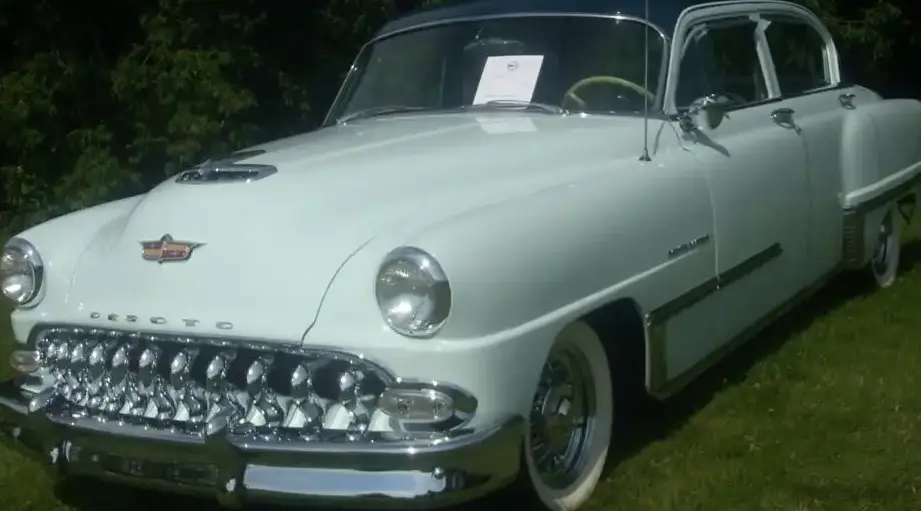
The DeSoto Powermaster Six 8-Passenger, as presented in its 1954 facelift, represented a significant offering from the Chrysler Corporation’s mid-range brand. Produced for the 1953 and 1954 model years, this iteration of the Powermaster Six aimed to provide comfortable, spacious transportation for families, capitalizing on the post-war American desire for larger automobiles. This particular variant, equipped with the 4.1-liter (250.5 cubic inch) inline-six engine producing 116 horsepower and paired with the PowerFlite two-speed automatic transmission, occupied a middle ground within the Powermaster lineup, offering a balance between affordability and convenience. It was positioned below the more powerful V8-equipped models but above the base-level DeSoto Deluxe.
Technical Specifications
| Brand | DeSoto |
| Model | Powermaster Six |
| Generation | Powermaster Six 8-Passenger (facelift 1954) |
| Type (Engine) | 4.1 (116 Hp) PowerFlite |
| Start of production | 1953 |
| End of production | 1954 |
| Powertrain Architecture | Internal Combustion engine |
| Body type | Sedan |
| Seats | 8 |
| Doors | 4 |
| Fuel Type | Petrol (Gasoline) |
| Power | 116 Hp @ 3600 rpm |
| Power per litre | 28.3 Hp/l |
| Torque | 282 Nm @ 1600 rpm / 207.99 lb.-ft. @ 1600 rpm |
| Engine displacement | 4105 cm3 / 250.5 cu. in. |
| Number of cylinders | 6 |
| Engine configuration | Inline |
| Cylinder Bore | 87.31 mm / 3.44 in. |
| Piston Stroke | 114.3 mm / 4.5 in. |
| Compression ratio | 7:1 |
| Number of valves per cylinder | 2 |
| Fuel injection system | Carburettor |
| Engine aspiration | Naturally aspirated engine |
| Engine oil capacity | 4.7 l / 4.97 US qt | 4.14 UK qt |
| Coolant | 15.1 l / 15.96 US qt | 13.29 UK qt |
| Length | 5686 mm / 223.86 in. |
| Width | 1972 mm / 77.64 in. |
| Height | 1650 mm / 64.96 in. |
| Wheelbase | 3543 mm / 139.49 in. |
| Front track | 1403 mm / 55.24 in. |
| Rear (Back) track | 1438 mm / 56.61 in. |
| Drag coefficient (Cd) | 0.6 |
| Minimum turning circle (turning diameter) | 13.5 m / 44.29 ft. |
| Drivetrain Architecture | The Internal combustion engine (ICE) drives the rear wheels of the vehicle. |
| Drive wheel | Rear wheel drive |
| Number of gears and type of gearbox | 2 gears, automatic transmission PowerFlite |
| Front suspension | Independent coil spring |
| Rear suspension | Leaf spring |
| Front brakes | Drum, 305 mm |
| Rear brakes | Drum, 305 mm |
| Steering type | Worm-reduction unit |
| Power steering | Hydraulic Steering |
Powertrain & Engine Architecture
The heart of this Powermaster Six variant was the DeSoto’s 4.1-liter inline-six engine. Designated internally with various codes depending on specific calibration, this engine featured a cast iron block and cylinder head. It utilized a single two-barrel carburetor for fuel delivery, a relatively common setup for the era. The engine employed a conventional overhead valve (OHV) configuration with two valves per cylinder, operated by a single camshaft. The 7:1 compression ratio was typical for the time, balancing performance with the availability of regular gasoline. The PowerFlite automatic transmission, introduced by Chrysler in 1953, was a two-speed unit. It was a significant step forward in automatic transmission technology, offering smoother shifts compared to earlier designs, though it lacked the multiple gears found in later automatics. The PowerFlite utilized a fluid coupling and planetary gearsets to achieve its two forward speeds and reverse.
Driving Characteristics
The 116 horsepower and 282 Nm (208 lb-ft) of torque produced by the 4.1-liter engine, when coupled with the PowerFlite automatic, resulted in a driving experience geared towards comfortable cruising rather than spirited acceleration. The two-speed automatic transmission, while convenient, limited the engine’s ability to operate at its most efficient or powerful points across a wider range of speeds. Acceleration was adequate for highway merging and passing, but it wasn’t particularly brisk. The PowerFlite’s shift points were calibrated for smooth operation, prioritizing comfort over performance. Compared to the available V8 engines, this six-cylinder automatic combination offered significantly less power and a slower 0-60 mph time. However, it provided a more relaxed driving experience and better fuel economy, albeit still modest by modern standards.
Equipment & Trim Levels
The Powermaster Six 8-Passenger, in this configuration, was generally well-equipped for the mid-1950s. Standard features included a spacious interior with seating for up to eight passengers, often upholstered in durable cloth or vinyl. The dashboard featured a combination of analog gauges, including a speedometer, fuel gauge, and temperature gauge. Power steering was a notable inclusion, making maneuvering the large vehicle easier. Optional extras included a radio, heater, whitewall tires, and various trim enhancements. The interior trim levels varied, with higher-grade materials and more elaborate detailing available at an additional cost. The exterior typically featured chrome trim around the windows, bumpers, and grille, adding to the vehicle’s aesthetic appeal.
Chassis & Braking
The Powermaster Six rode on a robust chassis featuring independent coil spring suspension in the front and a leaf spring suspension in the rear. This setup provided a reasonably comfortable ride, although it wasn’t particularly sporty. The large size and weight of the vehicle necessitated a sturdy suspension system. Braking was accomplished via drum brakes on all four wheels, measuring 305mm in diameter. While adequate for the time, the drum brakes lacked the stopping power and fade resistance of later disc brake systems. Steering was handled by a worm-reduction unit, assisted by hydraulic power steering, which reduced driver effort, especially at low speeds.
Market Reception & Comparison
The DeSoto Powermaster Six 8-Passenger, particularly the 4.1-liter automatic variant, was generally well-received by consumers seeking a large, comfortable family car. Critics praised its spacious interior and smooth ride, but noted its relatively modest performance compared to V8-powered competitors. Fuel economy, while better than the V8 models, was still relatively low by modern standards. Compared to other six-cylinder offerings from Ford and Chevrolet, the DeSoto Powermaster Six offered a similar level of comfort and features, but often at a slightly higher price point. The PowerFlite automatic transmission was seen as a positive feature, offering convenience and ease of use.
Legacy
The DeSoto Powermaster Six, and particularly this 1954 facelifted version, represents a snapshot of American automotive design and engineering from the mid-1950s. While DeSoto as a brand ultimately faded away in the 1960s, the Powermaster Six remains a popular choice among classic car enthusiasts. The 4.1-liter inline-six engine, while not known for its high performance, is generally considered to be a reliable and durable powerplant. Parts availability can be a challenge, but a dedicated community of DeSoto owners and restorers helps to keep these vehicles on the road. Today, well-maintained examples of the Powermaster Six 8-Passenger command respectable prices in the collector car market, appealing to those who appreciate the style and nostalgia of the 1950s.