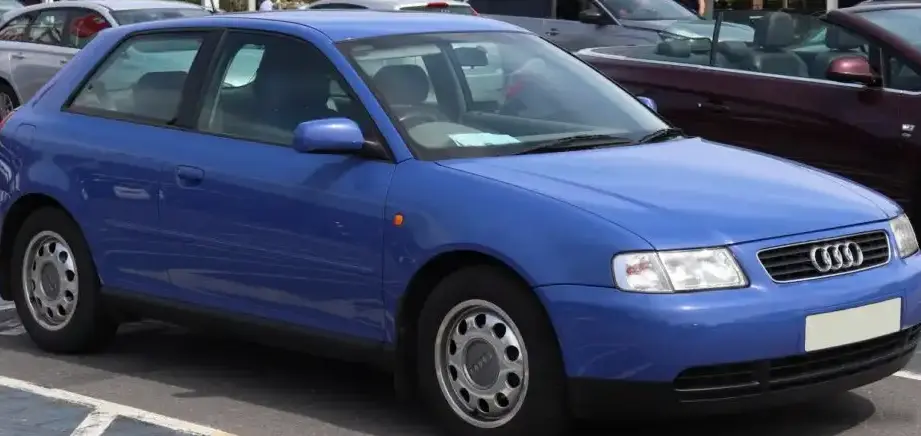
The Audi A3 Sportback 30 TFSI (116 hp) represents an entry point into the fourth generation (8Y, facelifted in 2024) of Audi’s popular compact hatchback. Introduced in April 2024, this variant is positioned as a fuel-efficient and accessible option within the A3 Sportback range, primarily aimed at buyers prioritizing economy and everyday usability. It builds upon the foundation of the 8Y platform, shared with other Volkswagen Group vehicles like the Volkswagen Golf and SEAT Leon, offering a blend of technology, comfort, and Audi’s signature refinement. This model is primarily marketed in Europe and other regions where smaller, fuel-efficient hatchbacks are in high demand.
Technical Specifications
| Brand | Audi |
| Model | A3 |
| Generation | A3 Sportback (8Y, facelift 2024) |
| Type (Engine) | 30 TFSI (116 Hp) |
| Start of production | April, 2024 |
| Powertrain Architecture | Internal Combustion engine |
| Body type | Hatchback |
| Seats | 5 |
| Doors | 5 |
| Combined fuel consumption (WLTP) | 5.5-6.1 l/100 km (42.8 – 38.6 US mpg, 51.4 – 46.3 UK mpg, 18.2 – 16.4 km/l) |
| CO2 emissions (WLTP) | 126-139 g/km |
| Fuel Type | Petrol (Gasoline) |
| Acceleration 0 – 100 km/h | 9.7 sec |
| Acceleration 0 – 62 mph | 9.7 sec |
| Acceleration 0 – 60 mph | 9.2 sec |
| Maximum speed | 205 km/h (127.38 mph) |
| Emission standard | Euro 6e |
| Weight-to-power ratio | 11.1 kg/Hp, 90.3 Hp/tonne |
| Weight-to-torque ratio | 5.8 kg/Nm, 171.2 Nm/tonne |
| Power | 116 Hp @ 5000-6000 rpm |
| Power per litre | 77.4 Hp/l |
| Torque | 220 Nm @ 1500-3000 rpm (162.26 lb.-ft. @ 1500-3000 rpm) |
| Engine layout | Front, Transverse |
| Engine Model/Code | EA211 evo2 / DXD |
| Engine displacement | 1498 cm3 (91.41 cu. in.) |
| Number of cylinders | 4 |
| Engine configuration | Inline |
| Cylinder Bore | 74.5 mm (2.93 in.) |
| Piston Stroke | 85.9 mm (3.38 in.) |
| Compression ratio | 12:1 |
| Number of valves per cylinder | 4 |
| Fuel injection system | Direct injection |
| Engine aspiration | Turbocharger, Intercooler |
| Valvetrain | DOHC |
| Engine oil capacity | 4.3 l (4.54 US qt | 3.78 UK qt) |
| Coolant | 11.2 l (11.83 US qt | 9.85 UK qt) |
| Engine systems | Start & Stop System, Particulate filter |
| Kerb Weight | 1285 kg (2832.94 lbs.) |
| Max. weight | 1830 kg (4034.46 lbs.) |
| Max load | 545 kg (1201.52 lbs.) |
| Trunk (boot) space – minimum | 380 l (13.42 cu. ft.) |
| Trunk (boot) space – maximum | 1200 l (42.38 cu. ft.) |
| Fuel tank capacity | 45 l (11.89 US gal | 9.9 UK gal) |
| Max. roof load | 75 kg (165.35 lbs.) |
| Permitted trailer load with brakes (8%) | 1500 kg (3306.93 lbs.) |
| Permitted trailer load with brakes (12%) | 1300 kg (2866.01 lbs.) |
| Permitted trailer load without brakes | 680 kg (1499.14 lbs.) |
| Permitted towbar download | 80 kg (176.37 lbs.) |
| Length | 4352 mm (171.34 in.) |
| Width | 1816 mm (71.5 in.) |
| Width including mirrors | 1984 mm (78.11 in.) |
| Height | 1441 mm (56.73 in.) |
| Wheelbase | 2635 mm (103.74 in.) |
| Front track | 1554 mm (61.18 in.) |
| Rear (Back) track | 1525 mm (60.04 in.) |
| Front overhang | 906 mm (35.67 in.) |
| Rear overhang | 811 mm (31.93 in.) |
| Drag coefficient (Cd) | 0.29 |
| Minimum turning circle (turning diameter) | 11.1 m (36.42 ft.) |
| Approach angle | 14.2° |
| Departure angle | 24.3° |
| Drivetrain Architecture | The Internal combustion engine (ICE) drives the front wheels of the vehicle. |
| Drive wheel | Front wheel drive |
| Number of gears and type of gearbox | 6 gears, manual transmission |
| Front suspension | Independent, type McPherson with coil spring and anti-roll bar |
| Rear suspension | Torsion |
| Front brakes | Ventilated discs, 288 mm |
| Rear brakes | Disc, 272 mm |
| Assisting systems | ABS (Anti-lock braking system) |
| Steering type | Steering rack and pinion |
| Power steering | Electric Steering |
| Tires size | 205/55 R16; 225/45 R17; 225/40 R18 |
| Wheel rims size | 7J x 16; 8J x 17; 8J x 18 |
Powertrain & Engine Architecture
The 30 TFSI variant utilizes the EA211 evo2 1.5-liter turbocharged four-cylinder gasoline engine, identified by the engine code DXD. This engine is a key component of Volkswagen Group’s modular engine family, known for its efficiency and compact design. It features direct fuel injection, a single turbocharger with an intercooler, and a dual overhead camshaft (DOHC) valvetrain. A notable feature of this engine is its ability to operate on the Miller cycle under certain load conditions, improving thermal efficiency. The engine is paired with a 6-speed manual transmission as standard, delivering power to the front wheels. The EA211 evo2 engine incorporates a particulate filter to reduce emissions, meeting stringent Euro 6e standards.
Driving Characteristics
The 116 hp and 220 Nm (162 lb-ft) of torque produced by the 30 TFSI engine provide adequate performance for everyday driving. Acceleration from 0 to 100 km/h (0-62 mph) takes approximately 9.7 seconds. While not particularly sporty, the engine offers a usable powerband, with peak torque available from 1500 to 3000 rpm. The manual transmission provides precise shifts, and the gear ratios are tuned for fuel efficiency rather than outright acceleration. Compared to higher-output A3 variants, such as the 40 TFSI with its 190 hp engine, the 30 TFSI feels less responsive, especially during overtaking maneuvers. However, its lighter weight and efficient engine contribute to better fuel economy.
Equipment & Trim Levels
The 30 TFSI typically comes with a respectable level of standard equipment. This generally includes Audi’s MMI infotainment system with a touchscreen display, Bluetooth connectivity, air conditioning, and a suite of safety features like ABS, electronic stability control, and multiple airbags. Interior upholstery is typically cloth, with options for leather upgrades. Common optional extras include a sunroof, upgraded sound system, parking sensors, and advanced driver-assistance systems like adaptive cruise control and lane-keeping assist. Trim levels, such as ‘Advanced’ or ‘S line’, offer progressively more features and cosmetic enhancements.
Chassis & Braking
The A3 Sportback 30 TFSI utilizes a McPherson strut front suspension and a torsion beam rear suspension. This setup provides a good balance between ride comfort and handling. The front brakes are ventilated discs, while the rear brakes are solid discs. The steering is an electric power-assisted rack and pinion system, offering precise and responsive control. The suspension is tuned for comfort, but it still provides adequate body control during cornering. Stabilizer bars are fitted to both the front and rear axles to reduce body roll.
Market Reception & Comparison
The A3 30 TFSI has been generally well-received by automotive critics as a practical and economical choice. Its fuel efficiency, comfortable ride, and well-equipped interior are often praised. However, some reviewers have noted its lack of outright performance compared to more powerful A3 variants. Compared to the 40 TFSI, the 30 TFSI offers significantly better fuel economy, but at the expense of acceleration and overall driving excitement. The 30 TDI (diesel) variant provides similar fuel economy with more torque, but diesel engines are facing increasing scrutiny due to emissions regulations.
Legacy
The EA211 engine family, including the DXD code used in the 30 TFSI, has proven to be relatively reliable. Common issues are typically related to the turbocharger or fuel injectors, but these are generally infrequent. The A3 Sportback 30 TFSI is expected to hold its value reasonably well, particularly as demand for fuel-efficient vehicles continues to grow. On the used car market, these models are likely to appeal to buyers seeking a stylish, practical, and economical hatchback with the prestige of the Audi brand. The longevity of this powertrain, combined with Audi’s reputation for build quality, suggests that these vehicles will remain a viable option for years to come.