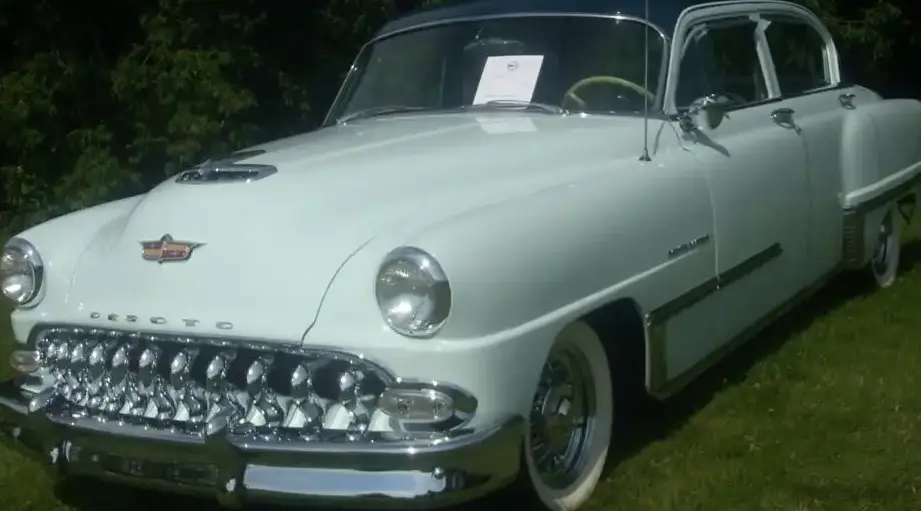
The DeSoto Powermaster Six All-Steel Station Wagon, specifically the 4.1-liter (250.6 cubic inch) 116 horsepower variant with the “Tip-Toe Shift” automatic transmission, represented a significant offering in the early 1950s American automotive landscape. Produced for the 1952 and 1953 model years, this station wagon was part of the broader Powermaster line, DeSoto’s full-size offering. It aimed to combine family practicality with the styling and comfort expected of a mid-range American car. This particular configuration, with its automatic transmission, was positioned as a convenience-focused option within the Powermaster range, appealing to buyers prioritizing ease of driving over outright performance.
Technical Specifications
| Brand | DeSoto |
| Model | Powermaster Six |
| Generation | Powermaster Six All-Steel Station Wagon |
| Type (Engine) | 4.1 (116 Hp) Tip-Toe Shift |
| Start of production | 1952 |
| End of production | 1953 |
| Powertrain Architecture | Internal Combustion engine |
| Body type | Station wagon (estate) |
| Seats | 6 |
| Doors | 5 |
| Fuel Type | Petrol (Gasoline) |
| Power | 116 Hp @ 3600 rpm |
| Power per litre | 28.3 Hp/l |
| Torque | 282 Nm @ 1600 rpm |
| Torque (lb-ft) | 207.99 lb.-ft. @ 1600 rpm |
| Engine displacement | 4106 cm3 |
| Engine displacement (cu. in.) | 250.56 cu. in. |
| Number of cylinders | 6 |
| Engine configuration | Inline |
| Cylinder Bore | 87.31 mm (3.44 in.) |
| Piston Stroke | 114.3 mm (4.5 in.) |
| Compression ratio | 7:1 |
| Number of valves per cylinder | 2 |
| Fuel injection system | Carburettor |
| Engine aspiration | Naturally aspirated engine |
| Engine oil capacity | 4.7 l (4.97 US qt | 4.14 UK qt) |
| Coolant capacity | 15.1 l (15.96 US qt | 13.29 UK qt) |
| Length | 5404 mm (212.76 in.) |
| Width | 1963 mm (77.28 in.) |
| Height | 1588 mm (62.52 in.) |
| Wheelbase | 3188 mm (125.51 in.) |
| Front track | 1430 mm (56.3 in.) |
| Rear track | 1513 mm (59.57 in.) |
| Drag coefficient (Cd) | 0.6 |
| Minimum turning circle | 13 m (42.65 ft.) |
| Drivetrain Architecture | Rear wheel drive |
| Number of gears | 4 |
| Gearbox type | Automatic transmission Tip-Toe Shift |
| Front suspension | Independent coil spring |
| Rear suspension | Leaf spring |
| Front brakes | Drum, 305 mm |
| Rear brakes | Drum, 305 mm |
Powertrain & Engine Architecture
The heart of the 1952-1953 DeSoto Powermaster Six Station Wagon was its 4.1-liter (250.6 cu. in.) inline-six cylinder engine. This engine, while not a powerhouse by modern standards, was a robust and reliable unit for its time. It featured a cast iron block and cylinder head, with a 7:1 compression ratio. Fuel delivery was handled by a single, two-barrel carburetor. The valvetrain employed a conventional pushrod design with two valves per cylinder. The “Tip-Toe Shift” automatic transmission was a Mopar-built unit, a three-speed automatic known for its smooth, albeit not particularly quick, shifts. It was marketed as providing effortless driving, a key selling point for family-oriented buyers. The transmission’s operation was relatively simple, relying on hydraulic pressure and a torque converter to manage power delivery.
Driving Characteristics
The combination of the 116 horsepower engine and the automatic transmission resulted in a driving experience focused on comfort and ease of use rather than spirited performance. Acceleration was adequate for highway cruising and city driving, but passing maneuvers required planning. The automatic transmission’s gear ratios were optimized for smooth cruising, with a relatively tall final drive. This contributed to decent fuel economy for the era, but also limited the vehicle’s ability to accelerate quickly. Compared to the manual transmission versions of the Powermaster Six, the automatic was noticeably slower. The automatic also lacked the engine braking capabilities of a manual transmission, requiring more reliance on the drum brakes.
Equipment & Trim Levels
The Powermaster Six All-Steel Station Wagon, even in its base configuration, offered a reasonable level of standard equipment for the early 1950s. Standard features included a spacious interior with seating for six passengers, a heater, and a basic instrument panel. The interior typically featured cloth upholstery, although optional upgrades to vinyl were available. The dashboard was relatively simple in design, with a speedometer, fuel gauge, and ammeter. Optional extras included a radio, whitewall tires, and various trim packages. The station wagon body style itself was considered a premium offering, adding to the vehicle’s appeal.
Chassis & Braking
The DeSoto Powermaster Six utilized a body-on-frame construction, typical of American cars of the period. The chassis featured an independent coil spring suspension in the front, providing a relatively comfortable ride. The rear suspension employed leaf springs, which were more robust and better suited for carrying loads. Braking was accomplished via drum brakes on all four wheels, measuring 305mm in diameter. While adequate for the vehicle’s weight and performance, the drum brakes lacked the stopping power of more modern braking systems. Steering was accomplished via a recirculating ball steering system, which provided relatively precise control.
Market Reception & Comparison
The DeSoto Powermaster Six All-Steel Station Wagon was generally well-received by critics and consumers alike. It was praised for its spacious interior, comfortable ride, and stylish design. However, the automatic transmission was sometimes criticized for its lack of responsiveness. Compared to other station wagons of the era, such as those offered by Ford and Chevrolet, the DeSoto Powermaster Six offered a competitive combination of features and price. Fuel economy was comparable to other vehicles in its class, and reliability was generally good. The automatic transmission, while convenient, was often seen as a compromise in terms of performance.
Legacy
Today, the 1952-1953 DeSoto Powermaster Six All-Steel Station Wagon, particularly the 4.1-liter automatic variant, is a sought-after classic car. While not as common as some other models from the era, it represents a significant piece of American automotive history. The inline-six engine is known for its durability, and many examples are still running today. However, finding parts can be challenging, and maintenance requires specialized knowledge. The “Tip-Toe Shift” automatic transmission, while reliable, can be expensive to repair. The station wagon body style adds to the vehicle’s collectibility, as it represents a popular and versatile body type from the 1950s. Well-maintained examples command a respectable price in the classic car market, appealing to enthusiasts who appreciate the styling and engineering of this era.