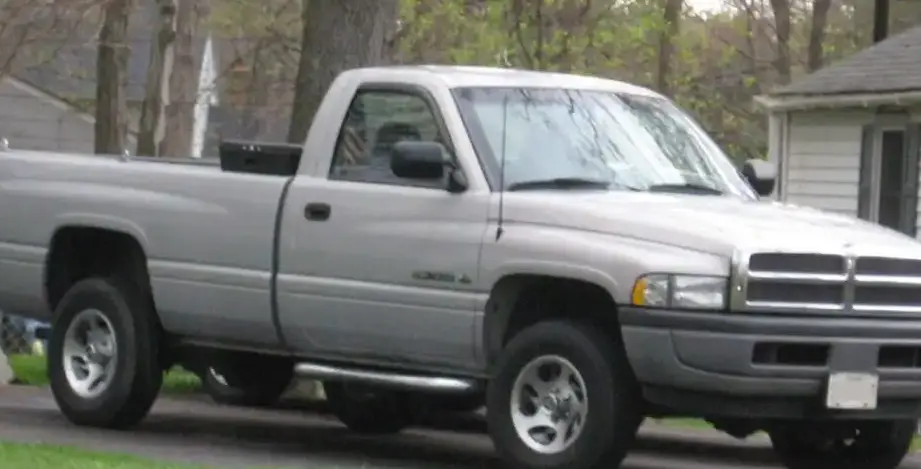
The Dodge Ram 1500 Regular Cab Long Bed (BR/BE) with the 5.9 V8 engine and four-speed automatic transmission was produced from 1994 to 1998. This configuration represented a popular, work-oriented trim within the second generation of the Ram pickup series (1994-2002). Positioned as a robust and capable truck, it catered to buyers needing a full-size pickup for towing, hauling, and general utility, particularly in rural and agricultural markets. The BR/BE designation refers to the chassis codes used during this production run, signifying the regular cab, long bed configuration. This generation of Ram marked a significant departure from previous designs, introducing a bolder, more aerodynamic exterior and a more comfortable interior.
Technical Specifications
| Brand | Dodge |
| Model | RAM |
| Generation | Ram 1500 Regular Cab Long Bed (BR/BE) |
| Type (Engine) | 5.9 V8 (230 Hp) 4×4 Automatic |
| Start of production | 1994 |
| End of production | 1998 |
| Powertrain Architecture | Internal Combustion engine |
| Body type | Pick-up |
| Seats | 3 |
| Doors | 2 |
| Fuel Type | Petrol (Gasoline) |
| Power | 230 Hp @ 4000 rpm |
| Power per litre | 39 Hp/l |
| Torque | 447 Nm @ 3200 rpm / 329.69 lb.-ft. @ 3200 rpm |
| Engine layout | Front, Longitudinal |
| Engine Model/Code | 360 Magnum |
| Engine displacement | 5899 cm3 / 359.98 cu. in. |
| Number of cylinders | 8 |
| Engine configuration | V-engine |
| Cylinder Bore | 101.6 mm / 4 in. |
| Piston Stroke | 90.93 mm / 3.58 in. |
| Compression ratio | 9.1:1 |
| Number of valves per cylinder | 2 |
| Fuel injection system | Multi-port manifold injection |
| Engine aspiration | Naturally aspirated engine |
| Valvetrain | OHV |
| Engine oil capacity | 4.7 l / 4.97 US qt | 4.14 UK qt |
| Coolant | 19 l / 20.08 US qt | 16.72 UK qt |
| Max. weight | 2903 kg / 6400.02 lbs. |
| Permitted trailer load with brakes (12%) | 3493 kg / 7700.75 lbs. |
| Length | 5692 mm / 224.09 in. |
| Width including mirrors | 2017 mm / 79.41 in. |
| Height | 1895 mm / 74.61 in. |
| Wheelbase | 3429 mm / 135 in. |
| Approach angle | 30.5° |
| Departure angle | 24.8° |
| Ramp-over (brakeover) angle | 18.8° |
| Drivetrain Architecture | The Internal combustion engine (ICE) drives the rear wheels permanently, and the front wheels are driven through an electrically or mechanically operated clutch if necessary. |
| Drive wheel | All wheel drive (4×4) |
| Number of gears and type of gearbox | 4 gears, automatic transmission |
| Front suspension | Dependent spring suspension with anti-roll bar |
| Rear suspension | Rigid axle suspension, Leaf spring |
| Front brakes | Disc |
| Rear brakes | Drum |
| Assisting systems | ABS (Anti-lock braking system) |
| Steering type | Steering rack and pinion |
| Power steering | Hydraulic Steering |
| Tires size | 225/75 R16 |
| Wheel rims size | 7J x 16 |
Powertrain & Engine Architecture
The heart of this Ram 1500 was the 360 Magnum 5.9-liter V8 engine. This engine, a member of the LA engine family, was known for its robust construction and relatively simple design. The “Magnum” designation indicated a higher-performance version of the LA engine, featuring improved cylinder heads and intake manifold for increased airflow. It utilized a multi-port fuel injection system, delivering fuel directly to each cylinder for optimized combustion. The engine employed an overhead valve (OHV) valvetrain with two valves per cylinder. The 9.1:1 compression ratio was a compromise between performance and the ability to run on readily available gasoline. Paired with this engine was a four-speed automatic transmission (typically the A727 or A518, depending on specific build dates and options). This transmission was a workhorse unit, known for its durability, but not particularly refined in its shifting characteristics. The 4×4 system employed a part-time transfer case, allowing the driver to switch between two-wheel drive and four-wheel drive as needed.
Driving Characteristics
The 5.9L V8 with the four-speed automatic delivered adequate, but not exhilarating, performance. With 230 horsepower and 330 lb-ft of torque, acceleration was reasonable for a full-size pickup, but it wasn’t designed for speed. The automatic transmission’s gear ratios were geared towards maximizing towing capacity and low-end torque rather than quick acceleration. Compared to the available 318 cubic inch (5.2L) V8, the 5.9 offered a noticeable increase in power and towing capability. However, it lacked the responsiveness of a manual transmission. The 5.9L automatic was significantly slower than the available 360 manual transmission. The ride quality was typical for a truck of this era – firm and somewhat bouncy, especially when unloaded. The long wheelbase contributed to a stable ride, but also made maneuvering in tight spaces more challenging.
Equipment & Trim Levels
The BR/BE Ram 1500 Regular Cab Long Bed in this configuration typically came with a fairly basic level of equipment. Standard features included a vinyl bench seat, air conditioning, and an AM/FM radio. Power steering and power brakes were also standard. Optional extras included a cassette player, upgraded cloth upholstery, cruise control, and a sliding rear window. The interior was functional and durable, designed to withstand the rigors of work-truck use. Trim levels were relatively simple, with options primarily focused on adding convenience features rather than luxury.
Chassis & Braking
The chassis of the BR/BE Ram 1500 featured a body-on-frame construction, providing a robust and durable platform. The front suspension utilized a traditional independent front suspension with coil springs and an anti-roll bar. The rear suspension employed a solid axle with leaf springs, a design favored for its load-carrying capacity. Brakes were disc brakes in the front and drum brakes in the rear. ABS (Anti-lock Braking System) was available as an option, improving braking performance and control, particularly on slippery surfaces. The long bed configuration provided ample cargo space, making it ideal for hauling large items.
Market Reception & Comparison
The Dodge Ram 1500 with the 5.9 V8 and automatic transmission was well-received by buyers seeking a capable and affordable full-size pickup. Critics praised its robust engine and durable construction. However, the automatic transmission was sometimes criticized for its lack of refinement and relatively slow shift times. Fuel economy was typical for a vehicle of this size and configuration, averaging around 14-16 mpg in mixed driving. Compared to the Ford F-150 and Chevrolet Silverado of the same era, the Ram offered a competitive combination of price, performance, and features. The 5.9L automatic was often seen as a good compromise for those who didn’t need the outright performance of the manual transmission but still wanted the power of the larger engine.
Legacy
The 360 Magnum engine, while not known for being the most fuel-efficient, proved to be remarkably durable and reliable. Many examples of the BR/BE Ram 1500 are still on the road today, a testament to the engine’s longevity. The four-speed automatic transmission, while not as sophisticated as modern transmissions, is also generally reliable if properly maintained. In the used car market, these trucks are often sought after by enthusiasts and those needing a dependable work truck. Parts availability is generally good, and the relatively simple mechanical design makes them relatively easy to repair. However, potential buyers should be aware of common issues such as rust, particularly in areas with harsh winters, and potential oil leaks from the engine.