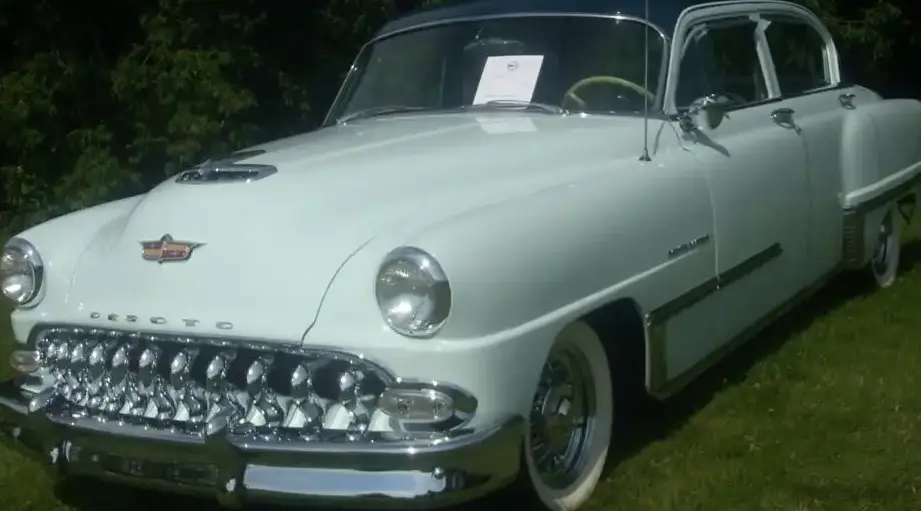
The DeSoto Powermaster Six All-Steel Station Wagon, specifically the 1954 facelifted model with the 4.1-liter (250.5 cubic inch) inline-six engine producing 116 horsepower, represented a significant offering in the American family car market. Produced for a relatively short period, from 1953 to 1954, this station wagon was part of the broader Powermaster line, DeSoto’s full-size offering. It aimed to combine the practicality of a station wagon with the styling and perceived luxury of the DeSoto brand, competing with models from Ford, Chevrolet, and Plymouth. This particular configuration, while not the most powerful in the Powermaster range, was positioned as a sensible and spacious option for families.
Technical Specifications
| Brand | DeSoto |
| Model | Powermaster Six |
| Generation | Powermaster Six All-Steel Station Wagon (facelift 1954) |
| Type (Engine) | 4.1 (116 Hp) |
| Start of production | 1953 |
| End of production | 1954 |
| Powertrain Architecture | Internal Combustion engine |
| Body type | Station wagon (estate) |
| Seats | 6 |
| Doors | 5 |
| Fuel Type | Petrol (Gasoline) |
| Power | 116 Hp @ 3600 rpm |
| Power per litre | 28.3 Hp/l |
| Torque | 282 Nm @ 1600 rpm / 207.99 lb.-ft. @ 1600 rpm |
| Engine displacement | 4105 cm3 / 250.5 cu. in. |
| Number of cylinders | 6 |
| Engine configuration | Inline |
| Cylinder Bore | 87.31 mm / 3.44 in. |
| Piston Stroke | 114.3 mm / 4.5 in. |
| Compression ratio | 7:1 |
| Number of valves per cylinder | 2 |
| Fuel injection system | Carburettor |
| Engine aspiration | Naturally aspirated engine |
| Engine oil capacity | 4.7 l / 4.97 US qt | 4.14 UK qt |
| Coolant | 15.1 l / 15.96 US qt | 13.29 UK qt |
| Length | 5439 mm / 214.13 in. |
| Width | 1972 mm / 77.64 in. |
| Height | 1632 mm / 64.25 in. |
| Wheelbase | 3188 mm / 125.51 in. |
| Front track | 1403 mm / 55.24 in. |
| Rear (Back) track | 1514 mm / 59.61 in. |
| Drag coefficient (Cd) | 0.6 |
| Minimum turning circle (turning diameter) | 13.1 m / 42.98 ft. |
| Drivetrain Architecture | The Internal combustion engine (ICE) drives the rear wheels of the vehicle. |
| Drive wheel | Rear wheel drive |
| Number of gears and type of gearbox | 3 gears, manual transmission |
| Front suspension | Independent coil spring |
| Rear suspension | Leaf spring |
| Front brakes | Drum, 305 mm |
| Rear brakes | Drum, 305 mm |
| Steering type | Worm-reduction unit |
| Power steering | Hydraulic Steering |
Powertrain & Engine Architecture
The heart of the 1954 DeSoto Powermaster Six Station Wagon was its 4.1-liter inline-six engine. This engine, designated within the DeSoto range as a key component of the Powermaster series, featured a cast iron block and cylinder head. It utilized a single carburetor for fuel delivery, a common setup for the era, and a relatively low 7:1 compression ratio. The engine’s valvetrain employed two valves per cylinder, operated by a conventional pushrod system. The 116 horsepower output at 3600 rpm, while respectable for the time, wasn’t the highest in the full-size segment. However, the engine’s 282 Nm (207.99 lb-ft) of torque, available at a low 1600 rpm, provided adequate pulling power for a large station wagon. The engine was mated to a three-speed manual transmission as standard, delivering power to the rear wheels.
Driving Characteristics
The driving experience in the 1954 DeSoto Powermaster Six Station Wagon was typical of large American cars of the period. The 116 hp engine, coupled with the three-speed manual transmission, provided adequate, but not exhilarating, performance. Acceleration was modest, and passing maneuvers required careful planning. The gear ratios were optimized for cruising rather than rapid acceleration. Compared to higher-output DeSoto models, or those equipped with optional upgrades, this configuration felt noticeably less powerful. However, the engine’s low-end torque made it reasonably drivable in everyday traffic. The station wagon’s substantial weight (approximately 1,750 kg or 3,858 lbs) contributed to a somewhat ponderous feel, especially when cornering. The hydraulic steering, while a welcome feature, didn’t offer a particularly sharp or responsive feel.
Equipment & Trim Levels
The 1954 DeSoto Powermaster Six All-Steel Station Wagon, even in its base configuration, offered a reasonable level of standard equipment for the time. The interior typically featured cloth upholstery, though optional upgrades to vinyl or leather were available. The dashboard was relatively simple in design, featuring a combination of analog gauges displaying speed, fuel level, coolant temperature, and oil pressure. A radio was often included as standard or as a popular option. The station wagon’s spacious interior could comfortably accommodate six passengers. The all-steel construction of the body, a relatively new feature for station wagons at the time, offered improved durability and safety compared to earlier wood-bodied designs. Optional extras included power steering, a heater, and whitewall tires.
Chassis & Braking
The DeSoto Powermaster Six Station Wagon utilized a body-on-frame construction, common for American cars of the 1950s. The front suspension employed independent coil springs, providing a relatively comfortable ride. The rear suspension utilized leaf springs, which were more robust and better suited for carrying heavier loads. Braking was provided by drum brakes on all four wheels, measuring 305 mm in diameter. While adequate for the time, the drum brakes lacked the stopping power of more modern braking systems. The steering system employed a worm-reduction unit, providing a relatively indirect steering feel. The relatively wide track width (1403 mm front, 1514 mm rear) contributed to a stable, if not particularly agile, handling characteristic.
Market Reception & Comparison
The 1954 DeSoto Powermaster Six Station Wagon received generally positive reviews from automotive critics. It was praised for its spacious interior, comfortable ride, and all-steel construction. However, some critics noted that the 116 hp engine felt underpowered for a vehicle of its size and weight. Compared to other trims in the Powermaster lineup, such as those equipped with the optional V8 engine, this 4.1-liter six-cylinder version was considered the entry-level option. Fuel economy, while not a primary concern for buyers in the 1950s, was typical for a full-size American car of the era – around 15-20 miles per gallon. Reliability was generally good, though maintenance requirements were relatively high due to the engine’s carbureted fuel system and conventional mechanical components.
Legacy
The 1954 DeSoto Powermaster Six All-Steel Station Wagon, while not a particularly rare or highly sought-after classic car, holds a place in automotive history as a representative example of the American family car of the 1950s. The 4.1-liter inline-six engine, while not known for exceptional performance, proved to be reasonably durable and reliable. Today, surviving examples are often found in restored condition or as project cars for enthusiasts. Parts availability can be a challenge, but many components are still available through specialist suppliers. The Powermaster Six Station Wagon represents a bygone era of American automotive design, characterized by its spaciousness, styling, and relatively simple mechanical construction. Its enduring appeal lies in its nostalgic charm and its ability to evoke a sense of mid-century Americana.