
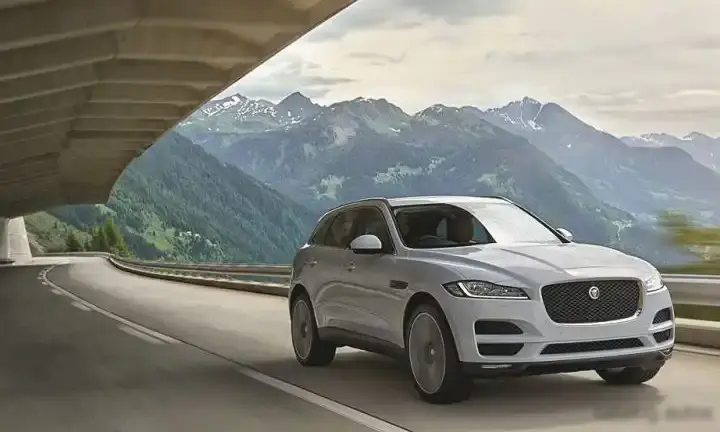
The Jaguar F-Pace 2.0d (163 hp) was a diesel-powered variant of Jaguar’s first foray into the compact luxury SUV segment. Introduced in 2017 and remaining in production through 2018, this model served as an entry point into the F-Pace lineup, offering a balance of fuel efficiency and Jaguar’s signature driving experience. It was positioned below the higher-powered 2.0d (180 hp) and the supercharged 3.0L V6 models. The F-Pace itself was built on the Jaguar Land Rover iQ[+] platform, sharing underpinnings with the Land Rover Discovery Sport, but distinguished by its more road-focused tuning and styling.
Technical Specifications
| Brand | Jaguar |
| Model | F-Pace |
| Generation | F-Pace |
| Type (Engine) | 2.0d (163 Hp) |
| Start of production | 2017 |
| End of production | 2018 |
| Powertrain Architecture | Internal Combustion engine |
| Body type | SUV |
| Seats | 5 |
| Doors | 5 |
| Fuel consumption (combined) | 4.8-4.9 l/100 km (49-48 US mpg, 58.9-57.6 UK mpg, 20.8-20.4 km/l) |
| CO2 emissions | 126-129 g/km |
| Fuel Type | Diesel |
| Acceleration 0 – 100 km/h | 10.2 sec |
| Acceleration 0 – 62 mph | 10.2 sec |
| Acceleration 0 – 60 mph | 9.7 sec |
| Maximum speed | 195 km/h (121.17 mph) |
| Emission standard | Euro 6 |
| Weight-to-power ratio | 10.4 kg/Hp, 96.4 Hp/tonne |
| Weight-to-torque ratio | 4.4 kg/Nm, 224.9 Nm/tonne |
| Power | 163 Hp @ 4000 rpm |
| Power per litre | 81.5 Hp/l |
| Torque | 380 Nm @ 1750-2500 rpm (280.27 lb.-ft. @ 1750-2500 rpm) |
| Engine layout | Front, Longitudinal |
| Engine Model/Code | Ingenium / 204DTD |
| Engine displacement | 1999 cm3 (121.99 cu. in.) |
| Number of cylinders | 4 |
| Engine configuration | Inline |
| Cylinder Bore | 83 mm (3.27 in.) |
| Piston Stroke | 92.4 mm (3.64 in.) |
| Compression ratio | 15.5:1 |
| Number of valves per cylinder | 4 |
| Fuel injection system | Diesel Commonrail |
| Engine aspiration | Turbocharger, Intercooler |
| Valvetrain | DOHC |
| Engine oil capacity | 6.5 l (6.87 US qt | 5.72 UK qt) |
| Coolant | 7.7 l (8.14 US qt | 6.78 UK qt) |
| Kerb Weight | 1690 kg (3725.81 lbs.) |
| Trunk (boot) space – minimum | 650 l (22.95 cu. ft.) |
| Fuel tank capacity | 60 l (15.85 US gal | 13.2 UK gal) |
| Permitted trailer load with brakes (12%) | 1600 kg (3527.4 lbs.) |
| Permitted trailer load without brakes | 750 kg (1653.47 lbs.) |
| Length | 4746 mm (186.85 in.) |
| Width | 2070 mm (81.5 in.) |
| Width with mirrors folded | 2175 mm (85.63 in.) |
| Height | 1667 mm (65.63 in.) |
| Wheelbase | 2874 mm (113.15 in.) |
| Front track | 1641 mm (64.61 in.) |
| Rear (Back) track | 1654 mm (65.12 in.) |
| Ride height (ground clearance) | 213 mm (8.39 in.) |
| Drivetrain Architecture | Rear wheel drive |
| Number of gears and type of gearbox | 6 gears, manual transmission |
| Front suspension | Double wishbone |
| Rear suspension | Coil spring |
| Front brakes | Ventilated discs |
| Rear brakes | Ventilated discs |
| Tires size | 235/65 R18 |
| Wheel rims size | 18 |
Powertrain & Engine Architecture
The F-Pace 2.0d (163 hp) was powered by Jaguar Land Rover’s Ingenium engine family, specifically the 204DTD four-cylinder diesel. This engine featured a lightweight aluminum block and cylinder head, designed for efficiency and reduced friction. The 1999cc engine utilized a turbocharger with an intercooler to boost power output, producing 163 horsepower at 4000 rpm and 380 Nm (280 lb-ft) of torque between 1750 and 2500 rpm. It employed a high-pressure direct injection common rail system for precise fuel delivery and optimized combustion. The engine also incorporated variable valve timing (VVT) on both intake and exhaust valves, controlled by a double overhead camshaft (DOHC) configuration. The 6-speed manual transmission was standard, delivering power to the rear wheels. This configuration prioritized fuel economy over outright performance.
Driving Characteristics
The 163 hp F-Pace offered a comfortable and refined driving experience, but wasn’t intended for spirited performance. Acceleration from 0-60 mph took approximately 9.7 seconds, and top speed was limited to 195 km/h (121 mph). The manual transmission, while engaging, required frequent shifting to maintain momentum, especially when overtaking or climbing hills. The gear ratios were tuned for fuel efficiency, resulting in a slightly less responsive feel compared to the higher-output 180 hp version or the V6 models. The rear-wheel-drive configuration provided a balanced feel, but lacked the all-weather capability of the all-wheel-drive variants. The suspension, tuned for comfort, absorbed bumps effectively, but didn’t offer the same level of body control as the sportier F-Pace trims.
Equipment & Trim Levels
The 2.0d (163 hp) typically came with a respectable level of standard equipment, though it was less lavish than the higher-spec models. Standard features generally included leather upholstery, automatic climate control, a touchscreen infotainment system with navigation, Bluetooth connectivity, and a suite of safety features like ABS, stability control, and multiple airbags. Optional extras included features like heated seats, a panoramic sunroof, premium audio systems, and advanced driver-assistance systems such as adaptive cruise control and lane departure warning. Trim levels were relatively simple, with options primarily revolving around adding packages of convenience and technology features.
Chassis & Braking
The F-Pace 2.0d utilized a double wishbone front suspension and a coil spring rear suspension. The suspension was tuned for a balance of comfort and handling, prioritizing ride quality over outright sportiness. Braking duties were handled by ventilated discs on all four wheels, providing adequate stopping power for the vehicle’s weight and performance. The electric power steering offered a light and precise feel, making it easy to maneuver in urban environments. The rear-wheel-drive configuration contributed to a relatively balanced weight distribution, enhancing handling characteristics.
Market Reception & Comparison
The F-Pace 2.0d (163 hp) was generally well-received by automotive critics as an accessible entry point into the F-Pace range. It was praised for its fuel efficiency, comfortable ride, and stylish design. However, some reviewers noted that the engine lacked the punch of the higher-output options, and the manual transmission wasn’t as refined as the automatic transmissions available in other F-Pace models. Compared to the 180 hp 2.0d, the 163 hp version offered slightly better fuel economy but noticeably slower acceleration. Against the V6 models, it represented a significant step down in performance but offered a more affordable price point.
Legacy
The Ingenium engine family proved to be relatively reliable, and the 204DTD engine in the F-Pace 2.0d (163 hp) has generally held up well over time. Common issues, when they arise, often relate to the diesel particulate filter (DPF) requiring regeneration, particularly on vehicles used primarily for short trips. On the used car market, this variant represents a more affordable option for those seeking the F-Pace’s style and practicality, but potential buyers should be aware of the lower performance compared to other trims. Its fuel efficiency and relatively simple mechanicals make it an attractive option for budget-conscious buyers looking for a comfortable and capable SUV.
