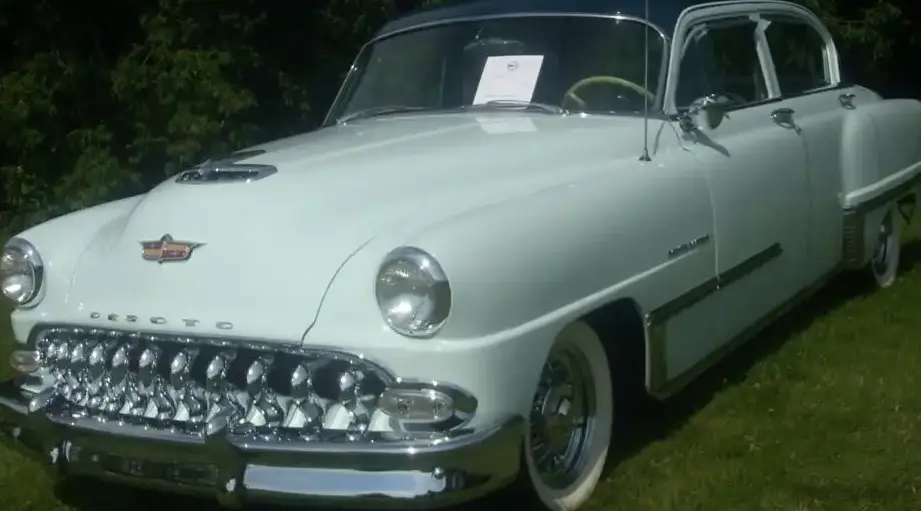
The DeSoto Powermaster Six Club Coupe, powered by a 4.1-liter inline-six engine paired with a PowerFlite automatic transmission, represented a significant offering in the early 1950s American automotive landscape. Produced for the 1953 and 1954 model years, this variant occupied a middle ground within the Powermaster lineup, balancing affordability with the styling and comfort expected of a full-size American car. It was part of the broader effort by DeSoto to establish itself as a premium, yet accessible, brand within the Chrysler Corporation.
Technical Specifications
| Brand | DeSoto |
| Model | Powermaster Six |
| Generation | Powermaster Six Club Coupe |
| Type (Engine) | 4.1 (116 Hp) PowerFlite |
| Start of production | 1953 |
| End of production | 1954 |
| Powertrain Architecture | Internal Combustion engine |
| Body type | Coupe |
| Seats | 6 |
| Doors | 2 |
| Fuel Type | Petrol (Gasoline) |
| Power | 116 Hp @ 3600 rpm |
| Power per litre | 28.3 Hp/l |
| Torque | 282 Nm @ 1600 rpm / 207.99 lb.-ft. @ 1600 rpm |
| Engine displacement | 4105 cm3 / 250.5 cu. in. |
| Number of cylinders | 6 |
| Engine configuration | Inline |
| Cylinder Bore | 87.31 mm / 3.44 in. |
| Piston Stroke | 114.3 mm / 4.5 in. |
| Compression ratio | 7:1 |
| Number of valves per cylinder | 2 |
| Fuel injection system | Carburettor |
| Engine aspiration | Naturally aspirated engine |
| Engine oil capacity | 4.7 l / 4.97 US qt | 4.14 UK qt |
| Coolant | 15.1 l / 15.96 US qt | 13.29 UK qt |
| Fuel tank capacity | 64 l / 16.91 US gal | 14.08 UK gal |
| Length | 5448 mm / 214.49 in. |
| Width | 1969 mm / 77.52 in. |
| Height | 1632 mm / 64.25 in. |
| Wheelbase | 3188 mm / 125.51 in. |
| Front track | 1403 mm / 55.24 in. |
| Rear (Back) track | 1438 mm / 56.61 in. |
| Front overhang | 940 mm / 37.01 in. |
| Rear overhang | 1321 mm / 52.01 in. |
| Ride height (ground clearance) | 178 mm / 7.01 in. |
| Drag coefficient (Cd) | 0.6 |
| Minimum turning circle (turning diameter) | 12.8 m / 41.99 ft. |
| Approach angle | 23° |
| Departure angle | 17° |
| Ramp-over (brakeover) angle | 15° |
| Drivetrain Architecture | The Internal combustion engine (ICE) drives the rear wheels of the vehicle. |
| Drive wheel | Rear wheel drive |
| Number of gears and type of gearbox | 2 gears, automatic transmission PowerFlite |
| Front suspension | Independent coil spring |
| Rear suspension | Leaf spring |
| Front brakes | Drum, 305 mm |
| Rear brakes | Drum, 305 mm |
Powertrain & Engine Architecture
The heart of the Powermaster Six Club Coupe was DeSoto’s 4.1-liter (250.5 cubic inch) inline-six engine. This engine, designated within Chrysler as the A-series, featured a cast iron block and cylinder head. It utilized a single two-barrel carburetor for fuel delivery, and employed a relatively low 7:1 compression ratio, typical for the era. The engine produced 116 horsepower at 3600 rpm and 282 Nm (207.99 lb-ft) of torque at 1600 rpm. The PowerFlite automatic transmission, introduced by Chrysler in 1953, was a two-speed unit. It was a relatively simple design, relying on a fluid coupling and planetary gearsets for shifting. While not as sophisticated as some later automatics, the PowerFlite provided smoother operation than manual transmissions, a key selling point for American buyers at the time.
Driving Characteristics
The 116-horsepower engine and two-speed PowerFlite transmission delivered adequate, but not exhilarating, performance. The Powermaster Six Club Coupe was designed for comfortable cruising rather than spirited driving. Acceleration was modest, and the two-speed automatic meant that the engine often operated at higher RPMs during highway travel. Compared to the more powerful V8-equipped DeSotos, the Six offered a more economical driving experience, but at the expense of outright speed. The PowerFlite transmission, while smooth, lacked the responsiveness of a manual gearbox, and downshifting was slow. The car’s substantial weight (approximately 1,670 kg or 3,680 lbs) further contributed to its relaxed driving character.
Equipment & Trim Levels
The Powermaster Six Club Coupe was positioned as a mid-range offering within the DeSoto lineup. Standard equipment included a spacious interior with bench seating for six passengers, a heater, and a basic set of gauges. The interior trim typically featured cloth upholstery, although optional upgrades to vinyl were available. Exterior styling was characterized by DeSoto’s signature “Forward Look” design, featuring prominent tailfins and chrome accents. Optional extras included a radio, whitewall tires, and a two-tone paint scheme. The Club Coupe body style offered a balance between practicality and style, appealing to families and those seeking a comfortable and visually appealing vehicle.
Chassis & Braking
The Powermaster Six Club Coupe utilized a traditional body-on-frame construction. The front suspension was independent, employing coil springs, while the rear suspension relied on leaf springs. This setup provided a reasonably comfortable ride, although it wasn’t particularly sophisticated by modern standards. Braking was accomplished via drum brakes on all four wheels, measuring 305 mm in diameter. The braking system was adequate for the car’s weight and performance, but lacked the stopping power of more modern systems. Steering was provided by a recirculating ball system, offering relatively light effort but limited feedback.
Market Reception & Comparison
The DeSoto Powermaster Six Club Coupe received generally positive reviews from contemporary automotive publications. Critics praised its styling, spacious interior, and comfortable ride. However, the 4.1-liter engine and PowerFlite transmission were often criticized for their lack of performance compared to competing models from Ford, Chevrolet, and Plymouth. Fuel economy, while typical for the era, was not a strong point. The Powermaster Six offered a more affordable alternative to the V8-powered DeSotos, appealing to buyers who prioritized comfort and economy over outright performance. Compared to the higher-trim DeSotos, the Six lacked some of the luxury features and refinement, but it provided a solid and reliable transportation option.
Legacy
The DeSoto Powermaster Six Club Coupe, while not a particularly rare or collectible vehicle today, represents an important chapter in American automotive history. The 4.1-liter inline-six engine and PowerFlite transmission proved to be reasonably durable, and many examples remain on the road today. However, finding parts can be challenging, and maintenance requires specialized knowledge. The car’s enduring appeal lies in its classic styling, spacious interior, and nostalgic charm. It serves as a reminder of a time when American cars were large, comfortable, and focused on providing a smooth and relaxed driving experience. The Powermaster Six, in its various configurations, helped establish DeSoto as a distinctive brand within the Chrysler Corporation, even if the brand ultimately faded away in the 1960s.