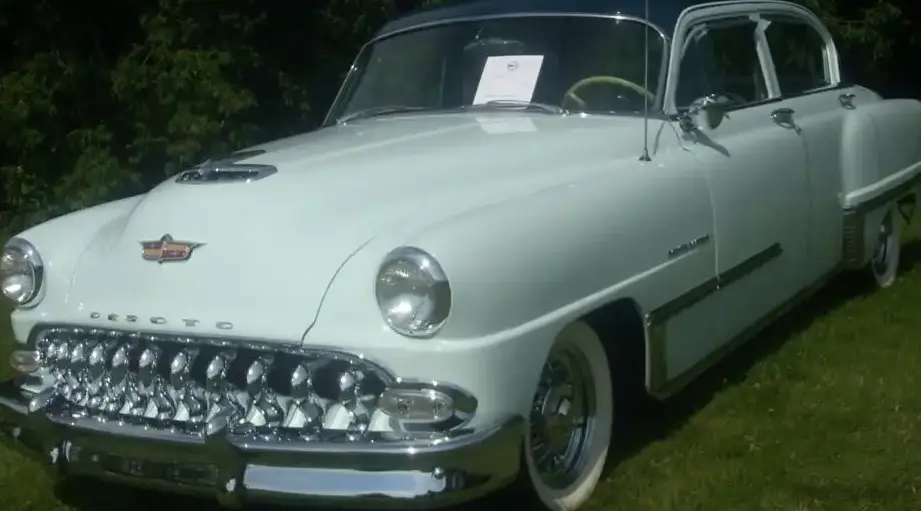
The DeSoto Powermaster Six Club Coupe, specifically the 4.1-liter (250.56 cubic inch) 116 horsepower variant with the “Tip-Toe Shift” automatic transmission, was produced for a relatively short period, spanning the 1952 and 1953 model years. Positioned as a mid-range offering within the Powermaster lineup, it aimed to provide a balance of style, comfort, and affordability for American families. This model represented DeSoto’s attempt to capture a segment of the market seeking a full-size car with modern conveniences, but without the higher price tag of more luxurious competitors. It was built on DeSoto’s H-body platform, shared with other Chrysler Corporation vehicles, and was a key part of the post-war automotive boom.
Technical Specifications
| Brand | DeSoto |
| Model | Powermaster Six |
| Generation | Powermaster Six Club Coupe |
| Type (Engine) | 4.1 (116 Hp) Tip-Toe Shift |
| Start of production | 1952 |
| End of production | 1953 |
| Powertrain Architecture | Internal Combustion engine |
| Body type | Coupe |
| Seats | 6 |
| Doors | 2 |
| Fuel Type | Petrol (Gasoline) |
| Power | 116 Hp @ 3600 rpm |
| Power per litre | 28.3 Hp/l |
| Torque | 282 Nm @ 1600 rpm / 207.99 lb.-ft. @ 1600 rpm |
| Engine displacement | 4106 cm3 / 250.56 cu. in. |
| Number of cylinders | 6 |
| Engine configuration | Inline |
| Cylinder Bore | 87.31 mm / 3.44 in. |
| Piston Stroke | 114.3 mm / 4.5 in. |
| Compression ratio | 7:1 |
| Number of valves per cylinder | 2 |
| Fuel injection system | Carburettor |
| Engine aspiration | Naturally aspirated engine |
| Engine oil capacity | 4.7 l / 4.97 US qt | 4.14 UK qt |
| Coolant | 15.1 l / 15.96 US qt | 13.29 UK qt |
| Fuel tank capacity | 64 l / 16.91 US gal | 14.08 UK gal |
| Length | 5420 mm / 213.39 in. |
| Width | 1963 mm / 77.28 in. |
| Height | 1588 mm / 62.52 in. |
| Wheelbase | 3188 mm / 125.51 in. |
| Front track | 1430 mm / 56.3 in. |
| Rear (Back) track | 1513 mm / 59.57 in. |
| Drag coefficient (Cd) | 0.6 |
| Minimum turning circle (turning diameter) | 13 m / 42.65 ft. |
| Drivetrain Architecture | The Internal combustion engine (ICE) drives the rear wheels of the vehicle. |
| Drive wheel | Rear wheel drive |
| Number of gears and type of gearbox | 4 gears, automatic transmission Tip-Toe Shift |
| Front suspension | Independent coil spring |
| Rear suspension | Leaf spring |
| Front brakes | Drum, 305 mm |
| Rear brakes | Drum, 305 mm |
Powertrain & Engine Architecture
The heart of the 1952-1953 DeSoto Powermaster Six Club Coupe was its 4.1-liter inline-six cylinder engine. This engine, internally designated with various codes depending on specific calibration, was a robust and relatively simple design. It featured a cast iron block and cylinder head, with a 7:1 compression ratio. Fuel delivery was handled by a single, two-barrel carburetor, a common setup for the era. The valvetrain employed a conventional pushrod configuration with two valves per cylinder. The “Tip-Toe Shift” automatic transmission was a Mopar-built unit, a three-speed automatic known for its smooth, albeit not particularly quick, shifts. This transmission was marketed as providing effortless driving, appealing to buyers prioritizing comfort over performance. The transmission’s operation was hydraulically controlled, and the “Tip-Toe” moniker referred to the light pedal effort required for gear changes.
Driving Characteristics
The 116 horsepower and 208 lb-ft of torque produced by the 4.1-liter engine provided adequate, but not exhilarating, performance for the Powermaster Six Club Coupe. Acceleration was leisurely by modern standards, and the car was more suited to cruising than spirited driving. The automatic transmission, while smooth, contributed to a somewhat sluggish feel, particularly when attempting to pass or merge onto highways. The gear ratios were optimized for fuel economy and relaxed cruising, rather than outright speed. Compared to the more powerful V8-equipped DeSotos of the same era, the six-cylinder version felt noticeably less responsive. However, the automatic transmission made it significantly easier to drive than the standard three-speed manual transmission, especially in city traffic.
Equipment & Trim Levels
The Powermaster Six Club Coupe with the Tip-Toe Shift transmission typically came standard with a fairly comprehensive list of features for the early 1950s. Interior appointments included a cloth and vinyl bench seat, capable of seating six passengers. The dashboard featured a combination of analog gauges, including a speedometer, fuel gauge, and temperature gauge. Standard exterior features included full wheel covers, chrome bumpers, and whitewall tires. Optional extras included a radio, heater, and power steering. The trim level was generally considered mid-range, offering a step up in comfort and convenience compared to the base DeSoto models, but lacking the luxurious appointments of the top-of-the-line models.
Chassis & Braking
The DeSoto Powermaster Six Club Coupe utilized a body-on-frame construction, typical of American cars of the period. The front suspension was independent, employing coil springs and a stabilizer bar, providing a relatively comfortable ride. The rear suspension was a traditional leaf spring setup, which was robust but less refined than the independent front suspension. Braking was accomplished via drum brakes on all four wheels, measuring 305mm in diameter. While adequate for the car’s weight and performance, the drum brakes lacked the stopping power of more modern braking systems. Steering was manual, although power steering was available as an option.
Market Reception & Comparison
The DeSoto Powermaster Six Club Coupe, particularly the 4.1-liter automatic version, received generally positive reviews from automotive journalists of the time. Critics praised its comfortable ride, spacious interior, and smooth-shifting transmission. However, some reviewers noted its lack of outright performance compared to competitors equipped with V8 engines. Fuel economy was typical for a full-size American car of the era, averaging around 16-18 miles per gallon. Reliability was generally good, although the carburetor required periodic adjustment and maintenance. Compared to other DeSoto models, the six-cylinder version offered a more affordable entry point into the brand, appealing to budget-conscious buyers. It was often compared to similar offerings from Ford and Plymouth.
Legacy
Today, the 1952-1953 DeSoto Powermaster Six Club Coupe is considered a classic American automobile. While not as highly sought after as some of its V8-powered siblings, the six-cylinder version remains a popular choice among collectors and enthusiasts. The 4.1-liter engine and Tip-Toe Shift transmission are generally regarded as reliable and relatively easy to maintain, although parts availability can be a challenge. The car’s enduring appeal lies in its classic styling, spacious interior, and nostalgic charm. Well-preserved examples command reasonable prices in the used car market, and the Powermaster Six Club Coupe continues to be a symbol of post-war American automotive design.