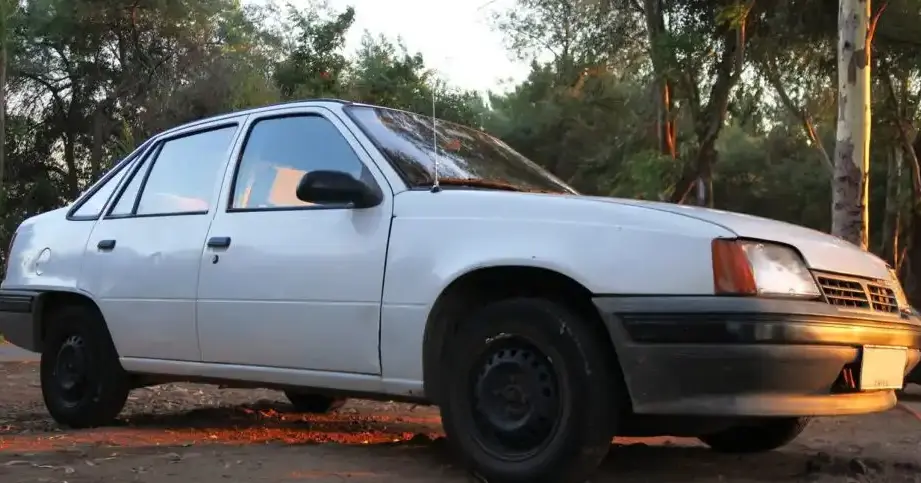
The Daewoo Racer Sedan 1.5 i (75 hp) Automatic, produced between 1993 and 1995, represented an entry-level offering within the broader Daewoo Racer lineup. The Racer, itself a rebadged and significantly updated version of the original 1986 Daewoo Maepsy, aimed to provide affordable and relatively modern transportation to a growing South Korean middle class. This particular variant, with its 1.5-liter engine and automatic transmission, was positioned as a comfortable and convenient option for urban commuters and families prioritizing ease of use over outright performance. It was built on the GM T-Platform, a global architecture used for various compact cars during the period.
Technical Specifications
| Brand | Daewoo |
| Model | Racer |
| Generation | Racer Sedan |
| Type (Engine) | 1.5 i (75 Hp) Automatic |
| Start of production | 1993 |
| End of production | 1995 |
| Powertrain Architecture | Internal Combustion engine |
| Body type | Sedan |
| Seats | 5 |
| Doors | 4 |
| Fuel consumption (urban) | 9.3 l/100 km (25.3 US mpg) |
| Fuel consumption (extra urban) | 5.1 l/100 km (46.1 US mpg) |
| Fuel consumption (combined) | 6.3 l/100 km (37.3 US mpg) |
| Fuel Type | Petrol (Gasoline) |
| Acceleration 0 – 100 km/h | 15.9 sec |
| Acceleration 0 – 62 mph | 15.9 sec |
| Acceleration 0 – 60 mph | 15.1 sec |
| Maximum speed | 156 km/h (96.93 mph) |
| Weight-to-power ratio | 12.9 kg/Hp |
| Weight-to-torque ratio | 7.9 kg/Nm |
| Power | 75 Hp @ 5400 rpm |
| Power per litre | 50.1 Hp/l |
| Torque | 123 Nm @ 3200 rpm (90.72 lb.-ft. @ 3200 rpm) |
| Engine layout | Front, Transverse |
| Engine displacement | 1498 cm3 (91.41 cu. in.) |
| Number of cylinders | 4 |
| Engine configuration | Inline |
| Cylinder Bore | 76.5 mm (3.01 in.) |
| Piston Stroke | 81.5 mm (3.21 in.) |
| Compression ratio | 9.5:1 |
| Number of valves per cylinder | 2 |
| Fuel injection system | Single-point injection |
| Engine aspiration | Naturally aspirated |
| Valvetrain | OHC |
| Kerb Weight | 969 kg (2136.28 lbs.) |
| Max. weight | 1460 kg (3218.75 lbs.) |
| Max load | 491 kg (1082.47 lbs.) |
| Trunk (boot) space | 530 l (18.72 cu. ft.) |
| Fuel tank capacity | 50 l (13.21 US gal | 11 UK gal) |
| Length | 4482 mm (176.46 in.) |
| Width | 1662 mm (65.43 in.) |
| Height | 1394 mm (54.88 in.) |
| Wheelbase | 2520 mm (99.21 in.) |
| Front track | 1400 mm (55.12 in.) |
| Rear track | 1406 mm (55.35 in.) |
| Drivetrain Architecture | Front wheel drive |
| Number of gears | 4 |
| Gearbox type | Automatic transmission |
| Front suspension | Wishbone |
| Rear suspension | Suspension with traction connecting levers |
| Front brakes | Ventilated discs |
| Rear brakes | Drum |
| Steering type | Steering rack and pinion |
| Power steering | Hydraulic |
| Tires size | 175/70 R13 |
Powertrain & Engine Architecture
The heart of the Racer Sedan 1.5 i Automatic was the 1498cc inline-four cylinder engine. This engine, often identified by its engine code, was a relatively simple design featuring a single overhead camshaft (OHC) and two valves per cylinder. Fuel delivery was handled by a single-point fuel injection system, a common technology for the time, but less sophisticated than multi-point injection. This system, while cost-effective, contributed to slightly lower fuel efficiency and performance compared to more advanced setups. The engine produced 75 horsepower at 5400 rpm and 90.72 lb-ft of torque at 3200 rpm. The four-speed automatic transmission was a typical three-speed unit with an overdrive fourth gear, designed for smooth operation and ease of driving. It wasn’t known for particularly quick shifts or sporty responsiveness.
Driving Characteristics
The 1.5-liter engine and automatic transmission combination resulted in a driving experience focused on comfort and practicality rather than performance. Acceleration was leisurely, taking approximately 15.9 seconds to reach 62 mph. The automatic transmission’s gear ratios were optimized for fuel economy and smooth cruising, rather than spirited acceleration. Compared to the available five-speed manual transmission, the automatic version felt noticeably slower. Higher-trim Racer models equipped with larger engines, such as the 1.6 or 1.8-liter variants, offered significantly more power and a more engaging driving experience. The suspension, tuned for comfort, provided a reasonably smooth ride on typical road surfaces, but didn’t offer particularly sharp handling.
Equipment & Trim Levels
The 1.5 i Automatic trim level generally represented the base model within the Racer Sedan range. Standard features typically included basic cloth upholstery, a simple dashboard layout with analog gauges, and manual windows and door locks. Air conditioning was often an optional extra, as were features like a radio/cassette player. The interior was functional and durable, but lacked the refinement of more expensive competitors. Higher trim levels added features like power windows, central locking, upgraded upholstery, and a more comprehensive instrument cluster.
Chassis & Braking
The Racer Sedan utilized a front-wheel-drive layout with a relatively simple chassis design. The front suspension employed a wishbone configuration, while the rear suspension featured a torsion beam setup with traction connecting levers. Braking duties were handled by ventilated discs at the front and drum brakes at the rear. The braking system was adequate for normal driving conditions, but lacked the stopping power and feel of more advanced systems. The steering was rack and pinion, assisted by hydraulic power steering, providing reasonably light and easy steering effort.
Market Reception & Comparison
The Daewoo Racer Sedan 1.5 i Automatic was generally well-received as an affordable and reliable family car in South Korea. Critics noted its comfortable ride and practical interior space. However, the engine’s modest power output and the automatic transmission’s lack of responsiveness were common criticisms. Compared to other trims in the Racer lineup, the 1.5 i Automatic offered the lowest price point but also the least amount of performance. Fuel economy was a strong point, with combined figures around 37.3 US mpg, making it an attractive option for budget-conscious buyers. Competitors in the same segment included the Hyundai Excel and the Kia Sephia, both of which offered similar levels of affordability and practicality.
Legacy
The Daewoo Racer, and specifically the 1.5 i Automatic variant, holds a place in automotive history as a representative of South Korea’s burgeoning automotive industry in the early 1990s. While not known for groundbreaking innovation, it provided a reliable and affordable transportation option for a large segment of the population. The powertrain, while simple, proved to be reasonably durable, and many examples remain on the road today, often as affordable used cars. However, finding parts can be increasingly challenging as the model has become increasingly rare. The Racer paved the way for Daewoo (later GM Daewoo) to establish a stronger presence in the global automotive market, and its legacy can be seen in the subsequent generations of Korean-built vehicles.